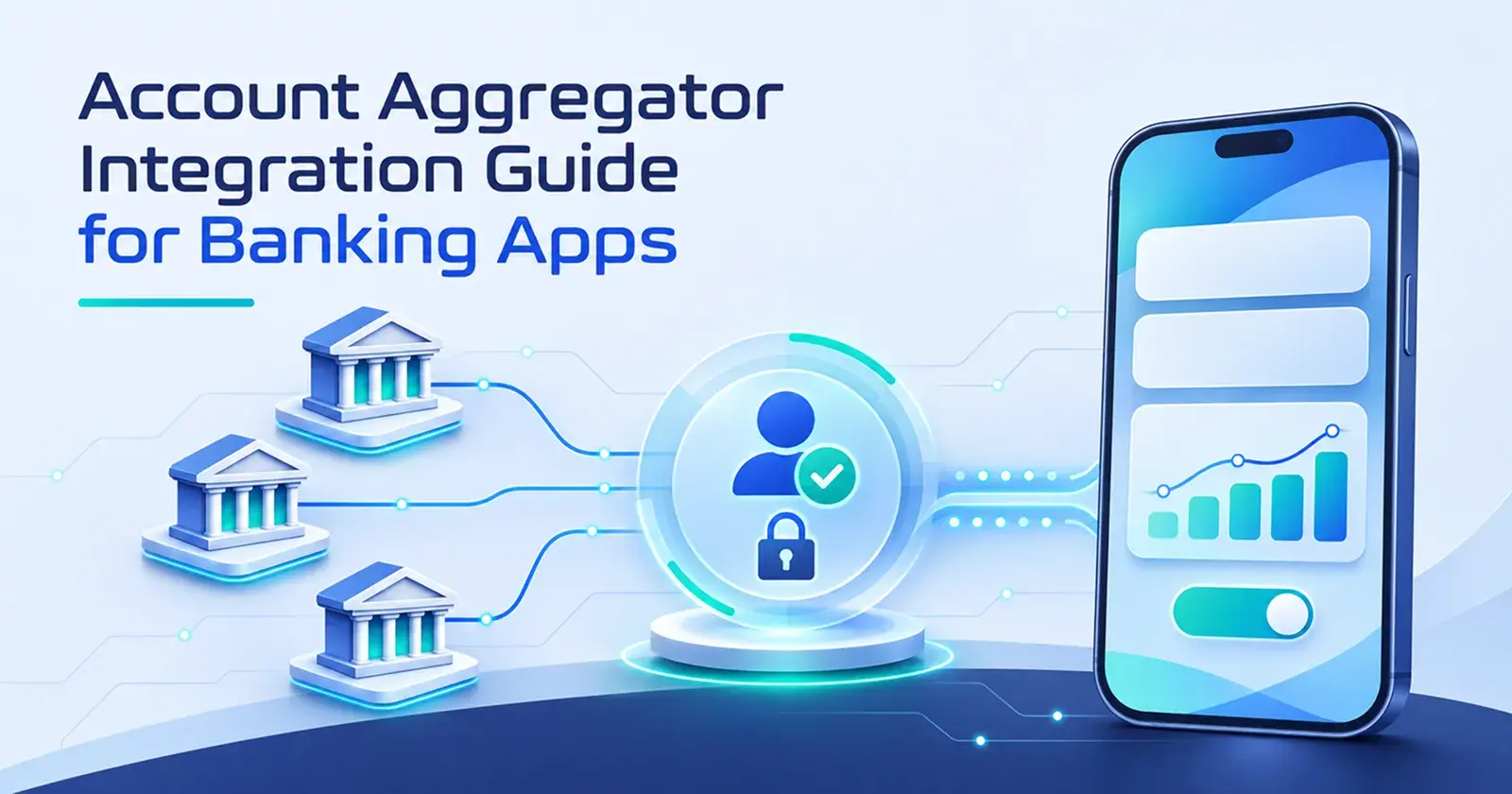
Account Aggregator integration connects an eligible financial information user to an RBI-licensed AA so customers can authorize financial data sharing. Start with the regulated recipient, approved purpose, and consent journey, then build secure retrieval, lifecycle controls, testing, and operational support.
For teams evaluating Banking Software Development, the first deliverable should be a responsibility map, not a successful demonstration API call.
Quick Summary / Key Takeaways
- Confirm the regulated entity and participant roles before selecting an integration vendor.
- Separate account linking, consent approval, data delivery, and business acceptance.
- Design withdrawal, expiry, failed requests, and partial data alongside the successful journey.
- Launch through evidence-based gates, with named owners for security, customer support, and ongoing changes.
This is an engineering guide, not legal advice. Have the participating institution's compliance and legal teams approve the proposed role, purpose, data handling, and contracts before production.
Reviewed by: Banking delivery lead, Deuex Solutions. Checked on 18 November 2026. Next review: February 2027.
What should the first acceptance test prove?
For any Account Aggregator integration, test first whether the customer can change their mind.
Consider an illustrative lending app, not a client case. A borrower selects accounts, approves a request, and returns to the application. Before the records arrive, the borrower revokes permission.
What happens next? Does a queued retry continue? Does the interface keep displaying an active connection? Can support explain which records arrived before the status changed?
I would settle those questions before adding another dashboard. They expose the difference between connecting to an API and operating a consent-based product.
Who are the FIU, FIP, and AA?

The RBI's Account Aggregator Directions, 2025 define the FIU, FIP, and AA roles. An FIU must be an entity registered with and regulated by a financial sector regulator; an app alone does not confer that status. An AA must be an NBFC holding a certificate of registration from the RBI, with net owned funds of at least ₹2 crore. The TSP role in the table below comes from Sahamati's ecosystem guidance, not from the RBI definitions.
RBI-regulated FIUs must also join as FIPs when they hold the specified information and qualify as providers. Confirm whether this applies before pricing the Account Aggregator integration.
Sahamati's FIP/FIU technology provider guidance notes that institutions can build FIP and FIU modules internally or use a TSP. It states that a TSP is not required to hold an NBFC-AA license to offer its services.
Buying a technical module is not the same as becoming an eligible data recipient.
For UAE-based teams building an India-facing product for open banking India use cases, establish the eligible participating entity first. Do not assume an overseas financial services license automatically meets the Indian framework's definition.
What does the AA framework in India authorize?
The RBI defines the AA business as retrieving, consolidating, and presenting a customer's financial information, and an NBFC-AA may not undertake any other business. Payment initiation is outside that scope. The RBI says information passed through an AA must not be used or disclosed by the AA or the FIU except as specified in the consent artefact, and that customer financial information accessed from FIPs must not reside with the AA.
The Ministry of Finance's official AA explanation states that the data AAs share is encrypted by the sender and can be decrypted only by the recipient, so the AA cannot see it. It also explains that registering with an AA is voluntary and that recurring sharing can be revoked at any time.
For a lending use case, specify the information required for assessment. Do not treat consent to retrieve statements as permission for unrelated marketing, unrestricted model training, or a completed credit decision.
The phrase open banking India can cover a wider discussion. Keep this project's scope precise: the permitted information, recipient, purpose, and operating controls.
What should teams verify against the 2026 specifications?
Base the Account Aggregator integration on the current regulatory and technical documents, not an old vendor tutorial as the complete contract.
For the AA framework in India, ReBIT's AA technical specification portal includes API families, financial information schemas, and adoption notices. On October 14, 2026, ReBIT published interoperability API specifications that let FIUs and FIPs communicate with AAs they are not directly connected to, with mutually linked AAs acting as gateways. On October 16, 2026, ReBIT moved the interoperability adoption deadline for AAs, FIPs, and FIUs forward from December 31 to December 1, 2026, so plan the work as an immediate requirement rather than a year-end task.
Do not interpret publication as proof that every proposed route is already operational. Ask the selected AA and participating FIPs to confirm supported versions, data types, routing, and production readiness.
ReBIT also issued a customer protection and user experience adoption notice on April 30, 2026. It says all NBFC-AAs and FIUs must adopt the new baseline standard by October 31, 2026, so a bank going live now should treat it as a current requirement. Include the applicable client requirements in acceptance testing rather than considering the mobile SDK a finished compliance package.
Record the documents and versions used for sign-off. Recheck adoption notices before launch.
How should the consent journey work?
Give the customer a clear view of who wants the information, why, and for how long. The RBI requires a standardised consent artefact that records the customer's identity, the nature of the information requested, the purpose, the recipients, the notification address, the creation and expiry dates, and the AA's digital signature. Customers must also be able to revoke consent, including for parts of the information. In consent manager integration, preserve the AA-controlled interaction rather than replacing it with a generic checkbox in the lender's app.
ReBIT's customer protection standard specifies clear presentation of consent fields, each consent shown separately with a single purpose, an approval step that is not combined with any other interaction, Approve and Reject buttons of the same size and visibility, and controls to revoke, pause, and resume consent.
Use the following as a product review worksheet based on its consent fields:
Those are different clocks. ReBIT's sample consent screen describes Data Life as the period in which the FIU may process the data for the consented purpose, and notes separately that the FIU may retain data under its internal guidelines in line with applicable law. Do not automatically equate consent expiry with erasing every record, or lawful retention with permission to keep using it for unrelated purposes.
For the product specification, record the consent identifier, approved terms, current state, and relevant event history. Ask the compliance owner to approve the policy for already received data and any downstream records.
What should the API architecture look like?

In a sound Account Aggregator integration, separate the customer journey from server-side consent and data session handling. Keep financial payloads away from unnecessary frontend, analytics, and diagnostic paths.
ReBIT's core API specification defines an asynchronous design with consent and financial information notifications. It separates account discovery and linking, consent management, data requests, and data fetching; account linking and consent interactions belong between the customer and the AA through its authorized client.
The published core flow includes a consent request, customer approval and a digitally signed consent artefact, followed by a financial information request that returns a session ID the FIU uses to fetch the data. Data is fetched when available. Confirm exact contracts against the versions supported by your partners.
My suggested application design has an authenticated entry point, an FIU connection service, a verified callback handler, a durable work queue, and restricted storage for permitted records. Separate consent state from data session state.
Consent approved does not mean information delivered. Information delivered does not mean information accepted for the business decision.
Before marking an application ready, validate the expected accounts, date coverage, schema, and completeness. Show a pending or incomplete result rather than silently interpreting missing information as zero activity.
Our API integration services guide covers related ownership and recovery questions. Here, apply them to the agreed AA contracts rather than inventing a parallel protocol.
How should financial data API integration handle failure?
Design recovery before production traffic. The asynchronous flow described above is the reason to test notifications, request state, and data readiness separately.
For each attempt, retain the consent reference, session reference, application reference, and processing outcome. Define how the system detects repeated notifications and prevents a retry from duplicating a downstream assessment.
Use bounded retries and an owned exception queue. Recheck authorization before another data request instead of assuming the consent state at the start of the journey still applies.
Test a lost response, delayed notification, expired consent, unavailable provider, and partial result. These are proposed engineering tests, not claims that every AA implements the same retry policy.
If your bank is also an FIP, test the outbound side: account matching, consent validation, correct data production, and recovery from partial failure. Do not hide that work inside the FIU estimate.
What security controls belong around the data flow?
Protect both the exchange and the systems that process the authorized result. End-to-end encryption through the AA is not the complete security design for the recipient's application.
Sahamati's ecosystem FAQ explains that data moving through the AA is encrypted and that AAs are not allowed to store, process, or sell customer data. It also describes the Central Registry, which publishes participant API endpoints, public keys, and access control metadata. In the financial sector, Sahamati notes, the consent managers of the data sharing model are the AAs themselves. Use the applicable technical contract for authentication, signatures, key handling, and message validation.
Our recommended acceptance checks include restricted key access, credential rotation, replay rejection, separated environments, encrypted storage, and audit trails. Mask payloads in support screens and exclude statement contents from general-purpose logs.
Require synthetic or approved masked test data. Review the service provider's administrative access and document how production information can be exported, retained, or removed.
For app-level controls, the secure mobile applications guide offers related reading. Make its relevant checks concrete for the chosen AA client and banking workflow.
What does research say about customer understanding?

Two customer research studies support testing comprehension, not just completion. Neither establishes a guaranteed conversion improvement or proves that an AA data fetch causes a better loan outcome.
What did Dvara Research and Final Mile find?
In their 2023 study of why customers exit AA consent journeys, Nishan Gantayat, Anushka Ashok, Srikara Prasad, and Beni Chugh reported a gamified behavioral simulation, run with Final Mile's EthnoLab method, involving 60 constrained customers in Uttar Pradesh and Maharashtra.
The study described loan urgency, perceived lack of choice, and unfamiliarity with the AA as influences on consent decisions. This was a specific simulated setting, not a nationwide estimate.
My product takeaway is to ask participants to explain the recipient, purpose, and withdrawal route in their own words. A completed screen alone should not be the evidence of comprehension.
What did CGAP and Sahamati observe?
Arisha Salman, Maria Fernandez Vidal, and Rutvik Paikine reported findings from AA customer research in April 2025, drawing on a 2024 survey of 1,860 smartphone users.
Respondents willing to share data cited convenience and trust in their bank or lender, while those unwilling most often cited not understanding the process and not knowing anyone who had used it. Its results concern the surveyed smartphone user population and reported experiences, not every Indian customer or causal credit effects.
Use those findings to shape language, explanation, and support testing. Do not copy a survey percentage into your project's promised adoption rate.
How should compliance and ownership be documented?
Create a decision record that identifies the regulated recipient, authorized use, data path, providers, retention policy, and escalation owners. Keep regulatory approval separate from technical completion.
For consent manager integration in this context, identify the licensed AA and the exact client arrangement. Ask the institution's advisers to assess privacy, outsourcing, security, and sector-specific duties alongside the AA requirements.
For teams operating across India and the UAE, map access by overseas developers and support staff, including logs, backups, and exports. Obtain approval for the actual arrangement rather than assuming a domestic cloud region settles every question.
Use the Deuex services overview to separate application engineering, testing, security, and operations during scoping. The contract should name who owns each deliverable and what remains with the institution.
What should testing prove before launch?
Before an Account Aggregator integration goes live, require evidence that the approved purpose, customer choice, and received data stay connected across the workflow.
Test rejection, revocation, expiry, pause and resume, repeated callbacks, invalid signatures, wrong session references, incomplete data, and interrupted mobile redirects where applicable. Include a negative test showing that a revoked or expired consent cannot start another request.
Sahamati's certification information explains that participants must adhere to ReBIT technical standards, that Sahamati provides tests to check that adherence, and that empanelled certifiers run independent certification under its framework. Confirm your partners' onboarding and certification requirements; do not describe a conformance result as approval of every business or legal aspect.
Add application security testing around the connection. Our SAST, DAST, and SCA comparison explains why dependency checks, code analysis, and runtime tests address different surfaces.
For final acceptance, have someone outside the original build team investigate a failed test journey using the runbook and permitted support tools.
What should production monitoring show?
Once the Account Aggregator integration is live, monitor the customer journey and data outcome, not only HTTP availability. The following are suggested measures for your operating plan.
Track discovery and linking completion, consent decisions, data session completion, latency by partner route, incomplete records, schema failures, and revocation propagation. Keep customer rejection separate from technical failure so the dashboard does not treat refusal as a defect.
Agree who investigates each alert and what the customer sees while it remains unresolved. Monitor retention and usage policy jobs without copying sensitive records into alert messages.
A successful status code is one technical observation. Your business acceptance test needs more.
How should you phase the rollout and budget?

Expand only after the previous stage meets its acceptance conditions. This is a proposed rollout model, not a promised delivery schedule.
For the financial data API integration and the work around it, request separate quotations for onboarding, client work, FIU and any FIP modules, key management, testing, analytics, and ongoing support. Ask how unsuccessful requests, recurring fetches, and infrastructure usage are charged rather than assuming one standard ecosystem fee.
Keep analytics development separate from obtaining the data. A connection can be technically complete while the bank's assessment logic still needs validation.
Do not reduce the rollout to an endpoint count. Price the responsibility for an authorized, usable result.
What should your team do next?
Bring one permitted use case, the proposed FIU, required financial information types, customer journey, and failure scenarios to the same review. Ask for a scoped pilot and a clear division between technical delivery and institutional approvals.
Explore Deuex Solutions' Fintech Development Services to plan that work around consent, security, testing, and production ownership.
An AA connection is ready when the institution can explain not only how data arrives, but why it was requested, who may use it, and how access stops.


Sanket Shah
CEO & Founder
I am Sanket Shah, founder and CEO of Deuex Solutions, where I focus on building scalable web mobile and data driven software products with a background in software development. I enjoy turning ideas into reliable digital solutions and working with teams to solve real world problems through technology.