


SAST analyzes source or compiled code without running the application, DAST probes a running application from the outside, and SCA identifies third-party components and checks them for known security issues. For most production applications, the better security strategy is not choosing only one of SAST vs DAST vs SCA, but placing each at the point in development where it provides the clearest evidence.
NIST's software verification guidance treats static analysis, dynamic analysis, software composition tools, and penetration testing as distinct techniques within a broader verification program. That distinction matters because each method observes a different part of software risk.
Quick Summary / Key Takeaways
-
SAST, or Static Application Security Testing, examines source code or compiled code to identify security flaws before the application needs to be running. OWASP notes that SAST can be used repeatedly during development and can identify the affected file, location, line, and code snippet for some findings.
-
DAST, or Dynamic Application Security Testing, interacts with a running web application from the outside. OWASP describes it as black-box testing because the scanner does not need access to source code.
-
SCA, or Software Composition Analysis, identifies third-party dependencies and can compare them against publicly disclosed vulnerabilities. An SBOM can support this work by recording which components and versions an application contains.
-
SAST is particularly useful for finding certain code-level weaknesses early, but OWASP warns that static scanners can generate false positives and struggle with some access-control, authentication, cryptography, and configuration problems.
-
DAST can show how a running application behaves when attacked, but scanner coverage depends on how much of the application's attack surface the tool can reach. OWASP also says some business-logic flaws, race conditions, and certain other weaknesses still require manual assessment.
-
SCA answers a different question: what third-party software are we shipping, and are known risks associated with those components? OWASP specifically recommends maintaining inventories of dependencies and monitoring them for known issues.
-
OWASP's 2025 Top 10 placed Software Supply Chain Failures at A03, reflecting risks involving dependencies, build systems, repositories, CI/CD, and other parts of the software supply chain.
-
Research comparing vulnerability-detection techniques found that different methods discovered different vulnerabilities. That is strong evidence against assuming one scanner can replace every other form of application security testing.
-
A 2025 empirical study of Apache projects reported that adoption of OWASP Dependency-Check was associated with a significant reduction in the overall number and severity score of vulnerable dependencies in the projects studied.
-
Security gates should be risk-based. Blocking every pull request because of every informational finding can create noise without necessarily improving security.
Businesses that want to place security controls directly into software delivery can explore Deuex Solutions' DevSecOps services, covering secure development workflows, application testing, CI/CD security, dependency checks, cloud security practices, and vulnerability management.
Three Reports Arrived Before Lunch
At 9:08 a.m., the development team received its first security alert.
A static scanner had found suspicious data flow between a request parameter and a database query.
At 10:21, the dependency scanner reported something unrelated. One package used by the application matched a version associated with a publicly disclosed vulnerability.
Then, shortly before noon, a dynamic scan against the staging site found a problem neither report had described.
A restricted endpoint responded differently than expected when called through the running application.
Three reports.
Three different parts of the same product.
The fictional engineering manager reviewing them asked:
"Which security tool are we supposed to trust?"
Wrong question.
The team did not have three tools disagreeing about one problem.
It had three testing methods looking at three different surfaces.
That is the simplest way to understand SAST vs DAST vs SCA.
One looks into your code.
One attacks the running software from outside.
One inspects what third-party components came along for the ride.
What Is SAST?
Static Application Security Testing examines source code or compiled software without executing the application. OWASP describes SAST tools as source-code analysis tools that can help identify security flaws in source or compiled code.
Think of SAST as reviewing the instructions before the software starts following them.
Depending on the tool and language, static analysis may inspect:
-
Source files
-
Data flows
-
Function calls
-
Inputs and outputs
-
Tainted data paths
-
Compiled code
-
Known insecure coding patterns
OWASP lists buffer-overflow and SQL-injection flaws among examples of issues certain SAST tools can identify. It also notes that findings may point developers directly to filenames, locations, line numbers, and relevant code snippets.
That location information can be useful.
If a developer receives this:
Untrusted input can reach this database query in OrderController.java, line 184.
there is somewhere concrete to investigate.
When Should SAST Run?

OWASP states that SAST can be included in IDEs and run repeatedly through continuous delivery or continuous-integration workflows.
A practical pipeline might run static checks:
Developer Writes Code → IDE Security Feedback → Pull Request → SAST Scan → Build → Deeper Security Scan
The advantage is timing.
The application does not need to be deployed before the team begins inspecting its code for some classes of weakness.
That is why static testing often fits naturally near developers.
What Can SAST Miss?
This part is easy to understate.
OWASP explicitly lists limitations.
Its SAST guidance says automated static tools can struggle with authentication problems, access-control issues, insecure cryptography, and configuration weaknesses. It also warns about false positives and notes that a scanner may identify a potential issue without being able to prove that the issue is exploitable in practice.
Consider access control.
The code for an endpoint may look perfectly reasonable in isolation.
The real weakness might appear only when:
-
A user logs in with Role A.
-
A request created for Role B is replayed.
-
The deployed routing or authorization configuration handles that request incorrectly.
Runtime behavior matters.
Static analysis does not observe every part of that situation.
That is where another technique enters.
What Is DAST?
Dynamic Application Security Testing examines a running application by sending requests and observing its behavior.
OWASP describes DAST as a black-box technique. The scanner communicates with a web application through its exposed interface and does not need source-code access. It looks for weaknesses by interacting with the running software.
The perspective is closer to an outside user or attacker.
Instead of asking:
"Does this code look unsafe?"
DAST asks:
"What happens if I send the running application this input?"
That distinction matters.
The application is now operating with:
-
Web-server configuration
-
Framework behavior
-
Routing
-
Authentication
-
Headers
-
Cookies
-
Session handling
-
Database connections
-
Reverse proxies
-
Other deployed components
DAST observes the exposed application rather than the source tree.
What Can Dynamic Testing Find?
The exact coverage depends on the scanner, application, authentication setup, crawling ability, and test configuration. OWASP states that DAST tools attempt to discover potential vulnerabilities and architectural weaknesses by interacting with web applications through the front end.
That makes dynamic testing useful when the question is:
Can this deployed behavior actually be attacked?
A scanner may send malformed, unexpected, or malicious-looking requests and analyze the response.
NIST similarly describes dynamic analysis as executing software and monitoring resulting behavior. Its DevSecOps guidance says dynamic testing can use inputs known to be dangerous or incorrect to exercise vulnerabilities, and it recommends running such analysis in test environments rather than casually attacking live systems.
That last point is worth remembering.
A security scanner is supposed to behave badly toward the application.
Give it somewhere safe to do that.
Why Can't DAST Replace SAST?
Because DAST does not see the whole codebase.
OWASP says a dynamic scanner cannot cover 100% of the application's source code and recommends evaluating how much of the application's attack surface the scanner can actually reach.
Imagine a vulnerable administrative function.
The code exists.
SAST may inspect it even if nobody has deployed that route correctly.
A DAST scanner might never reach it if:
-
It cannot authenticate
-
The feature is hidden behind a workflow
-
The route requires a special state
-
The crawler never discovers the path
The opposite can happen too.
A SAST scanner may report dangerous-looking code.
A dynamic test may provide stronger evidence about whether that behavior is reachable from the deployed application.
These are different questions.
What Is Software Composition Analysis?
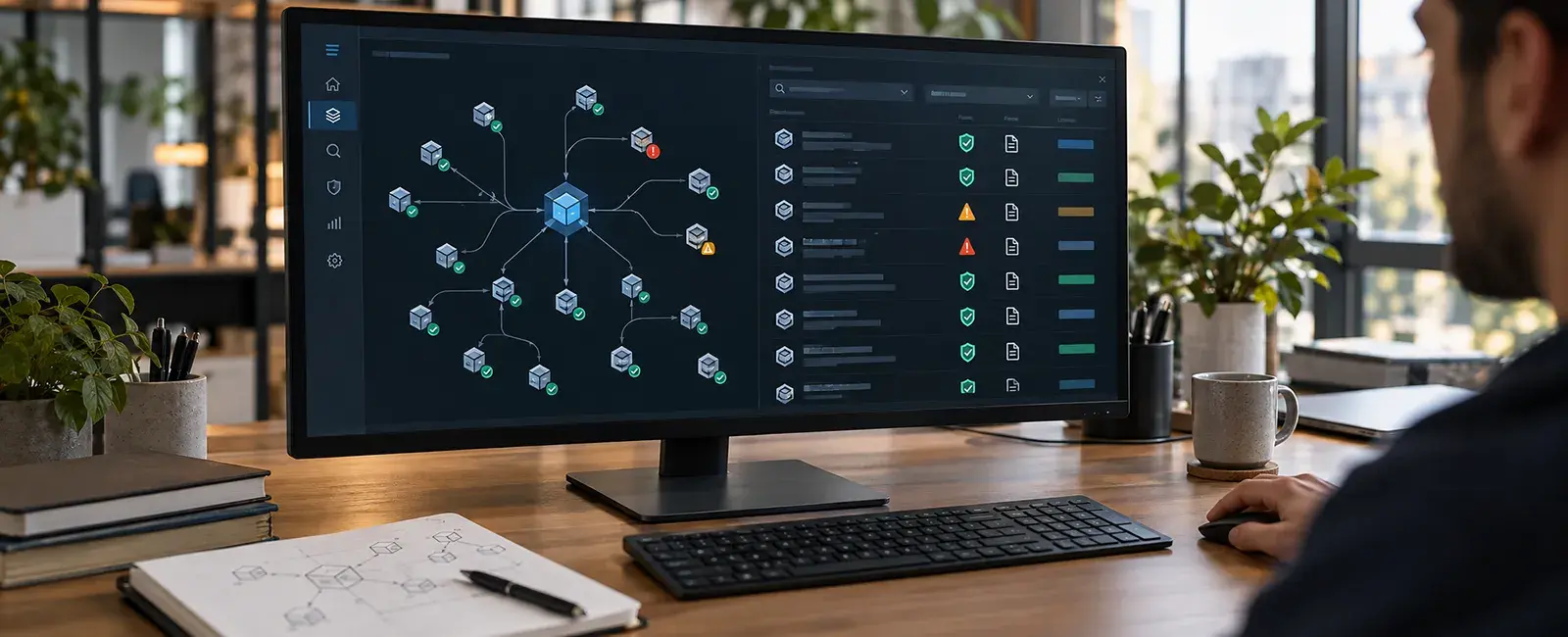
SCA focuses on the components your team did not write from scratch.
OWASP's Developer Guide explains that Software Composition Analysis can identify third-party dependencies. It also recommends recording dependencies used in production and notes that an SBOM can document component versions, sources, licenses, support status, and where dependencies are used.
OWASP Dependency-Check gives a narrower example: it identifies project dependencies and checks whether publicly disclosed vulnerabilities are associated with them.
Suppose your application contains:
Your custom code
 |

     +-- Framework A

     |      +-- Library B

     |

     +-- Library C

     |      +-- Package D

     |              +-- Package E

     |

     +-- SDK F
Your developers may have selected Framework A and SDK F directly.
Packages B, D, and E may have arrived transitively.
They still ship with your software.
OWASP's 2025 supply-chain guidance specifically recommends tracking both direct and transitive dependencies and continually monitoring component versions for known vulnerabilities.
That is the territory of software composition analysis.
Why Has SCA Become More Important?
OWASP's Top 10:2025 ranks Software Supply Chain Failures at A03. The category covers risks involving vulnerable or malicious third-party components as well as broader weaknesses in build and delivery processes.
OWASP recommends practices including:
-
Maintaining an SBOM
-
Tracking direct and transitive dependencies
-
Monitoring vulnerability sources
-
Removing unused dependencies
-
Reviewing outdated components
-
Securing repositories and CI/CD systems
-
Controlling changes across the supply chain
SCA helps with one important portion of that problem: understanding the software components in the application and known risks attached to them.
It does not magically secure the entire software supply chain.
That distinction is important.
SAST vs DAST vs SCA: Side-by-Side Comparison
This table is also why "Which one is best?" is usually the wrong framing.
The tools are not measuring the same thing.
Which Security Problems Fit Each Test Best?
The safest answer is to describe areas of strength rather than promise perfect detection.
The lesson is not that a tool in the "strong" column will find every relevant weakness.
Security scanners have false positives and false negatives.
Research makes that very clear.
What Does Research Say About SAST Accuracy?
A 2024 study presented at the ACM International Symposium on Software Testing and Analysis examined static-analysis support for secure code review using 319 real-world vulnerabilities drawn from 815 vulnerability-contributing commits across 92 C and C++ projects.
The researchers reported that a single SAST tool produced warnings in vulnerable functions for 52% of the vulnerability-contributing commits they studied.
There was another side to the result.
At least 76% of warnings inside vulnerable functions were irrelevant to the vulnerability-producing change, while 22% of the studied commits remained undetected because of limitations in the static-analysis rules.
That is a useful picture of SAST.
Useful?
Yes.
Complete?
No.
A static scanner helps prioritize review.
It does not replace judgment.
Research Comparing Static and Dynamic Testing Reaches a Similar Answer
Sarah Elder, Nusrat Zahan, Rui Shu, Monica Metro, Valeri Kozarev, Tim Menzies, and Laurie Williams compared four vulnerability-detection approaches on an open-source Java medical-records application:
-
SAST
-
DAST
-
Systematic manual penetration testing
-
Exploratory manual penetration testing
In their experiment, SAST found the largest number of vulnerabilities, while exploratory manual penetration testing identified more severe issues.
More interestingly, each technique discovered vulnerabilities the others did not find. The authors concluded that the right technique depends on the project's goals and resources, and that organizations trying to find the broadest possible set need multiple approaches.
That is probably the clearest answer to the title of this article.
There is no scanner that sees the whole application.
Does SCA Actually Help?
A 2025 IEEE/ACM Mining Software Repositories study by Sabato Nocera, Sira Vegas, Giuseppe Scanniello, Natalia Juristo and colleagues examined Software Composition Analysis in Apache Software Foundation Java Maven projects.
The researchers compared projects adopting OWASP Dependency-Check with those that did not.
They reported that adoption of the SCA tool appeared to produce a significant reduction in the overall number and severity score of vulnerable dependencies, including high-severity cases in the projects studied.
That finding does not mean an SCA tool fixes dependencies automatically.
It suggests that continuously identifying component risk can support better supply-chain security decisions.
Where Should SAST, SCA and DAST Run in DevSecOps?

OWASP's DevSecOps guidance lists SAST, DAST, SCA, infrastructure scanning, and container scanning among different security activities that can appear in CI/CD pipelines.
A practical model might look like this:
Developer → Code Commit → SAST (Inspect Custom Code) → SCA (Inspect Dependencies) → Build → Deploy to Test Environment → DAST (Test Running Application) → Manual Security Testing (Risk-Based) → Release → Continuous Dependency and Vulnerability Monitoring
This is not an official mandatory sequence.
It is a practical arrangement based on what each method requires.
SAST can run before deployment because it analyzes code. DAST needs a running target. SCA can analyze dependencies during build and continue monitoring them as vulnerability information changes.
Should Every Finding Block the Build?
Probably not.
A security program needs triage.
OWASP's own SAST guidance warns about false positives, while research has repeatedly found that automated tools can generate findings that require human interpretation.
A practical policy can consider:
-
Severity
-
Confidence
-
Exploitability
-
Whether the vulnerable path is reachable
-
Whether the dependency is actually shipped
-
Internet exposure
-
Data sensitivity
-
Existing mitigating controls
-
Whether the finding is new or accepted technical debt
For example:
Critical + High Confidence + Reachable → Block Release | High + Needs Verification → Security Review | Medium → Create Remediation Task with Deadline | Low / Informational → Track Without Automatically Stopping Delivery
The exact thresholds should follow the organization's risk model.
The useful principle is simpler.
A gate should stop risky software, not merely noisy software.
Where Does an SBOM Fit?
An SBOM is an inventory of software components.
OWASP describes an SBOM as a way to record information such as the dependency, version, source, license, support state, and where the component is referenced. It can then help teams determine which applications may be affected by a particular CVE or which known issues exist in a particular application's dependencies.
SCA and SBOM are related, but they are not identical.
Think of it this way:
SBOM: What components are present?
SCA: What can we learn about the security state of those components?
Platforms such as OWASP Dependency-Track ingest SBOMs and continuously compare components with vulnerability and policy data.
Why Scanning Once Is Not Enough for SCA
Your code can remain unchanged while dependency risk changes.
A library that appeared safe when version 3.2 was deployed may later receive a published vulnerability record.
OWASP's supply-chain guidance recommends continuously monitoring sources of vulnerability information and maintaining component inventories over the lifetime of software.
That means SCA is not only a pre-release activity.
A mature process needs to know:
"A new vulnerability was disclosed this morning. Which of our products contain the affected package and version?"
If the organization has a maintained SBOM or dependency inventory, that question becomes easier to answer.
Can DAST Find Business Logic Vulnerabilities?

Automated DAST should not be relied on for all business-logic testing.
OWASP states that manual assessment is often necessary for issues such as business-logic errors, race-condition checks, and certain zero-day vulnerabilities that automated tools may miss.
Imagine an ecommerce platform.
A scanner may understand:
POST /coupon/apply
It may not understand the business rule:
A customer must not combine an employee discount, referral credit, promotional coupon, and partner rebate in one transaction.
Finding that problem may require understanding the business rather than simply attacking parameters.
This is one reason security testing still needs people.
Is Penetration Testing Still Needed?
NIST's software verification guidance lists penetration testing separately from static analysis, dynamic analysis, and software composition tools.
The Elder et al. research also found unique vulnerabilities across automated and manual approaches, with exploratory penetration testing identifying more severe vulnerabilities than the automated approaches in their case study.
So automated tooling should not be presented as a complete replacement for skilled security testing.
SAST, DAST, and SCA scale repetitive inspection.
Human testing can reason about combinations, abuse paths, assumptions, workflows, and context that automated tools may not understand.
Which Test Should You Start With?
If you can only introduce one control at a time, choose based on the risk you currently cannot see.
Start With SAST When:
-
Your team develops substantial custom code.
-
Security feedback currently arrives late.
-
Developers need file and line-level findings.
-
You want code analysis inside pull requests or CI.
Those use cases match the strengths OWASP describes for source-code analysis.
Start With DAST When:
-
You have a running web application.
-
You need to examine externally observable behavior.
-
Deployment configuration matters.
-
Your current process does little runtime security testing.
DAST's black-box interaction model is designed around a running application.
Start With SCA When:
-
Your applications include third-party packages.
-
You do not know which component versions are deployed.
-
You need SBOM visibility.
-
Dependency vulnerabilities are being tracked manually.
Those are direct use cases described in OWASP's dependency guidance.
Use All Three When:
Your production application contains custom code, third-party packages, and an externally reachable runtime.
That recommendation is an inference from the different scopes of the three methods and NIST's guidance to treat static analysis, dynamic analysis, composition tools, and penetration testing as separate verification techniques.
What Does a Practical Security Testing Plan Look Like?
This layered approach is consistent with OWASP's DevSecOps model and NIST's recommendation to use several verification techniques rather than collapsing verification into one scanner.
Five Mistakes We See in Security Testing Programs
1. Calling SAST a Penetration Test
They are not the same activity.
SAST examines source or compiled code, while penetration testing and DAST interact with running systems in different ways. NIST lists these as separate verification techniques.
2. Believing DAST Covers the Entire Application
OWASP specifically warns that dynamic testing cannot cover 100% of source code and that teams should consider how much of the application's attack surface the scanner reached.
3. Treating SCA as a One-Time Dependency Report
OWASP recommends continuous component inventory and vulnerability monitoring because new information about existing dependencies can emerge after release.
4. Blocking Developers With Unreviewed Scanner Noise
OWASP identifies high false-positive volume as a SAST weakness, and empirical research has found substantial numbers of irrelevant warnings around real vulnerability-producing code changes.
5. Assuming Automated Testing Understands Business Risk
OWASP says some business-logic errors require manual assessment, while research comparing vulnerability techniques found unique findings across automated and manual methods.
The Three Reports Were All Right About Different Things
Back to our fictional security team.
The static finding went to the developer who owned the affected code.
The dependency issue went to the platform team, which first verified whether the affected component and version were actually present in the production artifact.
The dynamic finding went through reproduction in staging to understand whether the observed behavior represented a genuine security weakness.
Nobody deleted two scanners because the third one found something serious.
That would have misunderstood the evidence.
The team instead asked a better question:
What kind of risk could still pass through all three?
That question led to manual abuse testing around authorization and workflow logic.
Now the security program was no longer three dashboards.
It was a set of overlapping controls.
That is what application security testing should become.
Do Not Ask One Scanner to Do Three Jobs
SAST can inspect code before deployment.
DAST can challenge the software while it is running.
SCA can tell you what third-party components entered the product and whether known vulnerability information applies to them.
They overlap in the larger objective.
They do not have the same view.
That matters because modern software risk is spread across custom code, runtime behavior, dependencies, build systems, and operational decisions. OWASP's DevSecOps guidance reflects that reality by listing several types of scanning rather than presenting a single security test as sufficient.
At Deuex Solutions, our DevSecOps services help teams place security checks into development and CI/CD workflows, improve vulnerability triage, test applications at multiple stages, and reduce the gap between finding a problem and getting it fixed.
If your security pipeline currently relies on one scanner, the next step is not necessarily buying three new products.
First map what the existing control can actually see.
Then map what it cannot.
The best application security testing strategy is the one where important risks have fewer places to hide.


Sanket Shah
CEO & Founder
I am Sanket Shah, founder and CEO of Deuex Solutions, where I focus on building scalable web mobile and data driven software products with a background in software development. I enjoy turning ideas into reliable digital solutions and working with teams to solve real world problems through technology.


