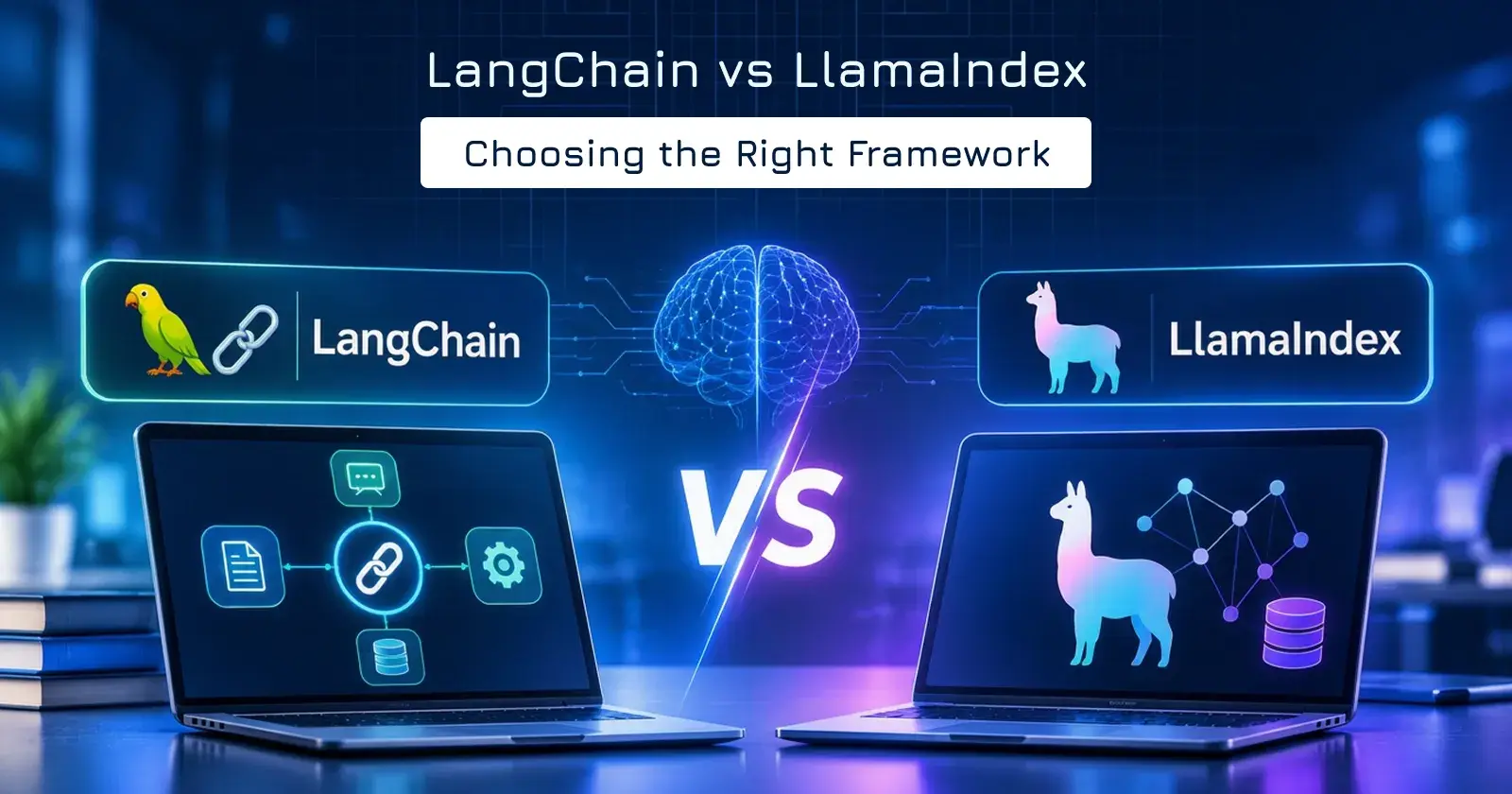
For LangChain vs LlamaIndex, my starting recommendation is LangChain with LangGraph for workflow-heavy agents, LlamaIndex for document-centered retrieval, and lighter custom components for a narrow, predictable task. Both ecosystems support RAG and agents, so choose through a representative pilot rather than treating those categories as exclusive.
For buyers evaluating AI Chatbot Integration Services, define the information the application may retrieve, the actions it may take, and the evidence needed before approving production use.
Quick Summary / Key Takeaways
- Compare the full application design, not just the framework name.
- Separate ingestion and retrieval quality from agent orchestration and business actions.
- Price open-source libraries, optional hosted services, and operating responsibilities separately.
- Test permissions, missing evidence, interrupted workflows, and handover alongside successful answers.
What should you decide before choosing a framework?
Before any LangChain vs LlamaIndex comparison, decide whether the difficult part is finding information, completing a workflow, or both. Then describe the smallest real task that exposes that difficulty.
Consider an illustrative support request, not a client case: "Check our replacement policy, find my order, and arrange an exchange."
The first part needs approved documents. The second needs authorized access to an order system. The third needs business rules, customer confirmation, and a record of the action.
Now interrupt the application immediately after it creates the exchange request. Restart it. Does it create another?
That is the exercise I would put into procurement. A convincing answer demonstrates one capability; a recoverable transaction demonstrates another.
LangChain vs LlamaIndex: What are you actually comparing?
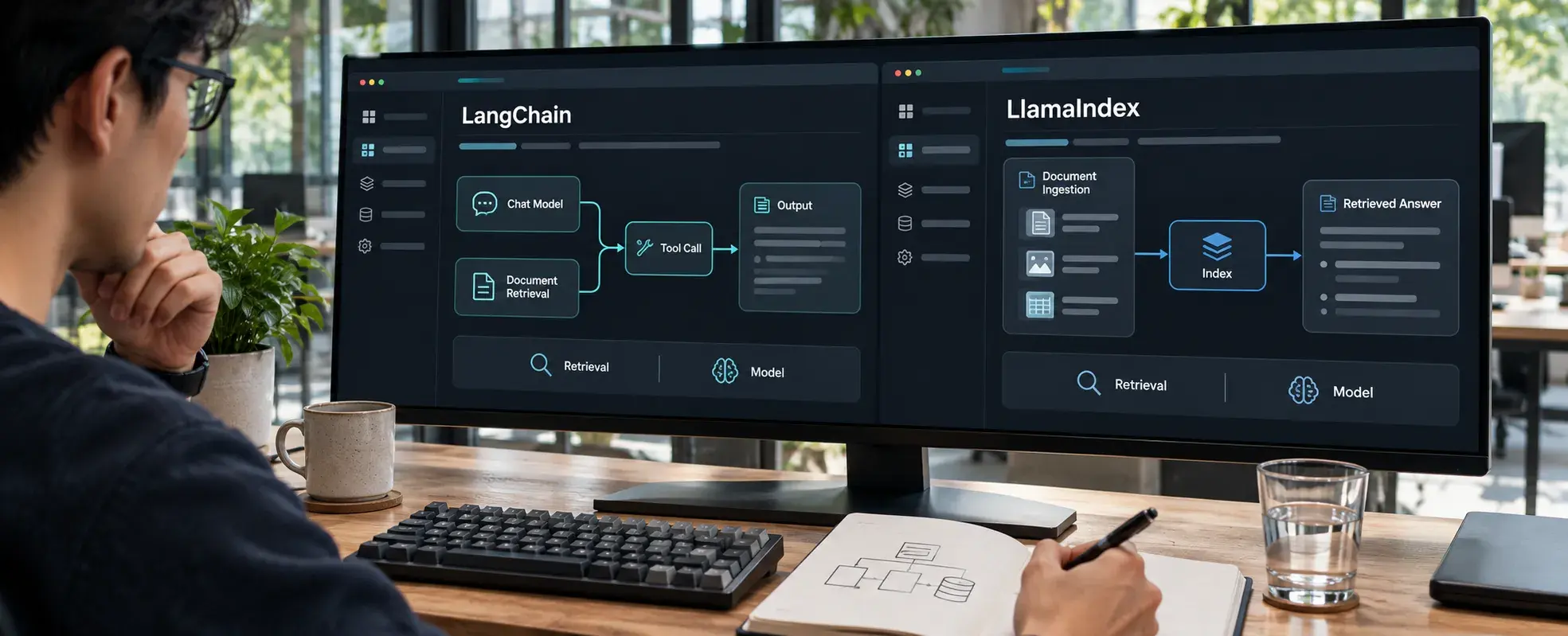
Compare the libraries and supporting runtime separately from commercial services. The names cover related products, not interchangeable bundles.
LangChain's overview describes configurable agents built from models, tools, prompts, and middleware. LlamaIndex's framework documentation describes connectors, indexes, retrieval, query engines, agents, and workflows.
The LangChain vs LlamaIndex capabilities in this table are examined below. The buyer questions are recommendations, not a ranking.
An LLM application framework should reduce work your team would otherwise own. It should not make the application harder to explain.
Which is a better RAG framework for company knowledge?
In a LangChain vs LlamaIndex shortlist for retrieval, start by evaluating LlamaIndex when document preparation and retrieval dominate the scope, but include LangChain when its surrounding application components fit your existing stack. That is a shortlist recommendation, not evidence that either produces inherently more accurate answers.
Retrieval-augmented generation, or RAG, supplies retrieved information to a model when answering. LangChain's retrieval documentation covers loaders, embeddings, vector stores, and both fixed retrieval sequences and agent-directed retrieval.
LlamaIndex's ingestion pipeline applies transformations to documents, produces nodes for downstream use, and can insert them into a vector store. It also documents caching transformation results when the relevant cache is retained.
For LlamaIndex development, ask how the proposed pipeline handles tables, document versions, source identifiers, and metadata. Demonstrate the difference between an approved policy and a superseded copy before expanding the knowledge base.
For LangChain development, ask the team to identify the retrieval steps explicitly rather than burying every search inside an agent loop. A predictable question-answering workflow is a useful baseline to test first.
Choose a RAG framework by inspecting the evidence it retrieves, not the fluency of the answer.
What should you check in data connectors and indexing?
Check the complete source lifecycle: initial loading, updates, deletions, access changes, and recovery after a failed synchronization. A connector's presence in a directory is not your acceptance test.
LangChain's document loader documentation describes a common interface for loading sources and explicitly warns that community loaders are user-contributed and unverified. LlamaIndex's connector guide explains that each data connector (reader) is published as its own llama-index-readers package, so teams install only the sources they need.
Ask the supplier to remove a document from the source and demonstrate the resulting behavior in search, cached responses, and evaluation records. Repeat the exercise after revoking a user's access.
For indexing, record the embedding model, chunking configuration, document identifier, and source version. Treat an embedding model change as a migration to assess, not a routine configuration edit with no downstream questions.
Our DataOps vs MLOps vs DevOps comparison covers the ownership discussion around changing data and production systems. Assign that responsibility before the connector goes live.
How do agents and orchestration differ?
For agents, judge LangChain vs LlamaIndex on the control flow model and recovery behavior. Do not assume LlamaIndex stops at retrieval or that LangChain itself is the same product as LangGraph.
LangGraph's overview describes a low-level runtime using state, nodes, and edges. It supports deterministic and model-directed steps, persistence, streaming, and human intervention, and it can be used without LangChain.
LlamaIndex Workflows uses events to connect steps. Its documentation describes branching, loops, concurrency, shared state, and steps that can retrieve information, call models, or request human input.
For the exchange example, require an explicit boundary between proposing an action and executing it. The approval should identify the actual order and change being authorized.
Recovery needs configuration. LangGraph's persistence guide distinguishes persistent checkpoints from in-memory state that disappears on restart. LlamaIndex's durable workflow guide explains checkpointing and warns that resumed steps may execute again, requiring repeat-safe side effects.
Neither capability should be purchased as an unexplained promise of duplicate-free business transactions. Test the downstream operation, including retries and lost responses.
For workflow ideas, our AI agent use cases for UAE businesses provides related reading. Keep the framework decision tied to one approved use case.
Can you use LangChain and LlamaIndex together?
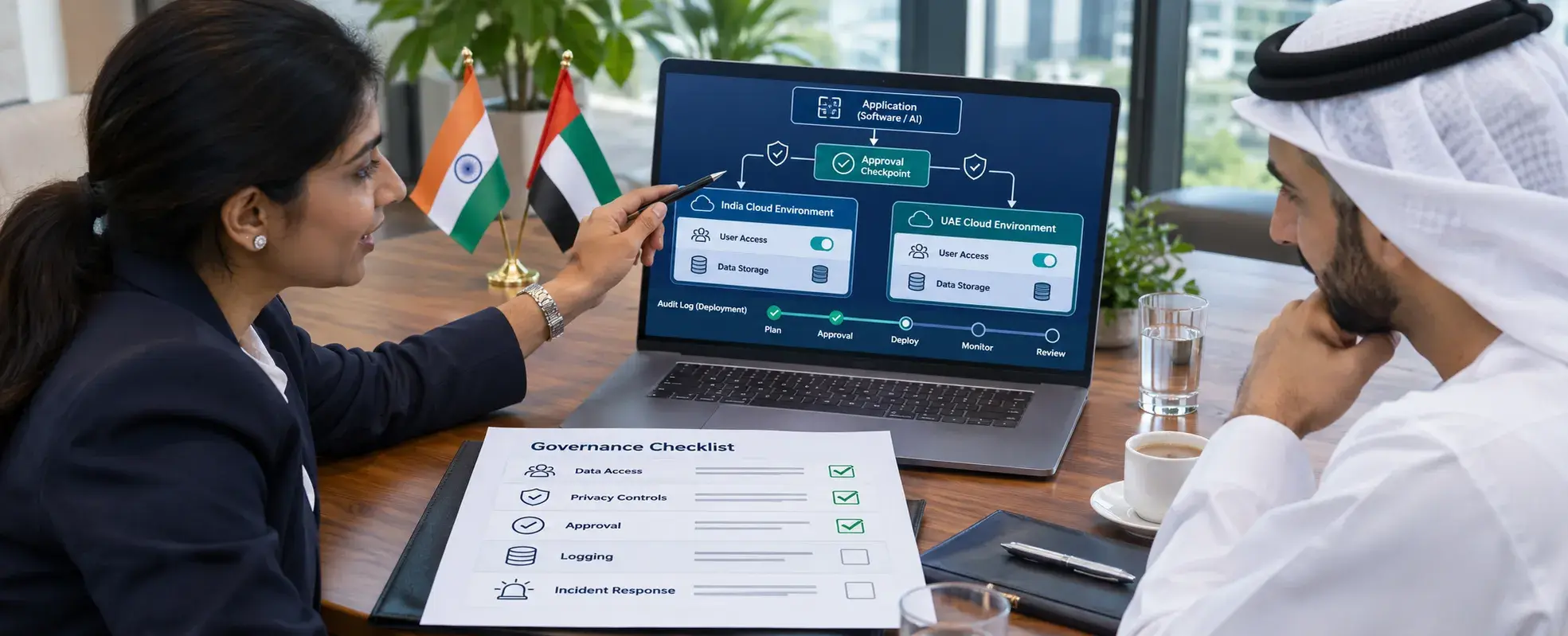
Yes, a possible design is to expose retrieval through a callable tool and let a separate orchestration layer use its result. LangChain documents tool interfaces, while LlamaIndex exposes query and retrieval components in the documentation cited above.
My recommendation is to combine them only when a pilot demonstrates a clear benefit. Define one owner for workflow state, cancellation, retries, and tracing rather than allowing both layers to control the same process implicitly.
Keep the interface narrow: authorized query in, evidence and source identifiers out. Make changes behind that interface testable.
Using both is an architectural option. It is not a maturity badge.
How should evaluation and observability work?
Evaluation asks whether an output meets your criteria. Observability helps the team inspect what happened during execution. Budget for both rather than treating a trace as proof of correctness.
LangSmith's evaluation documentation covers offline datasets, online evaluation, and human, code-based, and model-based evaluators. LlamaIndex's evaluation guide separates retrieval assessment from response assessment, including faithfulness to retrieved sources.
For traces, LangSmith Observability supports multiple frameworks and providers. LlamaIndex's observability documentation describes instrumentation and connections to external tools, including OpenTelemetry. Observability is not exclusive to either framework choice.
Our suggested test set should include outdated documents, conflicting policies, unanswered questions, unauthorized records, failed tool calls, and interrupted approvals. Review important cases with the business owner rather than approving a release from one aggregate score.
Also decide what must not enter a trace. Ask how prompts, retrieved passages, identifiers, and credentials are redacted, retained, and accessed.
What do two verified research studies contribute?
They help define the pilot's evaluation and control requirements for any LangChain vs LlamaIndex decision. Neither is a head-to-head benchmark showing that LangChain beats LlamaIndex, or the reverse.
What does RAGAs tell us about evaluation?
Shahul Es, Jithin James, Luis Espinosa Anke, and Steven Schockaert published RAGAs: Automated Evaluation of Retrieval Augmented Generation in the EACL 2024 System Demonstrations proceedings.
The paper introduces reference-free evaluation measures addressing retrieved context, faithful use of that context, and answer quality. Its DOI is 10.18653/v1/2024.eacl-demo.16.
Our purchasing inference is to evaluate those dimensions separately. A useful answer and a relevant source are related outcomes, but they should not collapse into one unexplained score. The paper does not certify current framework quality or replace business acceptance.
What does ReAct tell us about agents?
Shunyu Yao and colleagues presented ReAct: Synergizing Reasoning and Acting in Language Models at ICLR 2023, following an initial preprint in 2022.
The research studied interleaving model reasoning with actions that access external information or environments. It reported improvements on its selected question-answering and interactive task benchmarks, not on arbitrary enterprise workflows.
The practical implication I draw is to test the action sequence, not only the final message. A correct-looking exchange confirmation is not enough if the system changed the wrong order.
How do deployment and licensing affect the choice?
Separate the open-source framework from hosted parsing, observability, evaluation, and deployment products. The scope and contract for each can differ.
The core repositories publish MIT licenses for LangChain and LlamaIndex. Those licenses do not include hosting, model usage, third-party databases, or a managed support agreement.
LangSmith's deployment setup documents cloud, bring-your-own-cloud, and self-hosted options, with Enterprise plan conditions for the latter options. Running your own framework application is not the same purchase as self-hosting the LangSmith product.
LlamaIndex's workflow server documentation describes exposing workflows through an HTTP API using a separate server package. Treat that as a deployment building block, then specify authentication, persistent storage, scaling, and operational ownership for your application.
Check [LangSmith pricing](https://www.langchain.com/pricing) and [LlamaIndex's hosted LlamaParse pricing](https://www.llamaindex.ai/pricing) for the services actually proposed. They describe different products and charging units, so their entry plans are not equivalent framework prices.
For wider budgeting context, our AI chatbot development cost guide separates development scope from recurring operation. Request a workload-specific quote rather than importing a headline range into procurement.
How should governance affect an India or UAE deployment?
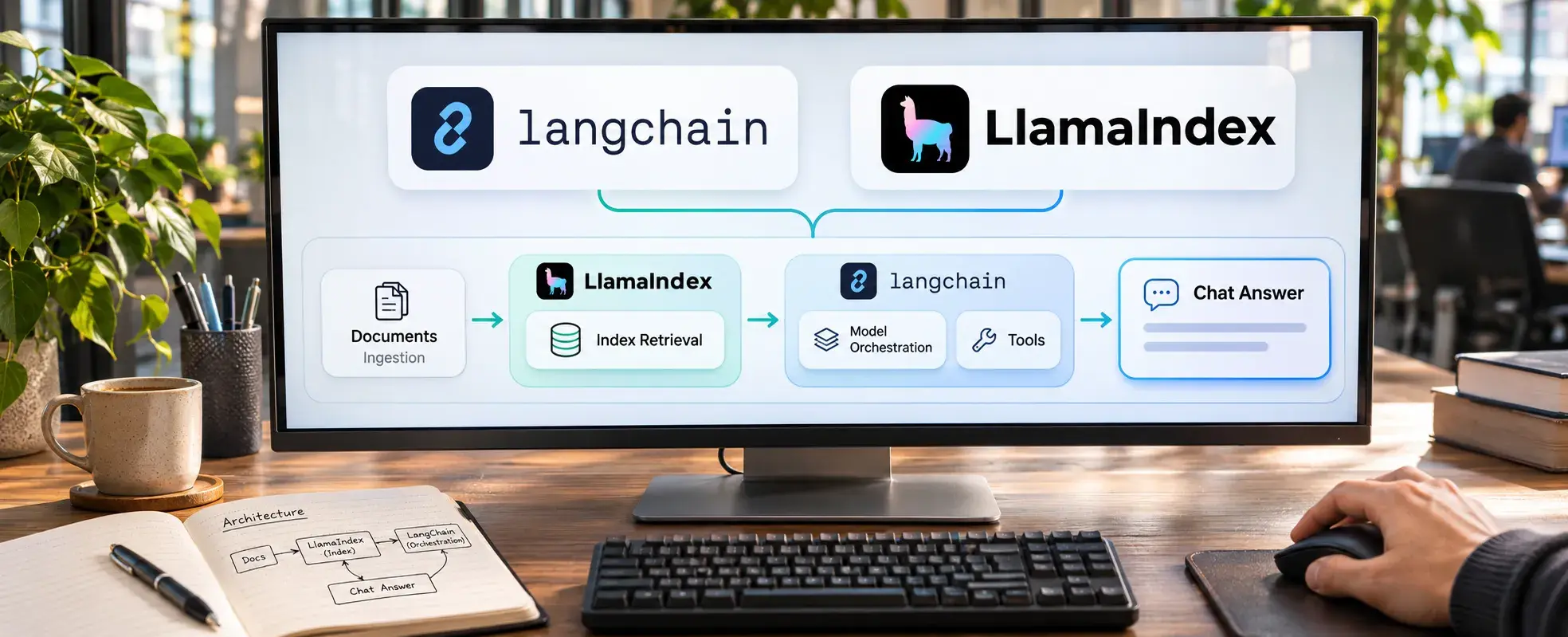
Make access and data handling part of the application contract. My recommended acceptance criteria would keep identity, document permissions, and action authorization in application controls rather than asking the model to determine its own authority.
Test permissions before retrieval and again before executing a business action. Include cached responses, conversation history, and exports in the review, not only the final chat message.
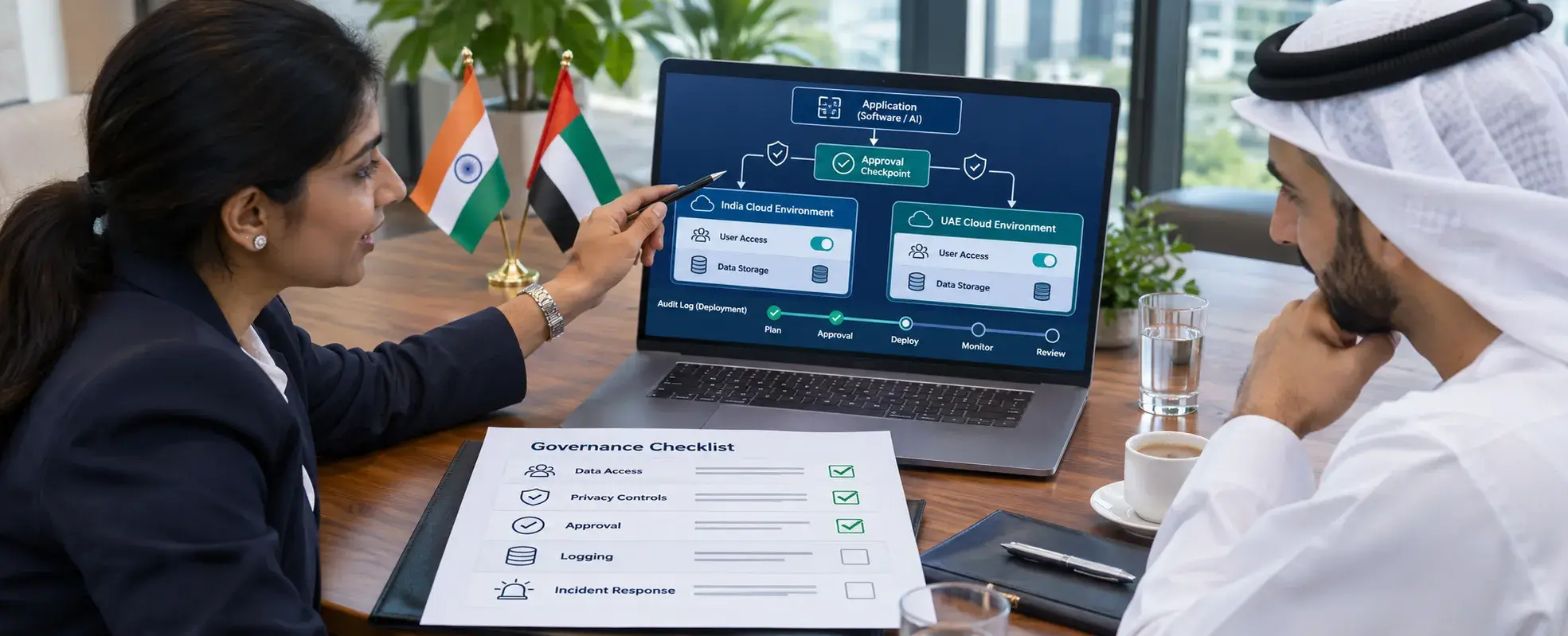
For India and UAE deployments, map where documents, model requests, indexes, and traces are processed. Ask the relevant teams to review that proposed data path and vendor terms; do not treat a framework choice as a compliance decision.
Include actual language requirements and representative documents in testing. Require a named owner for content corrections, access revocation, and incident response before launch.
When are lighter custom components the better option?
I would test a smaller custom design first when the workflow has a known sequence, limited sources, and no demonstrated need for complex stateful orchestration. This is a design recommendation, not a claim that custom code always costs less.
For example, a proposed read-only assistant could authorize the user, query an existing search service, request a structured model response, validate it, and return source references. The team could implement that sequence using the provider and search client libraries it already supports.
Ask what the framework removes from your maintenance burden. Then ask what your custom alternative would need to own: timeouts, retries, logging, evaluation, access checks, and provider changes.
Keep the comparison honest. Smaller application code is not automatically a smaller operating responsibility.
Choose lighter components when the complete system is simpler to own, not merely when the first example uses fewer lines.
Which option should your team shortlist?
Use the following as a proposed LangChain vs LlamaIndex decision matrix. Preserve a working stack unless evidence identifies a problem worth solving.
Use the [software services overview](https://deuexsolutions.com/services) to separate application, data, QA, security, and support responsibilities during scoping. Assign each deliverable instead of hiding the work under one framework name.
How should you run a fair production pilot?
Whether the pilot covers LangChain development, LlamaIndex development, or a custom baseline, give each candidate the same documents, model configuration, access rules, and representative tasks. Start with comparable retrieval settings, then record any tuning separately so the source of an improvement is visible.
Measure accepted answers, evidence quality, authorized task completion, response time, operating cost, and review effort. Define pass or fail conditions for access control and business actions rather than allowing a high average score to offset a serious failure.
Finally, ask a second engineer to update a source, diagnose a failed run, and release a tested change. That handover is part of the purchase.
Return to the interrupted exchange request. The winning design should explain what happened, what remains pending, and who can safely continue. That is a stronger decision signal than the most polished demonstration.
What should you do before committing?
Bring one real task, the relevant data sources, permitted actions, and failure scenarios to an architecture review. Ask for a bounded pilot and a cost model that separates development from production ownership.
Explore Deuex Solutions' AI Chatbot Integration Services to scope that review around the business workflow rather than a predetermined framework.
Choose the components your team can explain, test, recover, and maintain. Let the framework follow that decision.


Sanket Shah
CEO & Founder
I am Sanket Shah, founder and CEO of Deuex Solutions, where I focus on building scalable web mobile and data driven software products with a background in software development. I enjoy turning ideas into reliable digital solutions and working with teams to solve real world problems through technology.