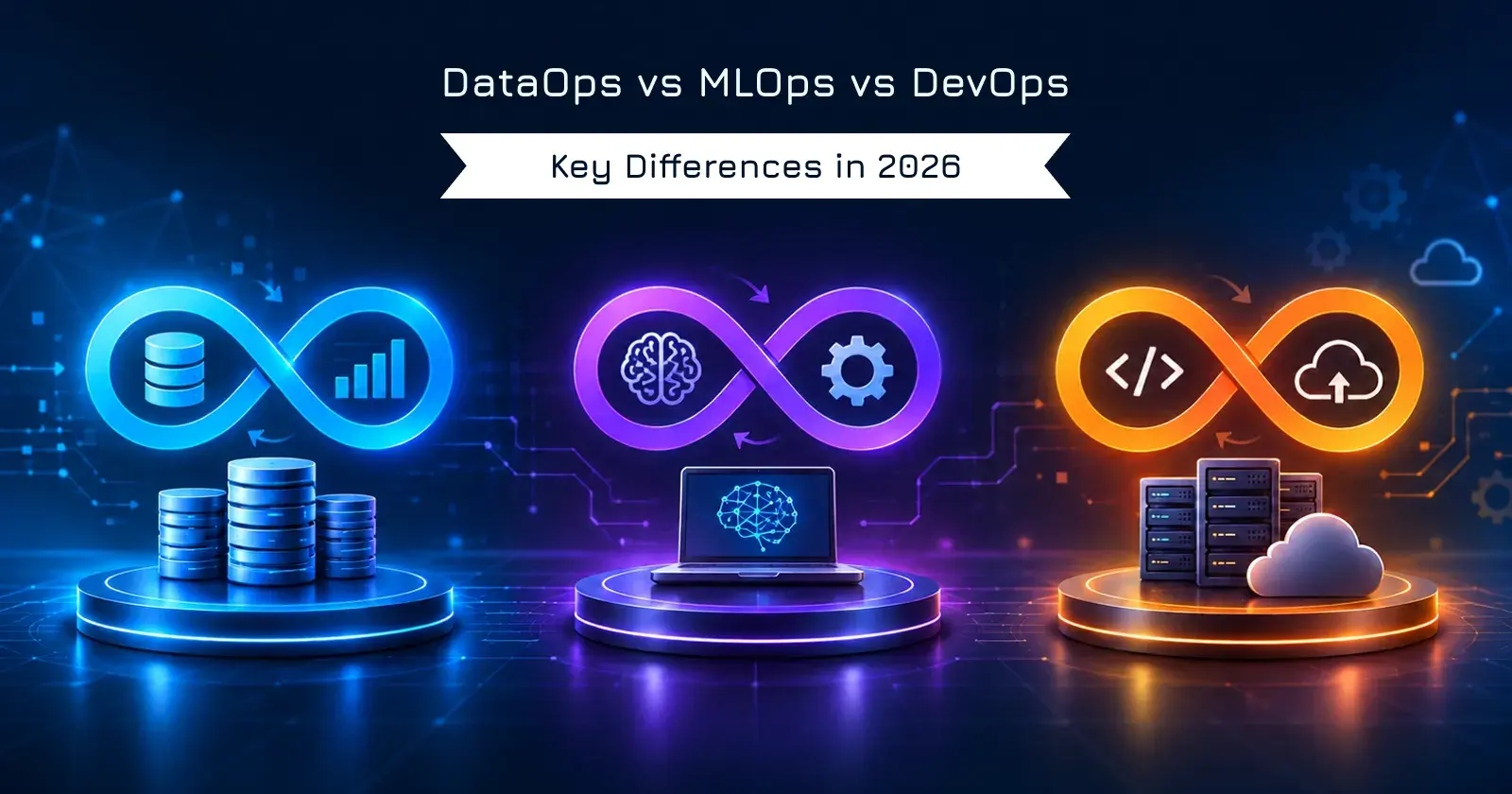
DataOps vs MLOps vs DevOps comes down to the work being managed: DataOps focuses on dependable data, MLOps on the machine learning lifecycle, and DevOps on software delivery and operations. These practices overlap; choose the capabilities that address your current failure points rather than treating them as competing products.
These distinctions follow the approaches described by IBM for DataOps, Google Cloud for MLOps, and AWS for DevOps.
For teams evaluating AI ML DataOps Services, start with an outcome: dependable reports, safer releases, or predictions that remain useful after deployment. The operating model should explain who delivers that outcome and what happens when it fails.
Quick Summary / Key Takeaways
- Identify the unreliable output before buying another platform.
- Separate successful execution from data quality and model quality.
- Share delivery infrastructure where useful, but retain explicit checks for each workload.
- Assign owners for datasets, model behavior, deployment, and incident decisions.
- Compare operating effort and evidence of improvement, not the number of tools installed.
What should you establish before choosing an operating model?
Establish what the business needs to trust and who may stop the workflow when that trust is lost.
Consider an illustrative handover exercise for a retailer serving India and the UAE. The proposed system turns sales records into replenishment forecasts and shows purchasing recommendations in a web application.
The buyer asks: “What happens when yesterday’s sales arrive tomorrow?”
The infrastructure engineer explains that the application stays available. The data engineer explains how late records will be handled. The ML engineer asks whether the forecast should be withheld until the input is complete.
Those are three different responsibilities within one product.
My starting question would be who can pause the recommendation and who tells purchasing what happened. A tool demonstration is not a sufficient answer.
DataOps vs MLOps vs DevOps: What actually changes?
Compare their primary focus, change controls, and acceptance evidence. The following is a practical synthesis of the source definitions above, not a mandatory organization chart.
The boundaries are not walls. Data and ML systems contain software, so their delivery processes can use DevOps practices too. Google Cloud’s MLOps guidance explicitly builds on DevOps principles while adding ML-specific requirements.
Our DevOps consulting guide covers the application delivery side in more detail. This comparison concentrates on the additional responsibilities around datasets and models.
How do the workflows and automation differ?
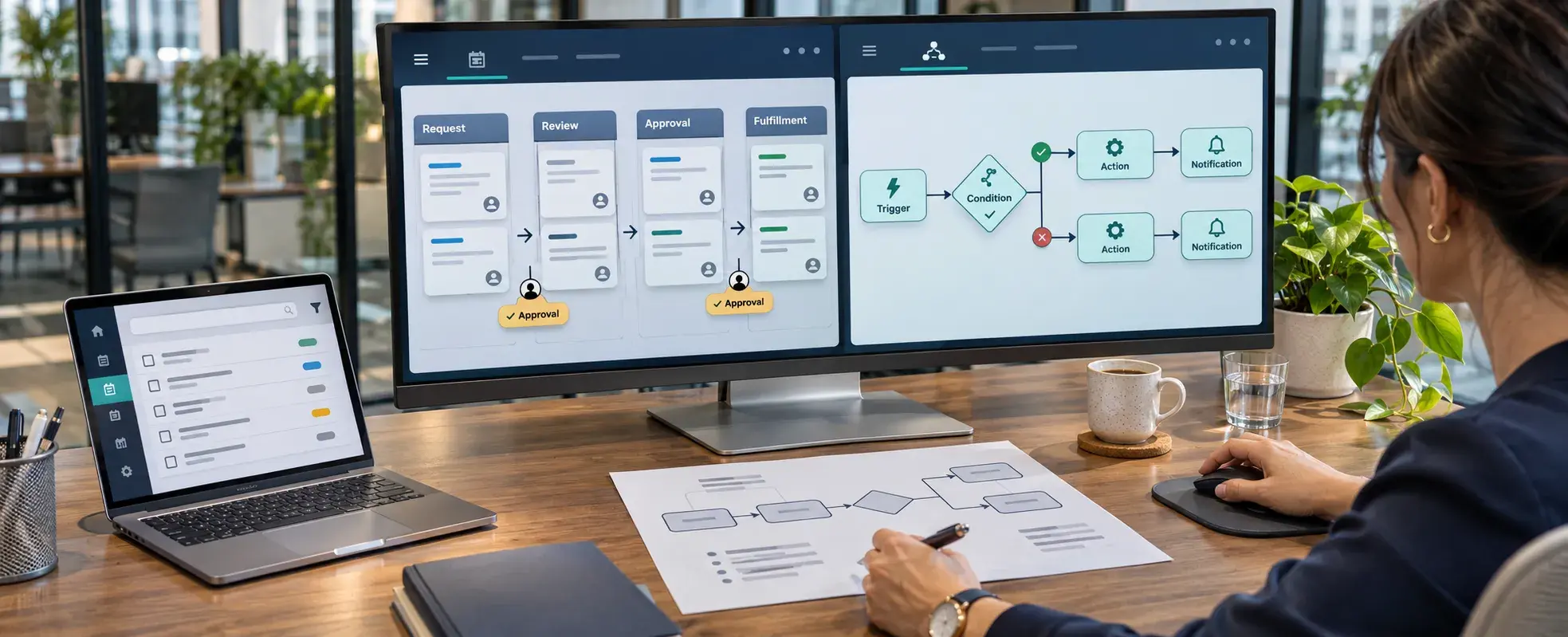
Separate the pipeline that releases code from the workflows that execute afterward. A data job can process another batch without a new deployment; an ML workflow may evaluate a candidate without approving it for production. Orchestrators such as Apache Airflow schedule and monitor those workflows, and Google Cloud’s MLOps guidance treats data validation, model evaluation, and deployment as separate steps.
What does the DevOps workflow control?
A practical delivery workflow reviews a change, builds it, runs checks, deploys an approved artifact, and observes the service. Agree recovery procedures and release responsibility alongside the automation.
For measurement, DORA’s software delivery guidance includes change lead time, deployment frequency, failed deployment recovery time, change fail rate, and deployment rework rate. DORA recommends applying these measures in the context of a particular application or service.
Use them to examine delivery. Add separate evidence for the data and predictions the service exposes.
What does DataOps add to the data pipeline?
DataOps extends the conversation beyond moving records. In the retail example, define acceptable freshness, required fields, currency meaning, duplicate handling, and responsibility for correcting the source.
For data pipeline automation, I would require a documented rule for late arrivals and a safe way to reprocess affected records. Specify what downstream consumers see while the correction is underway.
A data contract can record the agreement: expected structure, business meaning, quality conditions, owner, and change process. Treat it as an acceptance artifact, not merely a file generated by a catalog.
Our single source of truth article provides related context on ownership and shared definitions.
What does MLOps add beyond deploying an API?
Google Cloud’s MLOps guidance distinguishes software tests from data validation, trained-model evaluation, and model validation. It also explains that changing data can reduce model performance and treats continuous training separately from continuous delivery.
For the retailer, require a link between the candidate model, its training inputs, evaluation results, and approved release. Compare forecast behavior against an agreed baseline and relevant business segments before promotion.
Do not make retraining and production approval the same decision. Set the promotion criteria, fallback behavior, and accountable reviewer before automating either step.
Microsoft’s MLOps maturity guidance supports gradual capability development rather than adopting a mature platform’s full complexity upfront.
Where should the three operating models overlap?
Our recommendation is to share repeatable foundations, then add workload-specific checks. Shared code repositories, access management, release processes, and incident routines need not imply identical acceptance tests. In most DevOps vs DataOps discussions, delivery is the shared layer and the acceptance gate is where the two differ.
In the illustrative retail system, one delivery workflow could deploy the sales ingestion code, forecast service, and purchasing interface. Separate gates would decide whether incoming sales are complete and whether the forecast remains suitable for use.
Write down what recovery means at each layer. Reverting application code, reprocessing a dataset, and replacing a model version are different actions in this proposed design.
Before accepting a pipeline, ask the supplier to demonstrate a replay without duplicate business records and a model fallback using compatible inputs. These are suggested acceptance tests, not features every tool supplies automatically.
How should observability differ across software, data, and ML?
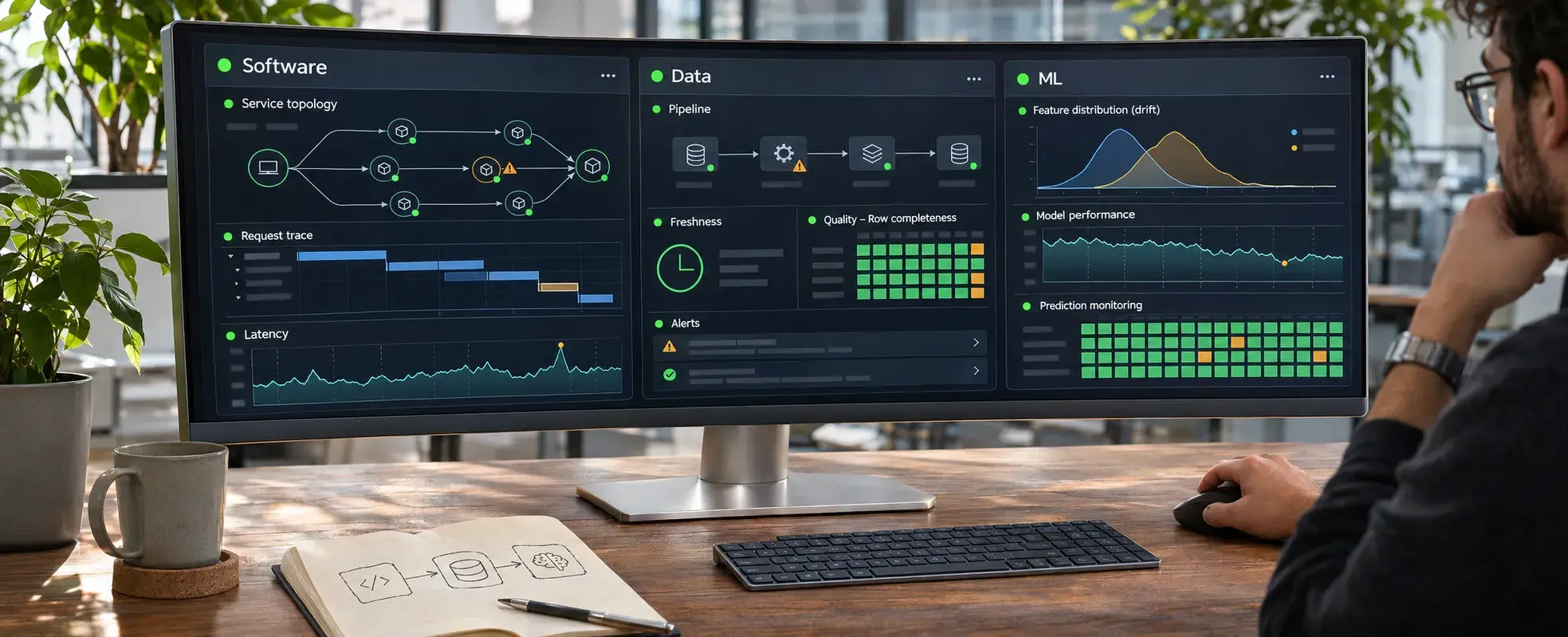
Monitor the condition of the business output alongside the health of the system producing it. For the retail example, a responsive recommendations page is not enough if its inputs are incomplete.
Use application signals to investigate service failures. Add data checks for freshness, completeness, unexpected values, and affected downstream consumers. For model evaluation, define the relevant outcome measure, comparison baseline, and review interval.
dbt’s data testing documentation, for example, describes checks for uniqueness, missing values, accepted values, and relationships. Those checks answer specific questions about records; they do not establish whether a forecast is commercially useful.
Our recommendation is to treat a distribution change alert as a reason to investigate, not an automatic instruction to replace the model. Check the source, expected business changes, and available outcome evidence before choosing the corrective action.
For delayed outcomes, document the uncertainty. A forecast cannot be compared with the actual result before that result exists.
Which tools support each model, and where do they overlap?
Select tools for defined capabilities. The examples below are not a required stack or a recommendation to buy five products.
OpenTelemetry explicitly distinguishes itself from an observability storage and visualization backend. Include the receiving system and its operating costs in the design.
Likewise, a model registry records lifecycle information. Your team still needs to define the approval process around it.
Who should own the data, model, and production service?
Assign responsibility by asset and decision, not by whichever team installed the platform. The following is our suggested division for the retail example.
The data owner approves definitions such as completed sales and returns. Data engineers own the agreed collection, validation, and correction workflows.
The model owner approves the intended use, evaluation criteria, and acceptable limitations. ML engineers and data scientists maintain the training, evaluation, and model release process.
The service owner coordinates deployment, availability, recovery, and customer-facing incident handling. Platform engineers provide shared infrastructure without becoming the default owners of every business rule.
One person may hold several responsibilities. What matters is that release approval, incident command, and business acceptance are explicit.
For an external supplier, put these duties in the scope and handover plan. “Managed platform” is not a sufficient description of who decides whether purchasing should keep using a forecast.
What does verified research tell us about these responsibilities?
Two studies support looking beyond tools when you weigh DataOps vs MLOps vs DevOps. Neither provides a guaranteed return on investment or a universal staffing ratio.
What does the DataOps research establish?
Kiran Mainali, Lisa Ehrlinger, Johannes Himmelbauer, and Mihhail Matskin published Discovering DataOps: A Comprehensive Review of Definitions, Use Cases, and Tools at DATA ANALYTICS 2021.
The review examines ambiguities in DataOps definitions, coverage across the data lifecycle, and the suitability of tools for different stages. Our purchasing inference is to ask what a proposed DataOps operating model actually covers rather than relying on the label.
This is foundational research from 2021, not evidence of a particular vendor’s current performance or a 2026 savings benchmark.
What does the 2026 MLOps study add?
Faezeh Amou Najafabadi, Justus Bogner, Ilias Gerostathopoulos, and Patricia Lago published An architectural perspective on MLOps: Structures, processes, tools, and stakeholders in Information and Software Technology in 2026.
Their systematic mapping study examines 93 primary studies and connects architectural components, process steps, tools, and stakeholder responsibilities. It provides a structured reference for design, not a controlled comparison proving that one platform works best.
The practical lesson I take from it is to review the operating process and its owners alongside the architecture diagram.
How should governance work for India and UAE teams?

Make governance part of the workflow: approved data sources, access restrictions, change reviews, release evidence, retention decisions, and named incident contacts. Treat this as an engineering checklist, not a claim of legal compliance.
For a cross-border product, document where source records, training datasets, model artifacts, telemetry, and exports are stored and accessed. Have qualified advisers assess the applicable requirements before committing to a hosting or vendor arrangement.
NIST describes its AI Risk Management Framework as voluntary guidance for managing AI risk across design, development, use, and evaluation. It is not a substitute for the rules that apply to your organization.
Require governance evidence in the handover: who approved the source, which version was released, who can access it, and how a disputed output can be investigated.
What changes when the product includes generative AI?
Add evaluation and traceability for the complete application, not only the model. Google Cloud’s guidance on operating generative AI applications covers evaluation, monitoring, and lineage across data, models, code, and evaluation artifacts.
Consider a knowledge assistant using a hosted model. Our suggested split is DataOps for approved content and refresh workflows, ML or AI operations for answer evaluation and model configuration, and DevOps for application delivery and runtime operation.
A custom training pipeline may not be part of that scope. Ask what the product actually changes: documents, retrieval settings, prompts, model versions, or business actions.
Then test those changes. A retraining schedule is not an answer to every AI quality problem.
How should you budget without buying three separate platforms?
Budget by workload and responsibility. This is a planning method, not a price benchmark: separate initial setup, ongoing infrastructure and tool charges, operational support, and future changes.
For DataOps services, ask how many sources, pipelines, datasets, quality rules, and operating hours are included. For MLOps consulting, ask which training, evaluation, serving, approval, and monitoring responsibilities are in scope.
Request the exact product editions, licenses, environments, and usage assumptions for every proposed tool. Avoid treating a software license and a fully operated service as the same purchase.
Reuse existing delivery foundations where the pilot shows they are suitable. Keep costs such as data reprocessing, evaluation runs, telemetry storage, and incident support visible rather than hiding them inside a platform total.
The Deuex software services overview can help organize the workstreams for discussion. The signed scope should assign each responsibility and state what remains with your team.
Which operating model should your data team prioritize?
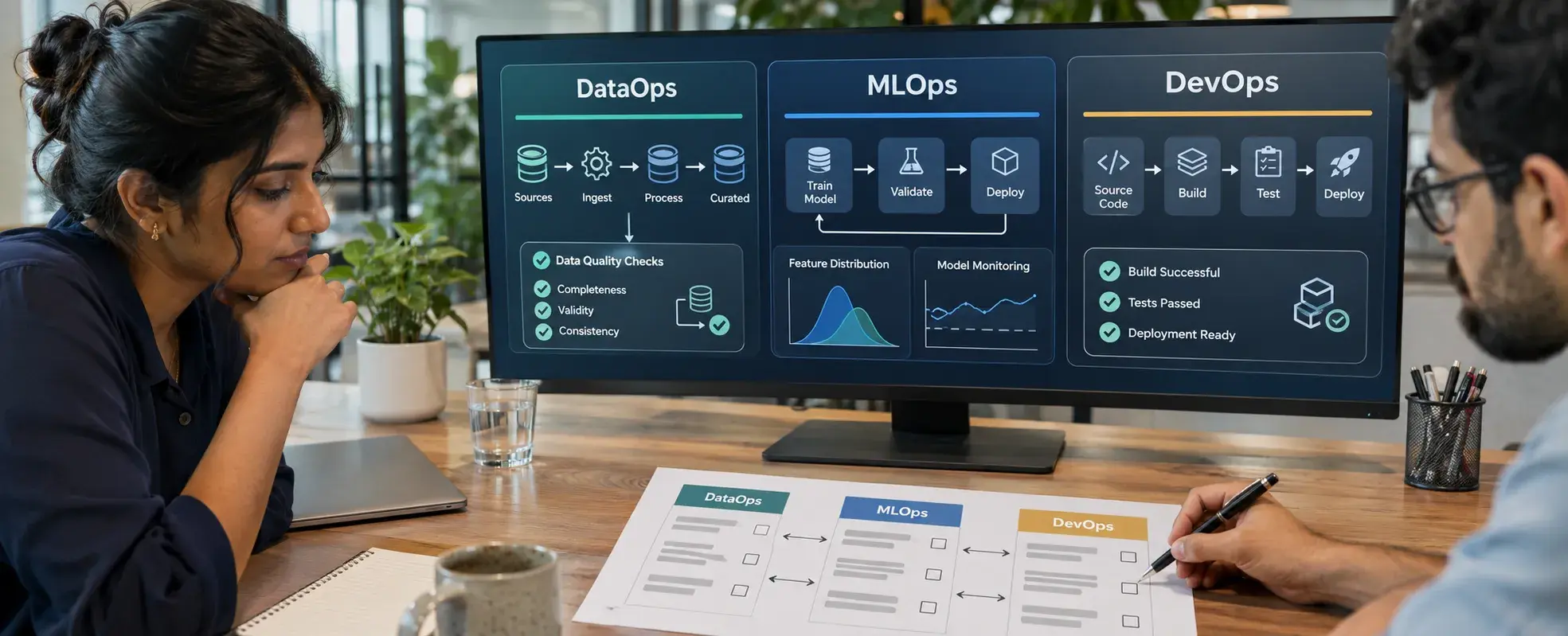
Prioritize the capability behind the failure that currently affects the business. The matrix below turns the DataOps vs MLOps vs DevOps comparison into a suggested starting point, not a mandatory sequence.
For a BI-only team, I would start with data reliability and delivery practices rather than fund model infrastructure with no identified use. For production predictive systems, evaluate the data and software foundations alongside model management.
The DevOps vs DataOps decision is often about where the missing controls belong, not which existing team should disappear.
What should the first rollout prove?
Choose one business-critical output and demonstrate that it can be delivered, checked, repaired, and handed over. Keep the first scope narrow enough to observe the result.
Record the baseline, define acceptable output, assign an owner, and rehearse a realistic failure. Keep the data pipeline automation in scope for that rehearsal, including the replay step. For the retail example, deliberately test late data in a safe environment and verify what purchasing sees.
Choose batch or streaming behavior according to the decision deadline. Our real-time analytics and streaming data guide provides related architectural context; the pilot should establish what timing your use case actually needs.
At handover, ask someone other than the original builder to identify the affected output and execute the agreed recovery. That exercise gives the buyer evidence of ownership, not just installation. If you bring in MLOps consulting support, ask the supplier to run this rehearsal with your team before sign off.
How do you move from labels to a working plan?
Bring one disputed report, unreliable pipeline, or difficult model release to the discussion. Ask for a map of the data path, software releases, approval points, and people accountable for each decision.
Use Deuex Solutions’ AI, ML and DataOps services to scope that assessment and a bounded pilot before committing to a wider platform program.
The right operating model is the one that makes an unreliable business output easier to verify, recover, and own.


Sanket Shah
CEO & Founder
I am Sanket Shah, founder and CEO of Deuex Solutions, where I focus on building scalable web mobile and data driven software products with a background in software development. I enjoy turning ideas into reliable digital solutions and working with teams to solve real world problems through technology.