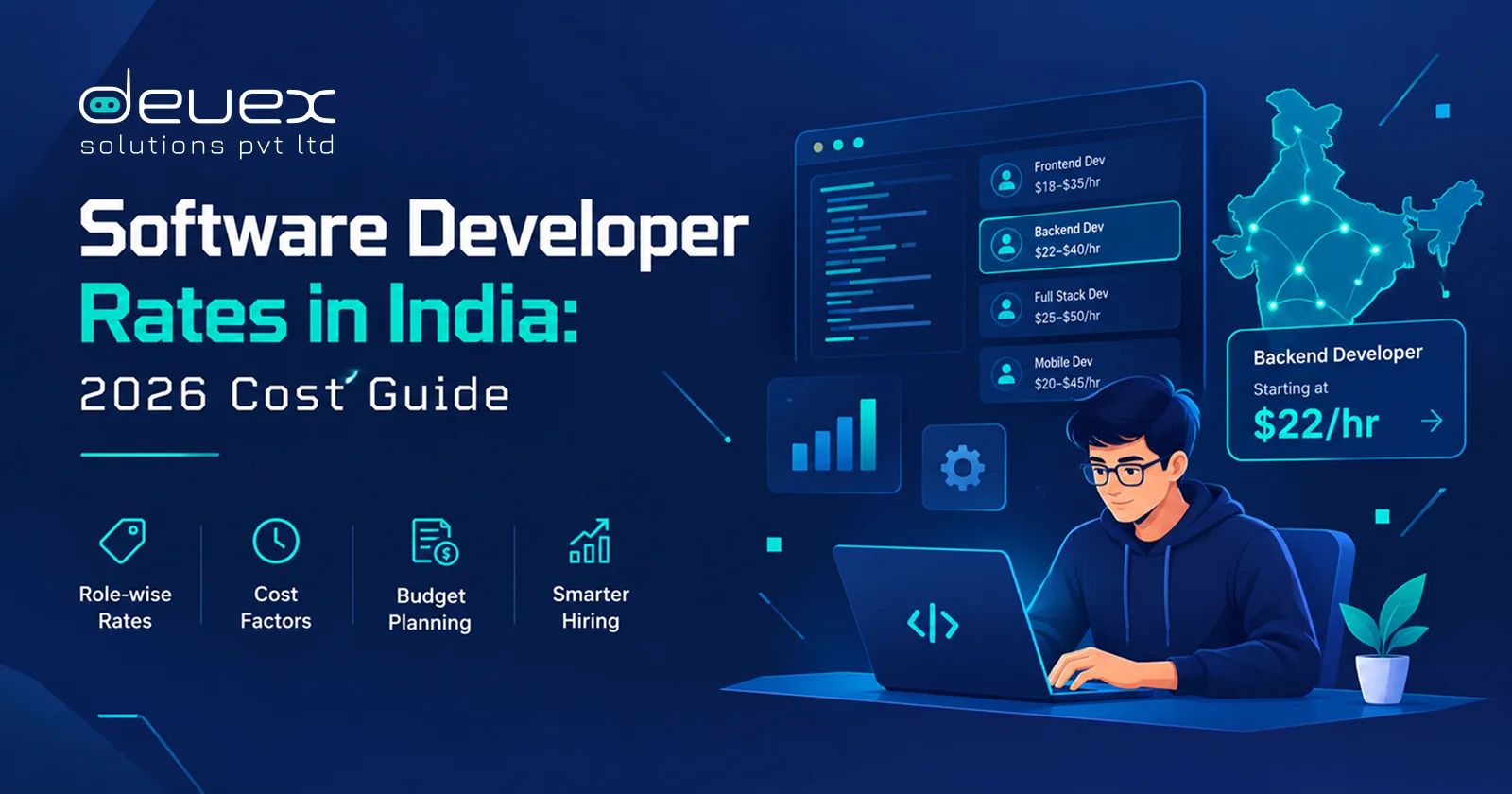
For buyers comparing software developer rates India 2026, published offers include backend developers starting at USD 22 per hour, according to Bacancy’s hiring page. That is one supplier’s starting price, not an India-wide average or a complete project budget. Bacancy
Next review: January 2027
Quick Summary / Key Takeaways
- Compare the same role, commitment, deliverables, and support terms before comparing hourly prices.
- Keep employee salaries, contractor fees, and managed-team charges in separate budget categories.
- Calculate estimated hours and additional delivery costs, not just the advertised hourly rate.
- Request an evidence-based estimate and test uncertain assumptions before committing to a larger build.
For a web project, the scope behind Web Application Development Services should be clear before requesting a rate. This guide examines buying and budgeting decisions rather than promoting one hiring model.
What are you actually buying when you hire a developer?
You might be buying individual engineering time, reserved monthly capacity, or responsibility for delivering a working product. Treat these as different purchases.
Consider an illustrative example, not a client case. An operations head approves a developer for a customer portal, expecting the supplier to manage design, testing, and deployment. The supplier expects approved designs, a prioritized backlog, and someone on the buyer’s side to review the work.
Neither expectation appears in the hourly-rate line.
Before negotiating the number, write down who owns requirements, architecture, testing, release approval, and production support. A lower price is meaningful only after those responsibilities match.
We would ask one question before everything else: What will our team still have to do after we pay this invoice?
What published developer prices can buyers verify in 2026?

The following are supplier-published offers checked on October 23, 2026. They are a small, nonrepresentative sample, not a salary survey, market average, supplier ranking, or Deuex rate card.
Do not average these figures. A team price and an individual rate have different denominators.
The Apex36 numbers illustrate how one supplier prices seniority. They do not establish what every junior or senior engineer in India should cost. PixelCrayons’ separate INR and USD prices are published local prices, not a currency-conversion formula.
Use the table to challenge a proposal’s structure, then request a dated quotation for your actual role and workload. For a broader directory view beyond supplier-owned pricing pages, compare verified client reviews and company profiles in Clutch’s India software-development directory.
How should you compare junior, mid-level, and senior developers?
Compare the decisions each person must own, not just their title. Our suggested evaluation is to match the responsibility to the work you are buying.
For well-defined interface tasks, ask whether a developer can follow your design, handle error states, and submit reviewable changes. For feature ownership, assess whether they can clarify requirements, manage data changes, and demonstrate the completed workflow.
For architecture-heavy work, ask the proposed senior engineer to explain failure handling, access boundaries, deployment, and maintenance. Request an example relevant to your system, not an impressive but unrelated technology presentation.
This is a purchasing framework, not a claim that every senior developer is faster. A higher rate needs a reason you can inspect.
Ask who reviews the code when the assigned engineer gets stuck. Then confirm whether that review time is included, separately billable, or your responsibility.
What should you know about developer hourly rates in Mumbai?

A Mumbai-specific supplier example is more defensible than an unsupported city average. Code B’s hiring plans list USD 25/hour for hourly work and USD 2,200/month for its full-time plan, with 40 hours per week and a three-month contract period; the page identifies its India delivery center in Mumbai. Code B Solutions Pvt Ltd
Those are that company’s advertised terms. They do not prove a Mumbai-wide rate or a standard discount for monthly hiring.
When comparing developer hourly rates Mumbai buyers receive, separate remote delivery from regular on-site attendance. Ask whether travel, workshops, office access, and particular working hours change the quote.
Then compare named engineers against the same scope. A city label alone does not tell you which person will review a difficult data migration or support a failed release.
We would not apply a fixed Mumbai premium without comparable quotes supporting it. For a project-specific proposal, discuss software development services in Mumbai with our delivery team.
Which engagement model fits your project?
Choose the model according to how much you know about the scope and how much delivery management you can provide. These are suggested decision criteria, not promises about any supplier’s standard contract.
A fixed price does not mean unlimited requirements. A monthly commitment does not, by itself, promise a particular number of completed features.
Decide what you need to control: capacity, expenditure, scope, or an accepted outcome. Then check whether the proposed contract actually gives you that control.
For feature and scope planning, the existing web application development cost guide covers a different question from this article: what goes into the product budget itself.
How do you calculate software development cost in India?

Build the estimate from work packages, role-specific rates, and agreed inclusions. Keep the labor subtotal separate from tools, infrastructure, customer-side effort, and post-launch support.
A useful planning formula is:
Delivery budget = agreed labor charges + separately priced delivery work + third-party charges + approved contingency.
For a hypothetical hourly assignment using the USD 25 rate in the Mumbai example, the arithmetic is straightforward:
These hours are invented planning inputs, not vendor estimates. The table does not price a particular application, assume a completion date, or include separately billed design, QA, hosting, taxes, or support.
Now examine the more useful sensitivity. At 480 hours, reducing the rate by USD 2 saves USD 960. An additional 80 hours at the original USD 25 rate adds USD 2,000.
That calculation does not prove rate negotiation is pointless. It shows why the effort estimate deserves at least as much scrutiny as the rate.
For INR budgets, request an INR quote. For UAE buyers paying in USD or AED, record the invoice currency, conversion rule, bank charges, and payment dates instead of applying an undated exchange rate.
What does research say about development estimates?
Research supports being careful about how an estimate was produced, but it does not provide a current India rate card.
Magne Jørgensen and Martin Shepperd’s 2007 study, A Systematic Review of Software Development Cost Estimation Studies, examined 304 papers across 76 journals. It highlighted gaps in real-world evaluation and concerns about how datasets were selected when assessing estimation methods.
This is foundational research about estimation, not evidence of 2026 prices. Our practical takeaway is to ask what makes the supplier’s reference projects comparable to yours.
Request the work breakdown, major assumptions, excluded tasks, and the conditions that could change the estimate. Where access to an old system is still uncertain, price the investigation before pretending the whole connection is understood.
A transparent estimate can be challenged. A confident total without assumptions cannot.
Which costs should sit outside the developer rate?
Ask for an explicit inclusions schedule. Do not assume that a reference to a delivery team means every discipline is included at unlimited capacity.
Have the supplier mark discovery, UX design, engineering review, QA, security assessment, deployment, data migration, training, and ongoing support as included, excluded, or separately priced. Assign an owner to every excluded item.
For software licenses and cloud services, ask who purchases the account, who can administer it, and who pays when usage increases. Request links to the actual vendor pricing pages in the proposal rather than an unsupported flat allowance.
For example, a reporting project should distinguish the engineer’s time from BI user licenses, embedding capacity, warehouse processing, and data preparation. This is a budget checklist, not a claim that every reporting product needs every charge.
The Deuex services overview can help identify workstreams to discuss, but the signed scope must define what your particular engagement includes.
How should India and UAE buyers compare outsourcing rates?
Normalize the commercial terms before comparing outsourcing rates India suppliers quote. Use the same role, availability, delivery scope, currency, and acceptance standard in each request.
A useful comparison should also identify the contracting entity, subcontracting arrangements, agreed working-hour overlap, and escalation contact. Ask finance and legal advisers to confirm the applicable tax, payment, and intellectual-property terms for your arrangement rather than assuming a cross-border invoice has one standard treatment.
Set repository access, cloud-account ownership, documentation, and handover expectations before onboarding. Specify what happens if the assigned engineer leaves or the engagement ends early.
For a business lead, the practical question is not whether the supplier can join a video call. It is who can make decisions when a requirement is unclear and who accepts the completed work.
Give that responsibility a name on both sides.
Should AI tools automatically reduce the development bill?
Do not apply an automatic discount simply because a supplier uses AI. Ask what changes in the estimated effort, what review remains necessary, and how any savings affect your commercial agreement.
Joel Becker, Nate Rush, Elizabeth Barnes, and David Rein’s 2025 research paper, Measuring the Impact of Early-2025 AI on Experienced Open-Source Developer Productivity, covered 16 developers completing 246 tasks in a randomized study. In that particular setting, allowing early-2025 AI tools increased completion time by 19%. arXiv
That result is not a verdict on today’s tools or all development work. In its February 2026 research update, METR said selection effects and measurement difficulties made its newer experiment an unreliable estimate of the current productivity effect. The researchers thought newer tools likely provided more benefit, but could not confidently quantify the change from that evidence. Metr
Our recommendation is a measured pilot on representative work. Compare accepted output, elapsed time, review effort, and defects against the agreed baseline.
An hourly contract, a monthly capacity contract, and a fixed deliverable do not reward time savings in the same way. Decide how improvements will be reflected before treating AI adoption as a budget reduction.
How can you reduce spending without buying an incomplete product?

Reduce uncertainty and unnecessary scope before removing the work needed to accept a release. Start with one business journey and define what a user must successfully complete.
For an illustrative customer portal, that could mean signing in, viewing an authorized order, downloading the correct document, and contacting support. A configurable report builder can remain outside the first release unless it is necessary to test the business case.
Our MVP development guide explores that narrower first-release approach. Use it to decide what deserves funding now rather than assuming every requested feature belongs in the first contract.
For an existing application, buy a bounded technical assessment where the unknowns sit. Ask the team to inspect the relevant code, APIs, and data, then revise the estimate with evidence.
That is not a promise that discovery always saves money. It gives you a clearer decision before committing more of it.
What should you ask before signing a developer agreement?
Request a proposal you can reconcile with an invoice and a working result. Our suggested buying checklist has four parts:
- People: Name the assigned engineers, responsibilities, reviewers, and replacement arrangements.
- Scope: Define deliverables, exclusions, acceptance tests, and who supplies designs, data, and decisions.
- Money: Record rates, reserved hours, billing increments, spending caps, extra-work approvals, and renewal terms.
- Ownership: Confirm repository access, third-party accounts, documentation, handover, and support boundaries.
For ongoing work, request a review showing approved tasks, accepted results, actual hours, remaining estimates, and unresolved risks. Do not use hours alone as proof of progress.
Agree how blocked time is handled when your team cannot supply access or a decision. Equally, document how the supplier handles defects against the accepted specification so correction work does not become an argument after every release.
The DevOps consulting guide offers related reading on release ownership and operational handover. Keep those responsibilities visible even when the immediate purchase is one developer.
How do you turn a rate comparison into a buying decision?
Choose the proposal whose assumptions you can inspect, not simply the price you can approve fastest. Put the rate beside the expected hours, acceptance criteria, included specialists, and continuing costs.
For dashboard or reporting projects, bring your source systems, intended users, sample reports, and licensing questions to Deuex Solutions’ Data Visualization and Analytics Services. Define the deliverable and operating costs before committing to developer capacity.
If you need a software development company in India to own delivery rather than supply hours alone, compare responsibility, acceptance criteria, and support as carefully as the rate.
Buy a clear responsibility for the work, not an unexplained number of hours.


Sanket Shah
CEO & Founder
I am Sanket Shah, founder and CEO of Deuex Solutions, where I focus on building scalable web mobile and data driven software products with a background in software development. I enjoy turning ideas into reliable digital solutions and working with teams to solve real world problems through technology.