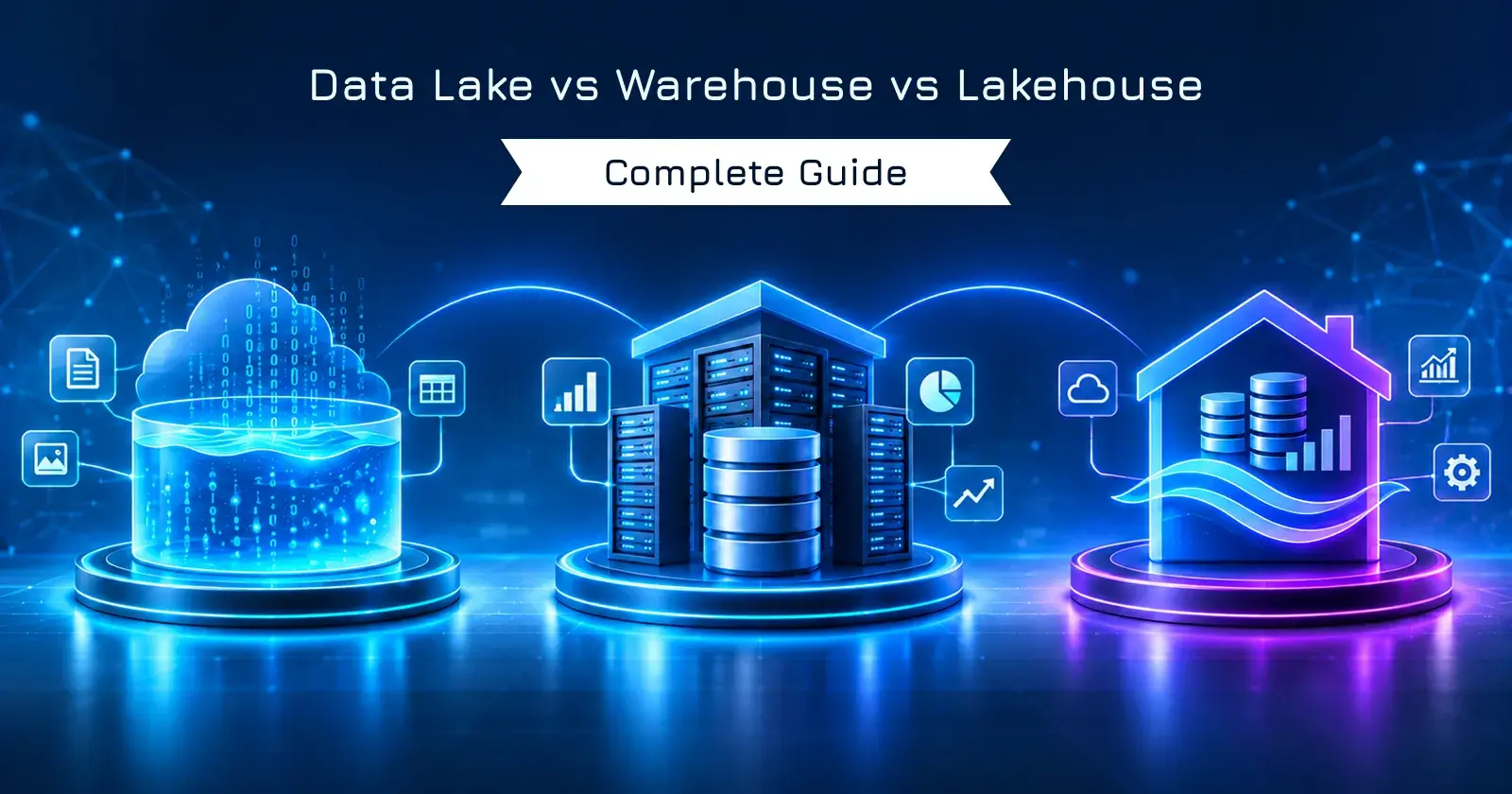
For data lake vs warehouse vs lakehouse, start with the workload: a lake retains varied source data, a warehouse serves curated analytics, and a lakehouse adds transactional table management to lake storage. Choose against reporting, AI, governance, and ownership costs rather than assuming the newest label wins.
These starting distinctions follow AWS’s comparison of lakes and warehouses and Delta Lake’s technical documentation. Actual product capabilities overlap.
For buyers evaluating Big Data Application Development Services, begin with the decisions people must make, the data they need, and the conditions under which that data can be trusted.
Quick Summary / Key Takeaways
- Choose around workloads and operating responsibilities, not storage labels.
- Separate raw retention, trusted analytical tables, and the interfaces serving business users.
- Compare ingestion, compute, governance, maintenance, and migration costs alongside storage.
- Pilot one business domain before committing to a wider replacement.
What decision comes before the architecture?
Define the outcome the platform must support. Every modern data architecture decision starts there. Then identify what must be stored, prepared, protected, and served to achieve it.
Consider an illustrative manufacturer operating in India and the UAE. Finance needs reconciled revenue, maintenance teams retain equipment photographs and sensor readings, and data scientists want to investigate failures.
A request to “put everything in one place” does not explain those needs. Ask whether finance requires a fixed reporting cut-off, whether maintenance needs original files, and which historical inputs the predictive model must reproduce.
My starting point would be one acceptance exercise: trace a reported number back to its approved inputs, then correct a late source record without losing the audit trail. The architecture should make that exercise understandable, not merely possible.
Data lake vs warehouse vs lakehouse: what changes?
The differences concern how data is organized and made usable, not simply where it resides. Treat the following as architectural patterns rather than guarantees attached to every product.
The practical distinction is how much preparation and management the proposed system provides, and how much your team must assemble. “Enterprise” should describe the operating requirements, not substitute for them.
Does schema-on-read mean you can skip data modeling?
No. It means some interpretation can happen when data is consumed rather than requiring every input to fit a predefined analytical model before storage. Ask where validation happens and who approves the result.
A file containing an amount and currency still needs an agreed meaning before it becomes a regional revenue measure. Storing the original record preserves options; it does not settle exchange rates, canceled orders, or reporting dates.
Avoid the opposite simplification too. Google’s BigQuery JSON documentation describes querying semi-structured information without forcing every field into a rigid STRUCT schema. A modern warehouse is not limited to fixed spreadsheets.
For lakehouse tables, Apache Iceberg’s schema evolution documentation explains supported changes such as adding, dropping, and renaming fields through metadata updates. That capability does not decide whether a changed field still means the same thing to finance.
Schema flexibility and semantic consistency are different requirements. Specify both in the acceptance plan.
What actually makes a lakehouse different from a folder of files?
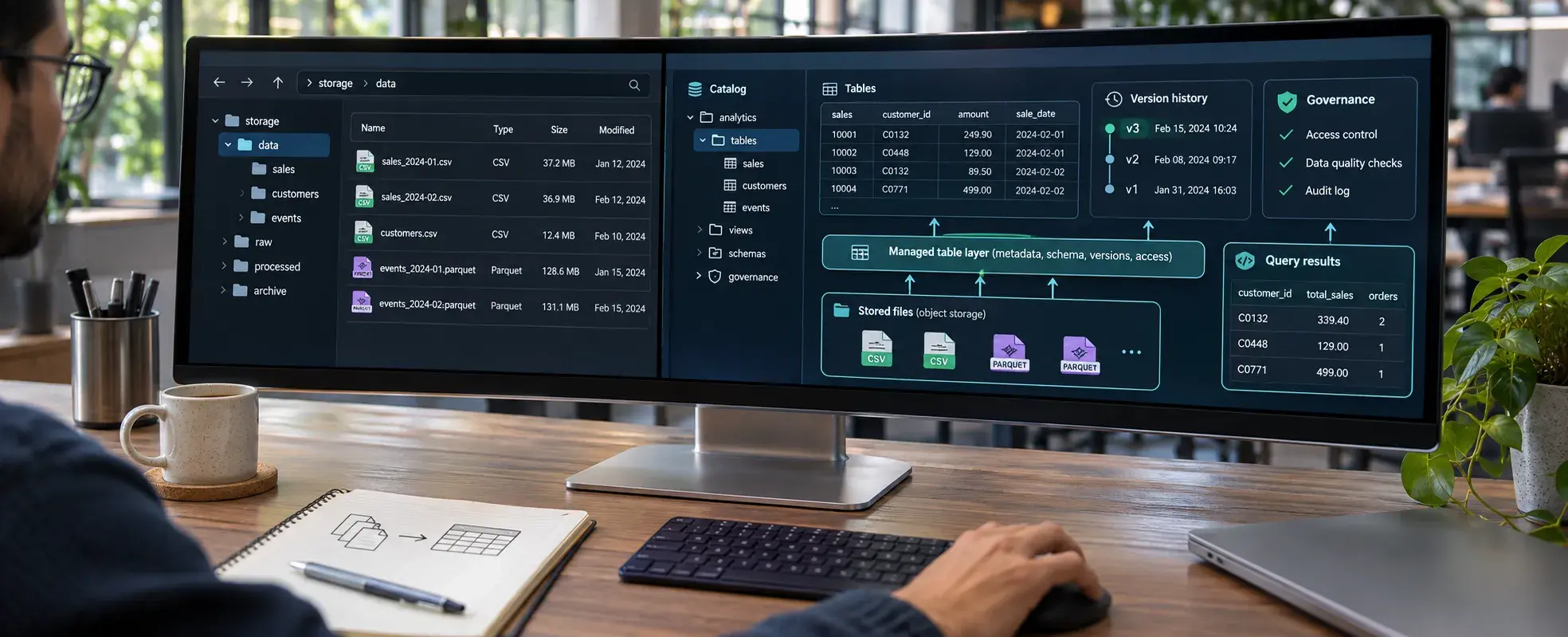
Look for table-level consistency, metadata, query access, and an operating model around the stored data. Those four elements are what a data lakehouse architecture should add. A collection of files alone does not provide all those capabilities.
Apache Iceberg’s reliability documentation describes snapshots, atomic table updates, consistent reads, and concurrent write handling. These mechanisms let compatible engines work with defined table versions rather than treating a directory listing as the complete state of a table.
For procurement, separate the file format, table format, catalog, and compute engine. Ask which component records the current table state, which engines may change it, and which operations each engine supports.
Also ask about transaction scope. A guarantee for one table should not be interpreted as a guarantee that several tables will update together.
That question matters when an order, payment, and inventory movement must reconcile. Require a demonstration of the intended consistency behavior rather than accepting “ACID” as a complete answer.
Why do current warehouse and lakehouse products overlap?
Because the product name no longer determines every storage and processing choice. Compare the documented capabilities of the proposed configuration, not an outdated category diagram.
Microsoft Fabric’s warehouse and lakehouse decision guide says both store data in Delta format in OneLake and share a SQL engine. The guide still distinguishes their development approaches and transaction capabilities.
Snowflake’s Iceberg table documentation describes using open-format tables with externally managed cloud storage, alongside catalog and feature-specific conditions. A warehouse-oriented platform can therefore participate in an open-table architecture.
Our recommendation is to treat openness as a test. Can another approved engine read the required tables, preserve the needed semantics, and enforce the intended access rules? Test writes and recovery separately.
Do not translate “open format” into “zero migration work.”
How should governance work across all three?
Require named owners, approved definitions, access boundaries, lineage, quality checks, and retention decisions. Do not assume a lake lacks governance or that a lakehouse automatically supplies it.
AWS Lake Formation documentation describes centralized permissions and fine-grained controls for lake data through supported services. This is a concrete example of governance capabilities around lake storage.
Test the complete access path. In our illustrative manufacturer, restrict a regional analyst’s access through the dashboard, notebook, exports, and underlying storage credentials. Record which paths are permitted and how access is revoked.
For India and UAE operations, request the actual locations of primary data, backups, logs, and administrative access. Have qualified advisers assess the relevant obligations rather than treating an architecture label as compliance evidence.
Our single source of truth guide discusses the related ownership and definition questions. A shared metric needs an accountable owner even when its records sit in one platform.
What does research establish about data lakes and lakehouses?
Two research papers help explain the design choices behind the data lake vs warehouse vs lakehouse debate. Neither provides a universal current ranking or a guaranteed cost saving.
What does the data lake survey show?
Rihan Hai, Christos Koutras, Christoph Quix, and Matthias Jarke published Data Lakes: A Survey of Functions and Systems in IEEE Transactions on Knowledge and Data Engineering in 2023.
The survey organizes lake capabilities around ingestion, maintenance, and exploration, including metadata, discovery, cleaning, and provenance. It examines systems and research problems rather than proving that one commercial platform wins.
The purchasing lesson I take from it is straightforward: budget for making stored data discoverable and usable, not only for storing it.
What does the lakehouse research argue?
Michael Armbrust, Ali Ghodsi, Reynold Xin, and Matei Zaharia presented Lakehouse: A New Generation of Open Platforms that Unify Data Warehousing and Advanced Analytics at CIDR 2021.
The paper proposes combining open data access, management features, and analytical performance. It includes benchmark results for the authors’ system. The authors have Databricks affiliations, and the paper is an architectural argument with system-specific evidence, not an independent 2026 buyer comparison.
Its useful question is whether your workloads can share managed data without unnecessary movement. Its forecast about replacing warehouses should not become your migration plan without testing.
Which architecture performs best for analytics?
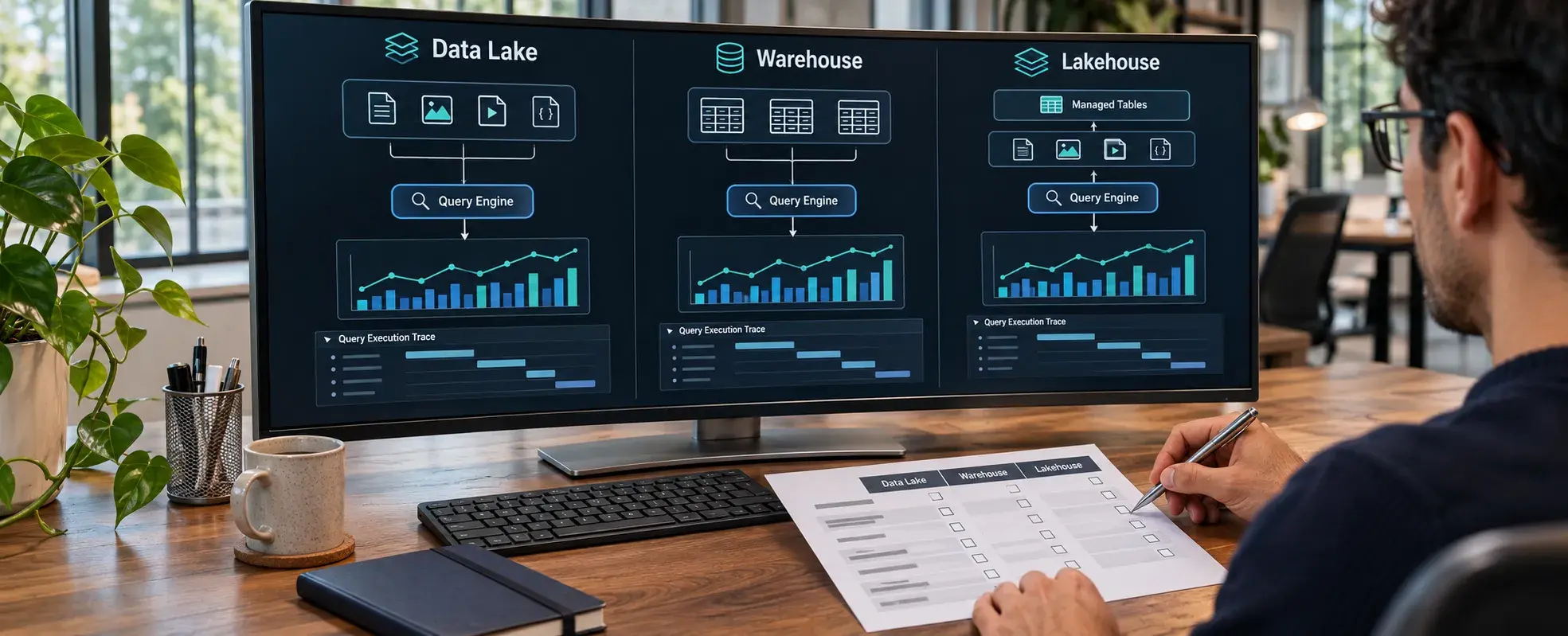
Test the workload you intend to operate. The sources reviewed do not justify declaring every warehouse faster than every lakehouse, or every lakehouse cheaper at equivalent performance.
Require comparable data volumes, query mixes, freshness, security rules, and concurrency on each shortlisted big data platform. Measure cold and warm runs, ingestion delay, long-running queries, and the effect of corrections while dashboards are active.
For enterprise-scale acceptance, include skewed data, large joins, and a period when batch processing overlaps with reporting. Record the compute configuration and cost alongside response time.
Our recommendation is to test the user’s experience, not just one query. How long does it take to open the report, apply filters, and obtain a result that includes the agreed source updates?
The Power BI vs Tableau vs Looker comparison addresses the reporting layer separately. Keep its behavior in the pilot rather than assuming a fast query automatically produces a responsive dashboard.
Which option fits AI and machine learning workloads?
Start with the model’s required inputs and evaluation workflow. Do not assume that choosing a lakehouse creates an AI-ready dataset or that an enterprise data warehouse excludes machine learning.
Google’s BigQuery ML documentation describes building and evaluating models through SQL and other supported interfaces. That is direct evidence that warehouse-centered analytics can include ML capabilities.
For the manufacturer’s maintenance model, our suggested assessment would include original sensor readings, relevant image files, event timestamps, labels, and a reproducible training dataset. Test the cost and effort of preparing those inputs in each shortlisted design.
For a document assistant, map how approved content becomes searchable, how permissions are preserved, and how corrections reach the retrieval layer. Price that path separately from the storage platform.
A lakehouse can be part of the data foundation. It is not the entire model development or AI serving system.
How should you compare total cost and licensing?
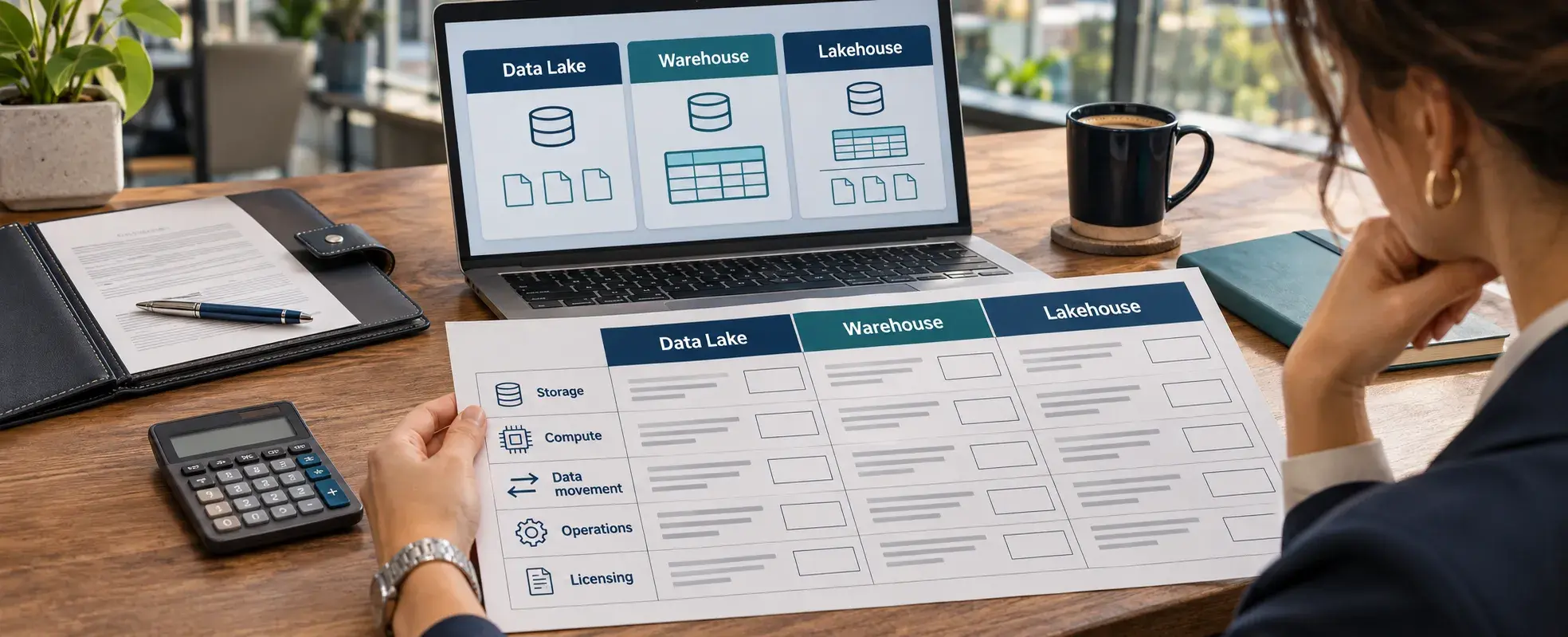
Build a workload-based ownership estimate. Do not compare object storage price alone with a complete managed analytics service and call the difference a saving.
The published charging structures illustrate why. Amazon S3 pricing separates storage from requests, retrieval, transfer, and other features. BigQuery pricing offers on-demand query processing and capacity-based compute, with storage and other charges considered separately.
Snowflake’s cost documentation describes compute, storage, and transfer costs, with some features carrying additional charging models. None of these pages establishes a fixed price for your complete architecture.
Use this budget worksheet across every candidate:
Lakehouse maintenance is a real budget item. Apache Iceberg’s maintenance guide covers snapshot expiration, old metadata and orphan file cleanup, and optional compaction. These are activities to assign, automate, and monitor, not evidence that a lakehouse is inherently expensive.
Request a three-year forecast using the same growth, retention, and service assumptions. For India and UAE purchasing, confirm invoice currency, deployment region, and local commercial terms rather than converting a headline price into a quotation.
How do you choose the right modern data architecture?
Choose the smallest operating design that meets the approved workload requirements and leaves a credible path for change. The matrix below turns the data lake vs warehouse vs lakehouse comparison into a recommendation framework, not a product capability guarantee.
For that final case, our real-time analytics and streaming data guide provides related context. Test whether the analytical store should serve the application directly or feed another serving system.
How should you migrate without replacing everything at once?
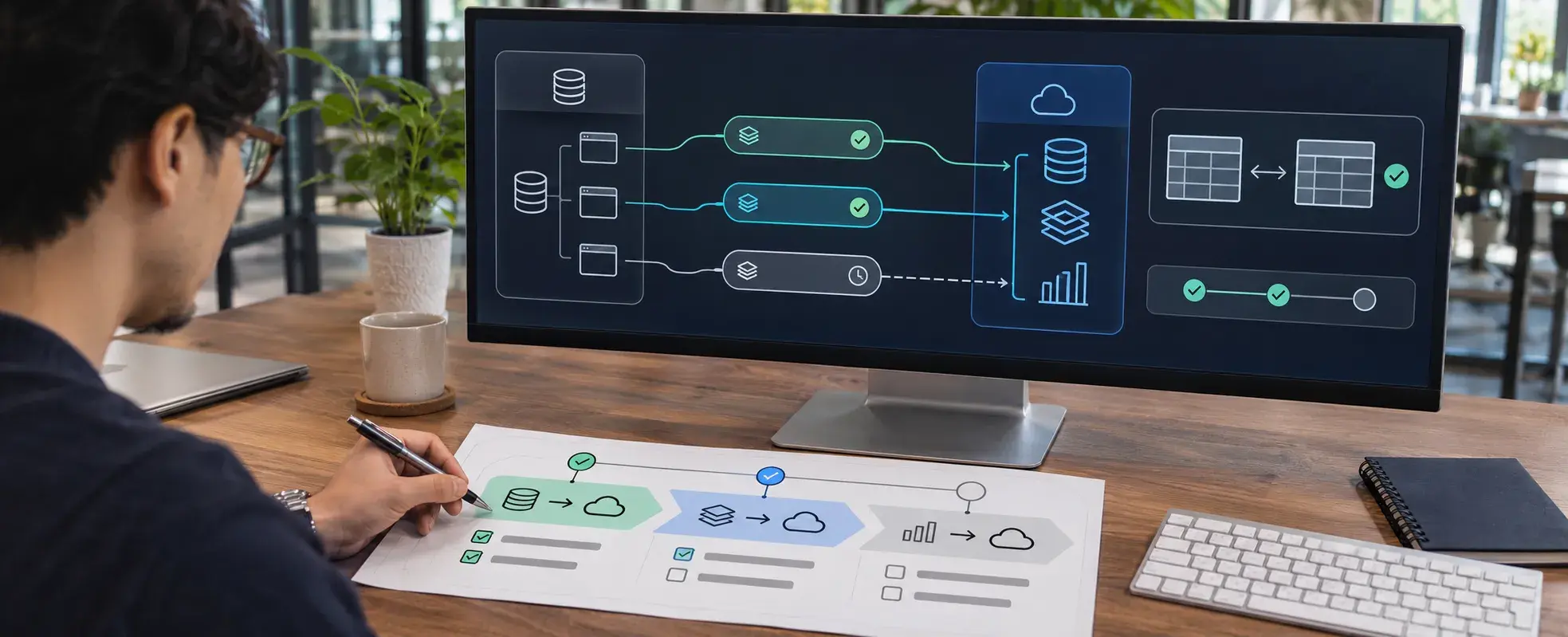
Move one business domain with explicit acceptance and rollback conditions. Our recommendation is to preserve working outputs until the replacement proves correctness, access, performance, and operating cost.
What should move from a lake to a lakehouse?
Choose a dataset that needs managed updates, reproducible versions, or shared analytical access. Assign table ownership, validate schema changes, and test the intended readers and writers.
Keep original inputs where justified by the agreed retention plan. Do not convert every historical file simply to make the architecture diagram uniform.
How should you move from a warehouse?
Inventory reports, transformations, scheduled jobs, access rules, and downstream consumers before translating queries. Reconcile equivalent outputs at the same business cut-off, including currency treatment, time zones, rounding, and late records.
Run both paths for an agreed validation period. Set exit criteria before starting so parallel operation has an end condition rather than becoming a permanent additional expense.
When should the systems coexist?
Keep both where each has a defined job and the ownership cost is justified. Document which dataset is authoritative, how derived copies are refreshed, and who investigates disagreement.
Use the Deuex services overview to separate engineering, analytics, application, and operational workstreams when scoping the change. The contract should identify each deliverable rather than hiding everything inside “platform migration.”
What should your team do next?
Bring a representative dataset, a business-critical report, an AI use case if relevant, and the current operating costs to one review. Ask the proposed architecture to prove correctness, access, performance, and recovery under those conditions.
For a bounded assessment, explore Deuex Solutions’ Big Data Application Development Services and request a pilot with measurable acceptance criteria before committing to a new big data platform.
Choose the architecture your team can operate and explain, not the label that makes the diagram look current.
About the author
Harsh Soni is a technical author at Deuex Solutions, focused on Python, vector search, and AI data systems. This guide examines data architecture through workload requirements, governance, and operating responsibility.


Sanket Shah
CEO & Founder
I am Sanket Shah, founder and CEO of Deuex Solutions, where I focus on building scalable web mobile and data driven software products with a background in software development. I enjoy turning ideas into reliable digital solutions and working with teams to solve real world problems through technology.