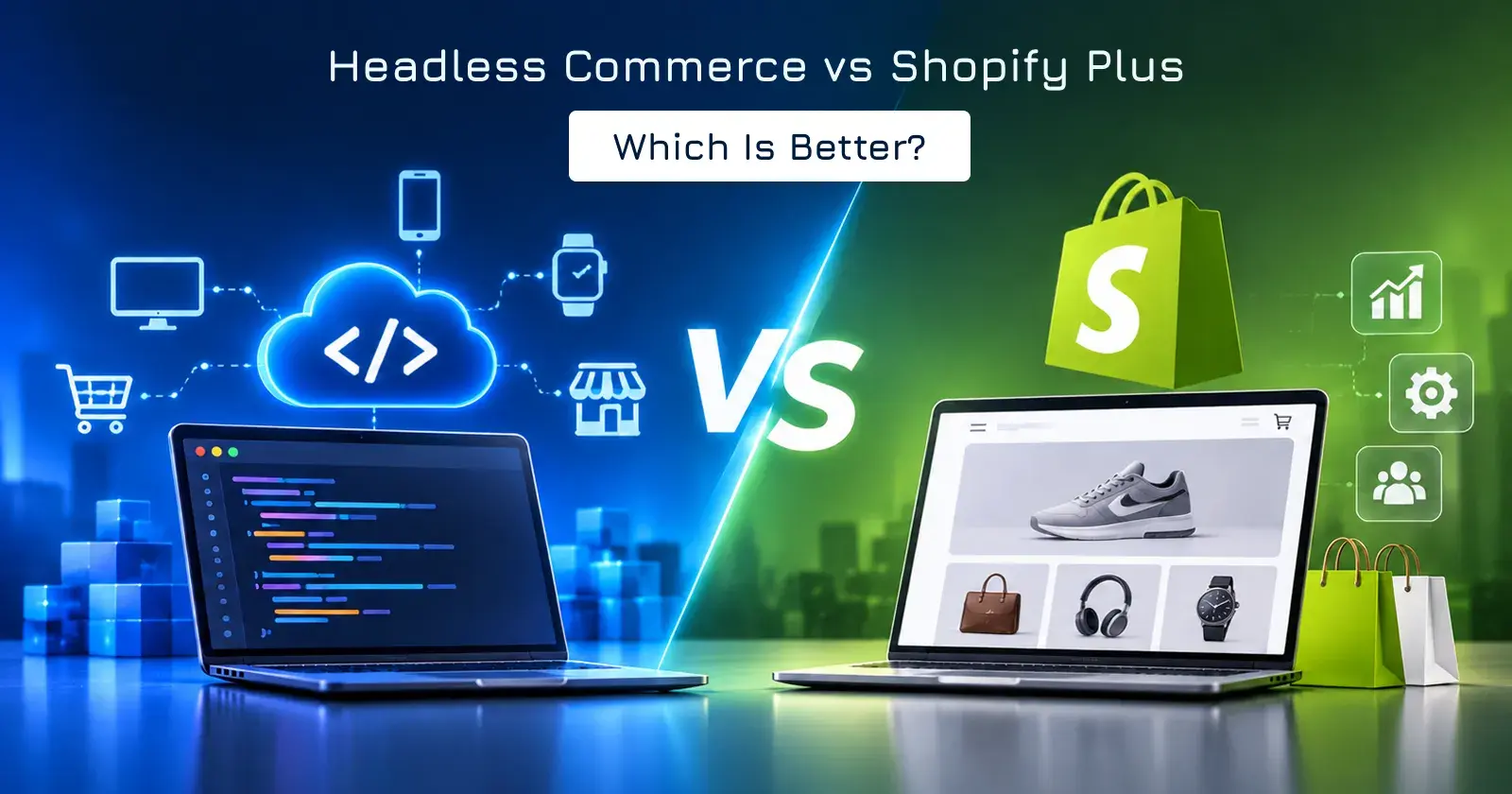
Headless commerce vs Shopify Plus compares an architecture with a platform: Shopify Plus can support a separate, custom storefront. Start with a Shopify theme if it meets your requirements; consider headless when distinctive buying journeys justify dedicated engineering. Shopify’s headless commerce documentation explains how the two work together.
Quick Summary / Key Takeaways
- Compare three options: Shopify Plus with a theme, headless Shopify Plus, and headless commerce using another backend.
- Test content publishing, checkout, payments, and fulfillment before choosing the architecture.
- Treat speed as a measured outcome. Include real customer journeys in the pilot.
- Budget for development, subscriptions, connections, maintenance, and eventual migration.
- Match the amount of custom software to the team available to maintain it.
For delivery planning, the Web Application Development Services page provides a starting point for scoping the storefront, business systems, and ongoing support.
What does headless commerce vs Shopify Plus actually compare?
Consider a fictional retailer selling in India and the UAE. During planning, its marketing lead asks for Arabic campaign pages, operations asks for accurate stock availability, and the CTO asks who will maintain the new storefront after launch.
Everyone agrees they need more flexibility. They mean different things.
Headless separates the customer interface from the commerce backend. Composable commerce extends the discussion to choosing and connecting capabilities such as content, search, and order management. For this comparison, a broader composable stack means independently selected services behind the storefront.
First identify the limitation: presentation, business operations, or both. Changing the frontend addresses a different problem from replacing the system that manages orders.
This ecommerce platform comparison should begin with requirements that someone can demonstrate. “More flexible” needs an example.
Headless does not itself require Plus. Shopify’s Oxygen environment documentation lists public storefront environments for Basic, Grow, and Advanced too. Evaluate the need for Plus features separately.
How much design and content freedom do you need?

In a headless commerce vs Shopify Plus evaluation, start by asking a merchandiser to publish a real campaign. Watch where the process stops.
Shopify’s theme editor supports changes to content, layout, typography, and colors through theme settings and sections, with a preview. That gives the team a concrete baseline to test before commissioning a separate publishing system.
For our fictional retailer, the request might be straightforward: publish a collection, change promotional copy, and update photography. Try it in the proposed theme. Record any unmet requirements.
If the business instead wants buying guides assembled from several content sources, unusual product configuration, or shared editorial content across multiple channels, prototype that exact experience. Include the work behind the screen.
Ask the editor to:
- Preview an unpublished product and its translated content.
- Schedule a campaign and withdraw it safely.
- Reuse an approved component without changing its design.
- Correct a mistake without waiting for a developer.
For headless ecommerce development, make those tasks acceptance criteria. My preference would be to see the publishing workflow demonstrated alongside the storefront, before approving the build.
What happens to checkout when you go headless?
A custom storefront does not give unrestricted control over Shopify checkout. Shopify’s Checkout UI extensions documentation describes specific extension points: UI extensions on the information, shipping, and payment steps require Plus, and extensions operate in a sandbox with limited components and APIs.
Validate the hardest checkout requirement early. That might be a delivery instruction, a company purchasing rule, or a regional payment journey. Ask for a working demonstration within the supported extension model.
There is a useful reminder in Baymard’s 2024 checkout research. Research lead Edward Scott describes more than 200 moderated user/site sessions across 16 retail sites. In one documented example, a payment validation error cleared all of the shopper's previously entered payment information, forcing her to reenter it.
This was qualitative industry research, not a platform ranking. Its practical lesson for procurement is simple: include error recovery in the demonstration. Ask what happens after a declined payment, an invalid address, or a failed retry.
Include a failed payment in the demo, then check whether the shopper can retry without rebuilding the cart.
How should you assess ERP, inventory, and app connections?
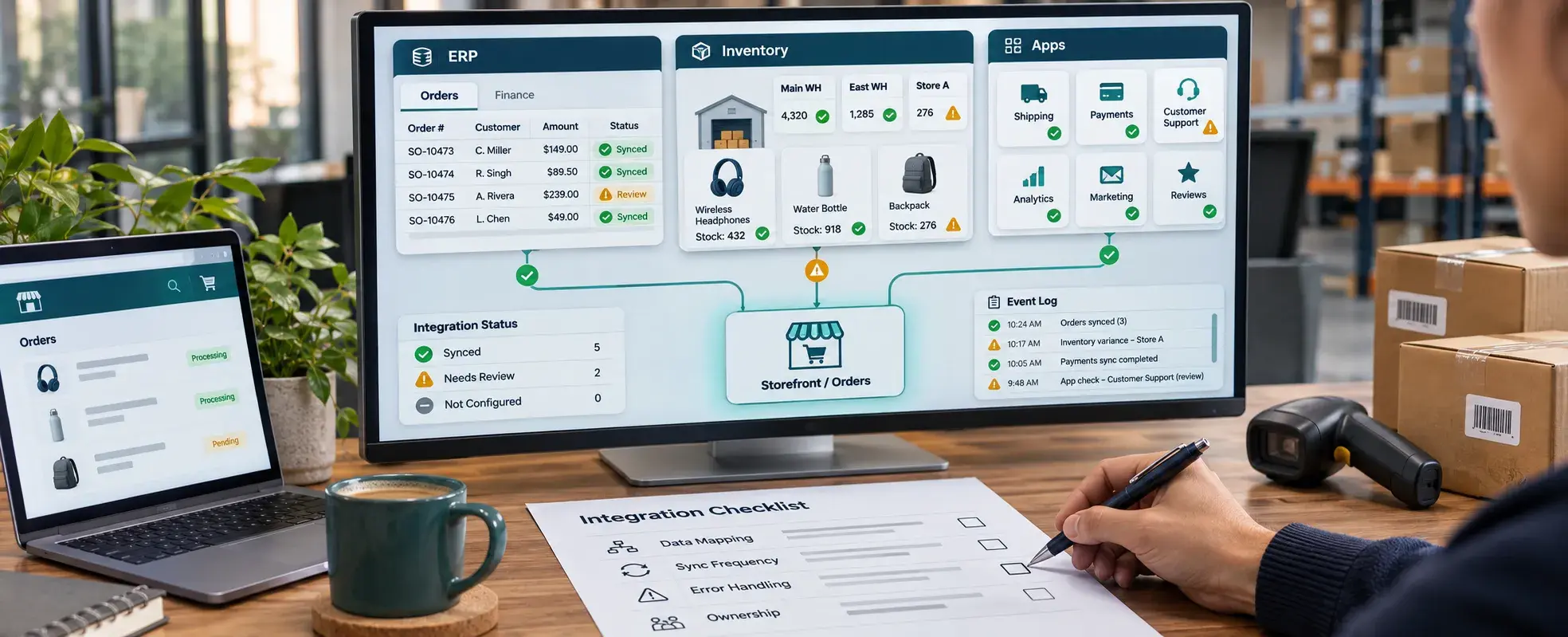
Map the required data flows before choosing the storefront. For each flow, name the authoritative system, the acceptable delay, and the person responsible when records disagree.
For example, determine whether the ERP or commerce platform controls available stock. Then decide how a cancellation restores it. Include partial refunds, split shipments, and product changes in the same discussion.
Shopify’s webhook guidance explains that event delivery and ordering are not guaranteed. It recommends reconciliation jobs, signature verification, and duplicate handling. Those requirements matter whether the storefront uses a theme or custom code.
An example acceptance rule: when Shopify records an order but the ERP is unavailable, retain the event for retry and alert the assigned operator. Prove that replay cannot create a duplicate ERP order. Agree on the permitted delay with operations.
App compatibility needs its own review. Shopify’s app blocks documentation describes content rendered inside themes. For an app that supplies such a block, ask the vendor how its customer interface will work on your proposed headless storefront.
Check loyalty, subscriptions, reviews, search, customer accounts, and tracking separately. A supported API and a ready customer interface are different deliverables.
Our guide to planning reliable API connections can help structure those questions. Put failure recovery and reconciliation into the scope, with an owner and a test case.
Is headless commerce faster than Shopify Plus?
Any headless commerce vs Shopify Plus speed comparison has no useful answer without a comparable workload. Set a performance target, build representative journeys, and measure both candidates under the same conditions.
Deloitte Digital and Fifty-Five’s 2020 mobile speed study, commissioned by Google, examined 37 brand websites in Europe and the US over four weeks. It found associations between mobile speed and purchasing behavior. The study observed natural speed fluctuations, and its reported findings excluded some observations with minimal or no effect.
That evidence supports testing speed as a business concern. It does not establish that a headless migration will increase conversion, or that one commerce platform is inherently faster.
For your pilot, use the same product images, analytics, consent behavior, search requirements, and delivery calculations. Measure loading and interaction on devices and connections representative of customers in your target markets.
Then test the whole journey. Can someone change a variant, recover a cart, select delivery, pay, and receive confirmation?
Approve performance against your own agreed targets. Keep a lightweight demonstration separate from a production candidate carrying the services your business actually needs.
What changes when you sell across India and the UAE?
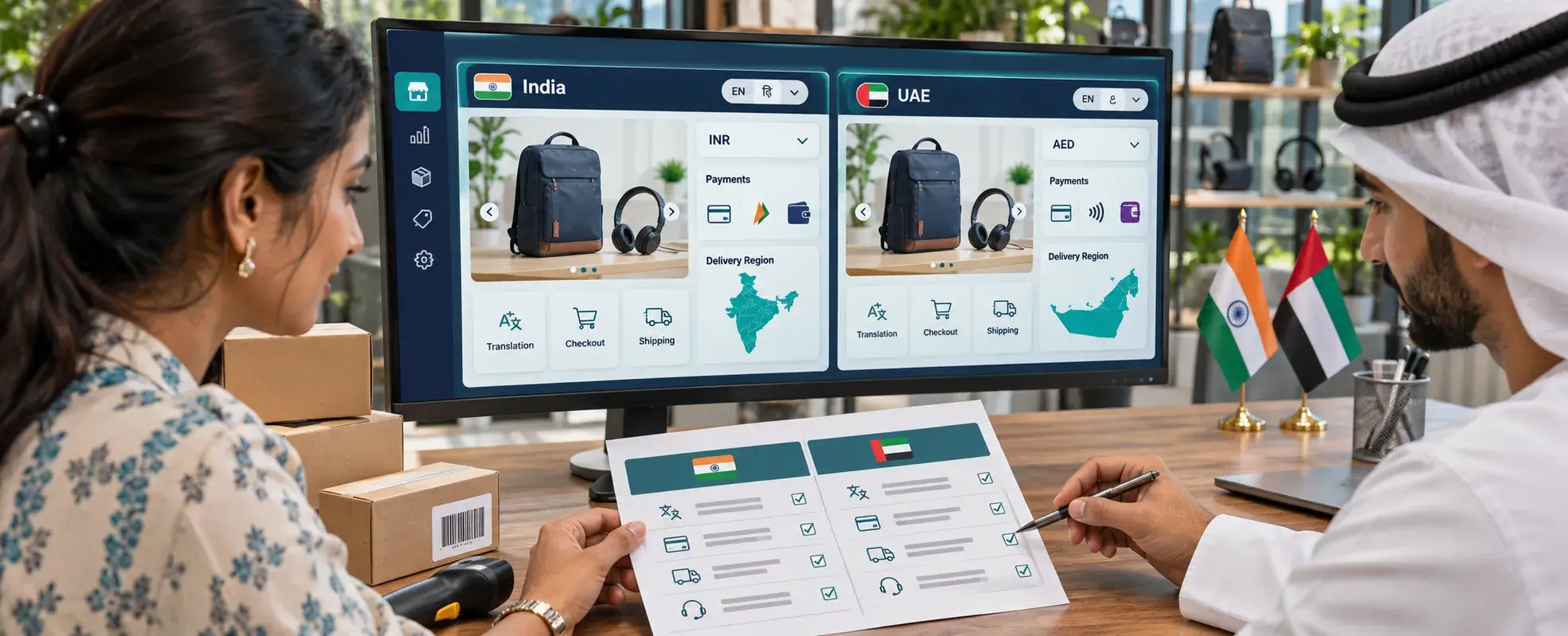
Separate language, displayed currency, accepted payment, settlement, and fulfillment requirements. Test each against the business entity that will sell to the customer.
According to Shopify’s Markets requirements, accepting payments in multiple currencies requires Shopify Payments or Adyen. With another processor, customers pay in the store’s default currency. Markets also requires configured shipping rates for the countries where you sell.
As checked on November 23, 2026, Shopify Payments’ supported country list includes the UAE and does not include India. Eligibility still depends on business type, verification, and the applicable country requirements.
For the fictional retailer, this suggests separate checkout tests for its Indian and UAE operations. An Arabic storefront preview would not answer whether the intended entity can accept and settle the intended payment.
Test local addresses, right-to-left layouts, refunds, delivery promises, and the finance team’s reconciliation process. Ask the implementation partner to document unsupported combinations before contracts are signed.
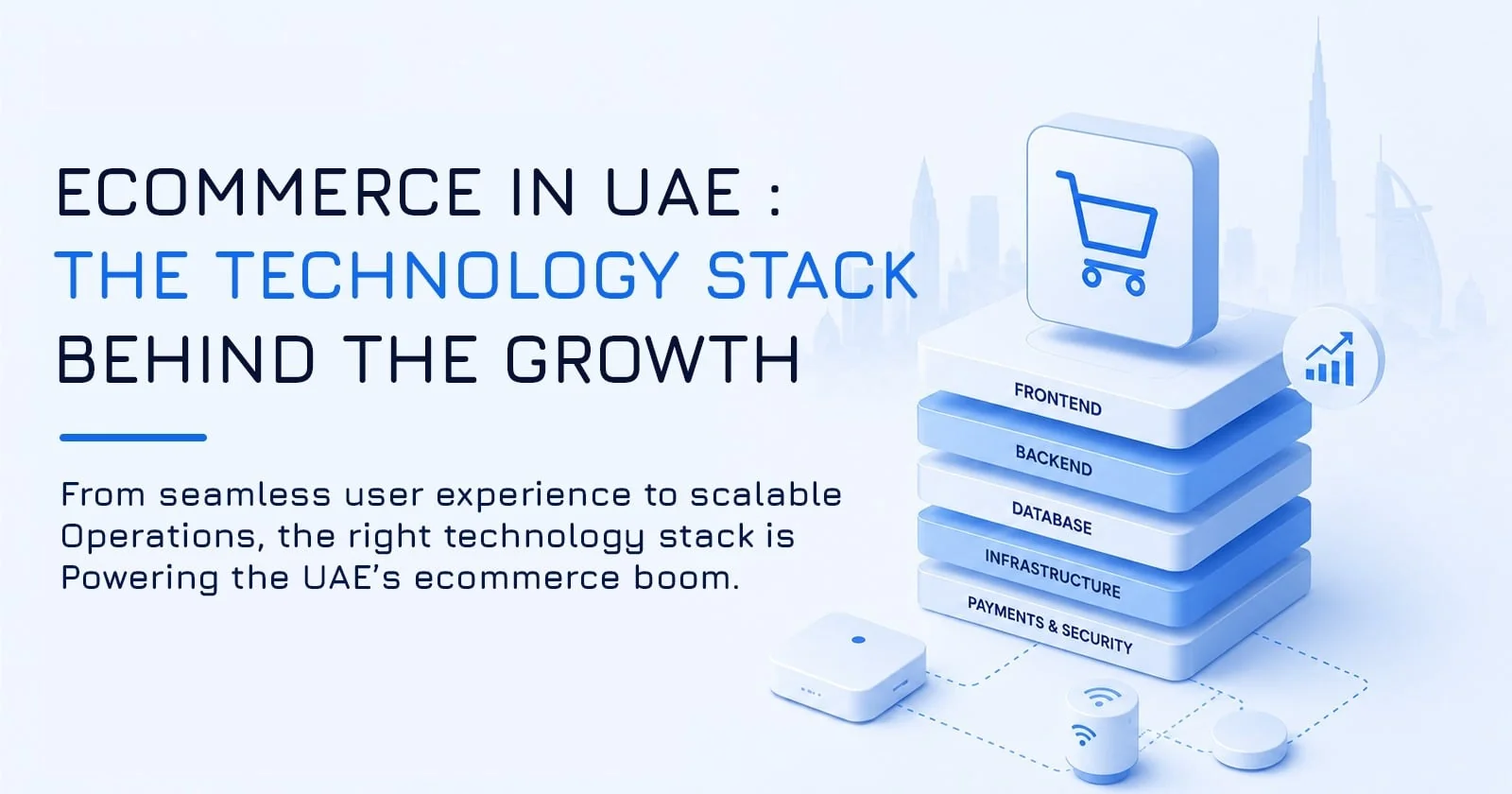
For broader operating considerations, see our discussion of ecommerce technology choices in the UAE.
What does Shopify Plus cost, and what does headless add?
Start with the platform contract, then price the delivery and operating scope separately. Headless is not a single product with a standard subscription price.
Shopify’s published Plus pricing lists these starting monthly fees for standard setups, checked November 23, 2026:
Shopify says complex or higher-volume businesses may pay a variable platform fee based on revenue and business model. Custom development, themes, and apps can add charges. Payment provider fees and Shopify’s applicable third-party transaction fees need separate consideration.
These are platform prices, not complete project quotes. Confirm tax treatment, billing currency, transaction terms, and renewal conditions in the proposal.
To make the commitment concrete, multiplying the published ₹175,000 monthly rate by 36 gives ₹6,300,000 across the three-year term. That calculation excludes development, payment fees, other services, and taxes.
For headless ecommerce development, ask suppliers to price these additional work packages explicitly:
- Storefront engineering and the editorial workflow.
- App replacements or custom customer interfaces.
- CMS, search, hosting, and monitoring where required.
- Automated tests, release management, and incident support.
- API upgrades, data reconciliation, and documentation.
Hosting deserves a careful distinction. Shopify’s October 2026 Hydrogen announcement describes its headless toolkit as compatible with different JavaScript frameworks and states that Oxygen hosting remains free. That does not remove the other delivery and operating work above.
Compare costs over a consistent planning period. My suggested worksheet is build and migration, plus platform and service fees, payment costs, maintenance, planned changes, and an exit allowance.
Run the worksheet at launch and at your forecast volume. Ask how traffic, catalog size, transactions, additional storefronts, and editorial seats affect each supplier’s bill. Mark every assumption that needs a contract answer.
Ask each bidder to identify assumptions and exclusions. A proposal with a lower build price but no production support answers a different purchasing question.
Who owns the store after launch?
Name the people who will publish content, approve releases, investigate failed orders, and maintain connections. Do this before selecting a delivery partner.
With a headless build, put repository access, deployment access, documentation, and code rights into the agreement. Specify who responds when a dependency changes and who funds the resulting work.
Ask the proposal to distinguish defect fixes, routine upgrades, and new features. Each needs a named owner and a clear charging arrangement.
For a broader composable commerce stack, assign responsibility at every boundary. A CMS vendor, search provider, and commerce platform may each supply a support channel; your contract should identify who coordinates an incident involving several services.
Test portability as well. Request a sample data export, a list of platform-specific assumptions, and a walkthrough of what replacing one component would involve.
A practical exit rehearsal is modest: export a sample catalog, map its fields, and rebuild one product page from that data. Record what still depends on platform APIs or app licenses, especially if a supplier describes the build as fully portable.
Review the relevant software development and support services against this ownership map. Scope the work you need maintained, rather than buying an undefined support retainer.
When should you consider Shopify Plus alternatives?

Consider another commerce backend when a business requirement remains unsupported after testing the available configuration and extension options. A preference for a different storefront design is a separate decision.
For wholesale projects, verify current plan capabilities rather than assuming every B2B requirement demands Plus. Shopify’s B2B requirements now describe availability across Basic, Grow, Advanced, and Plus, with features varying by plan.
Use the following decision matrix as a starting recommendation, then require evidence from your pilot.
For the fictional retailer, the next step is now specific: demonstrate the Arabic publishing journey, the inventory flow, and each regional checkout. The architecture decision follows those results.
How can you test the decision before a full rebuild?
Choose one representative buying journey and agree on pass or fail criteria before development starts. Include merchandising and customer support in the review.
Build a small pilot that covers product discovery, cart changes, checkout, order creation, and one refund scenario. Use approved test data. Keep a decision log: what passed, what required manual work, what remains unsupported, and who must fix it.
Before approving a migration, ask for a rollout plan covering redirects, analytics, consent, account access, search visibility, and rollback. Rehearse how orders will be checked if traffic moves between storefronts.
The headless commerce vs Shopify Plus decision becomes easier when the proposal shows who does the work, how the store behaves, and what ownership will cost. Keep those three questions visible throughout procurement.
Choose the architecture your team can operate
Bring your current stack, target markets, difficult customer journeys, and maintenance expectations to the next planning discussion. Ask for a recommendation backed by a working pilot and a complete ownership budget.
Explore Deuex’s Ecommerce Website Development Services to plan that assessment and define a delivery scope around the requirements your business needs to meet.


Sanket Shah
CEO & Founder
I am Sanket Shah, founder and CEO of Deuex Solutions, where I focus on building scalable web mobile and data driven software products with a background in software development. I enjoy turning ideas into reliable digital solutions and working with teams to solve real world problems through technology.