

Quick Summary / Key Takeaways
For local delivery support, explore Deuex Solutions' software development services in Dubai for UAE-based planning, implementation, and long-term support.
-
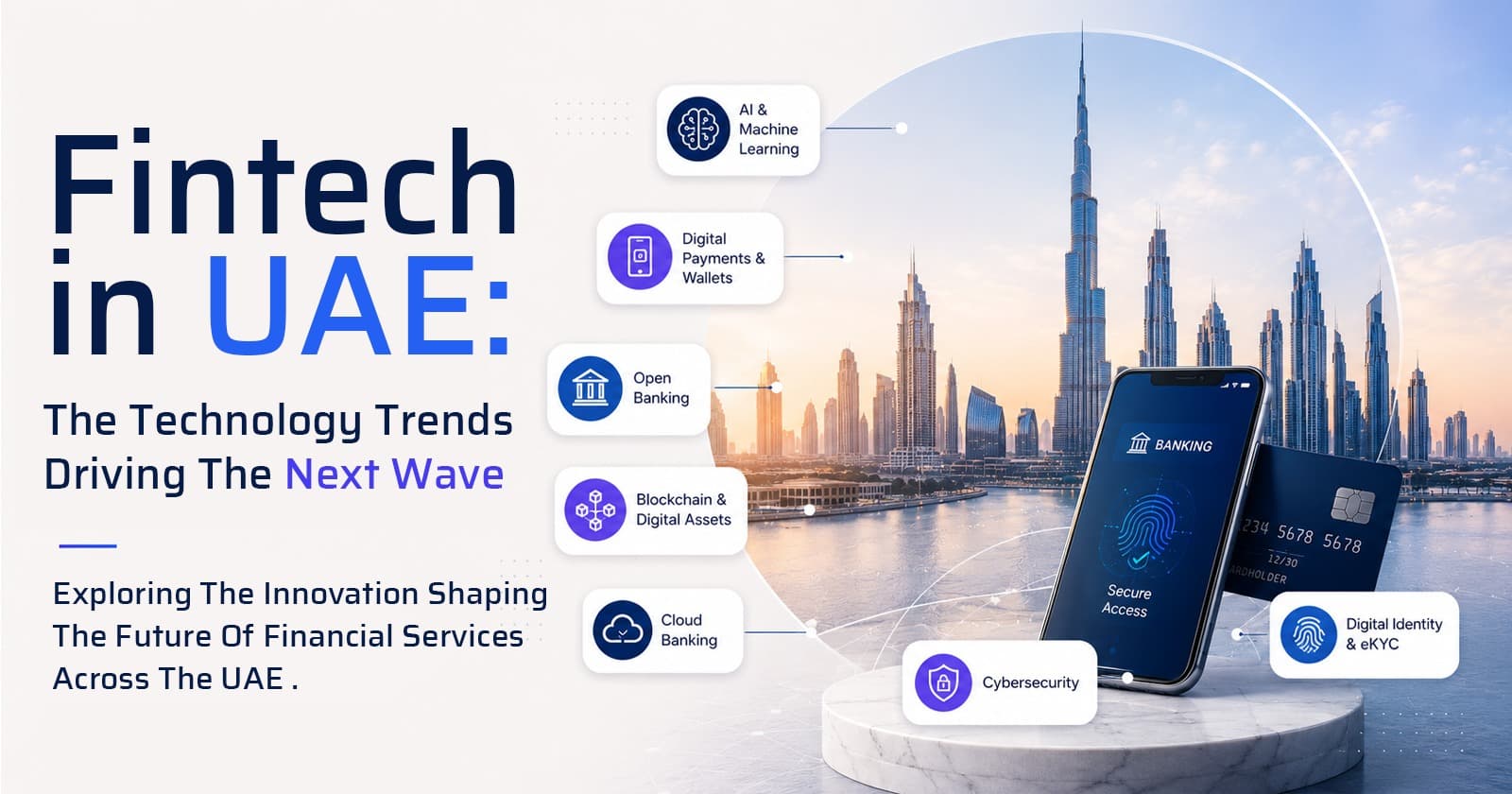
Fintech in UAE is moving beyond digital wallets and mobile banking. The next wave is being shaped by instant payments, open finance, AI agents, unified digital identity, tokenized assets, embedded credit, and the Digital Dirham.
-
DIFC ended 2025 with 1,677 AI, fintech, and innovation-focused entities, up 35% in a year. The broader UAE fintech market was valued at an estimated $3.16 billion in 2024 and is projected to reach $5.71 billion by 2029.
-
Aani, the UAE’s instant payment platform, reached 12.5 million registered users by April 2026, with transfers completed in roughly three seconds.
-
Open finance may change how banks, insurers, fintech companies, and nonfinancial platforms share consented customer data and initiate financial transactions.
-
AI is beginning to move from answering questions to completing financial actions. A 2025 UAE pilot allowed an AI agent to search, compare, and initiate a purchase.
-
Tokenization is leaving the conference stage. Regulators in Dubai and Abu Dhabi are building controlled environments for tokenized funds, securities, real estate, and alternative assets.
-
The strongest opportunity may not belong only to banks. Retailers, logistics companies, property platforms, healthcare businesses, and B2B marketplaces can all add financial services inside their existing customer journeys.
Fintech in UAE is entering a different phase. The first phase put banking, payments, and investing on phones. The next appears likely to make finance almost invisible, woven into commerce, software, identity, and everyday business decisions.
For companies planning financial platforms, payment products, lending tools, or AI-backed workflows, Deuex Solutions helps turn complex ideas into secure, usable software.
A AED 48,600 Payment Tells the Whole Story
At 9:07 on a Tuesday morning, Noura approves a supplier invoice from her office in Dubai.
AED 48,600.
One tap. A quick identity check. Done.
To Noura, the payment is ordinary. Underneath that small action, though, several systems wake up. Her identity is confirmed. Account permissions are checked. Transaction risk is scored. The receiving business is verified. The payment moves through national infrastructure. Records are updated for finance, tax, and audit.
Soon, that chain may include more.
An AI agent could negotiate the payment date. An open finance connection could compare working-capital offers. A programmable Digital Dirham might release funds only after delivery confirmation. The invoice itself could become part of a tokenized trade-finance instrument.
That sounds distant.
In the UAE, pieces of it already exist.
Noura and her company are fictional, but the sequence reflects questions we hear from businesses across the region: How will finance become faster? Who controls the data? Where does AI fit? What should companies build now, and what should they leave alone?
Follow the payment, and the next chapter of fintech becomes much easier to see.
Business intent
↓
Digital identity and e-KYC
↓
Consented financial data
↓
AI, fraud, and compliance checks
↓
Instant payment or programmable money
↓
Settlement, reporting, and audit
What Does Fintech in UAE Look Like in 2026?
Fintech in UAE now covers far more than banking apps. It includes national payment rails, financial APIs, AI-assisted services, embedded credit, digital identity, virtual assets, tokenized investments, regulatory technology, and central bank digital currency infrastructure.
The numbers suggest a market gaining depth, not merely attracting attention.
DIFC reported 1,677 AI, fintech, and innovation-focused entities at the end of 2025, a 35% annual increase. Across the UAE, fintech startups raised about $265 million in 2024, roughly one-third of all national startup funding. The same Emirates NBD and PwC report found that 89% of UAE consumers used digital-first bank accounts.
KPMG reported that fintech investment across the Middle East rose from $741.4 million in 2024 to $1 billion in 2025, even though the number of deals declined. That pattern may indicate a market becoming more selective, with capital moving toward larger or more proven opportunities.
The next wave is not one technology. It is several layers arriving at once.
Why Are Payments Becoming Almost Invisible?

Payments are becoming less like a separate task and more like background infrastructure.
Noura does not want to “use a payment system.” She wants the supplier paid. The best payment experience is often the one she barely notices.
Aani shows how quickly expectations are shifting. By April 2026, the platform had reached 12.5 million registered users. Transfers were being completed in about three seconds, and the system had integrated with 85% of banks, along with exchange houses, wallets, and finance companies. Transfer volume grew sixfold year over year during 2025.
The infrastructure is widening too. On July 20, 2026, the Central Bank formally inaugurated Jaywan, the UAE’s first national card scheme. The scheme was created to strengthen domestic payment infrastructure and the country’s position in digital payments.
For businesses, this may produce several changes:
-
Faster supplier settlement
-
Lower dependence on manual bank transfers
-
More payment choices inside apps and platforms
-
Better reconciliation through shared transaction references
-
New domestic and cross-border payment products
The business opportunity is not “build another wallet.”
It may be to remove payment friction from a journey that already exists.
A property platform could collect deposits without sending users elsewhere. A logistics app could trigger a driver payment after verified delivery. A B2B marketplace could split one customer payment among several suppliers automatically.
The payment disappears.
The service becomes better.
How Will Digital Identity Change Customer Onboarding?
Digital identity is turning onboarding from a repeated paperwork exercise into a reusable data process.
In April 2026, the Central Bank announced development of a nationwide unified e-KYC platform. It is intended to connect trusted data sources, automate parts of KYC and KYB, reduce duplicated due-diligence work, and let data sharing happen with explicit customer consent.
That same month, a Tourist Identity initiative enabled nonresident visitors to open digital bank accounts instantly and securely through a digital identity process.
Then there is biometrics.
A Central Bank proof of concept at Dubai Land Department allows users to authorize payments through facial or palm recognition without presenting a card or phone. It is still a pilot, so broad adoption is not guaranteed. Yet it suggests that identity and payment may gradually merge into one action.
Back in Noura’s office, this changes more than login screens.
Her company could onboard a vendor without requesting the same trade license and ownership records by email three times. A fintech lender could verify a small business faster. A wealth platform could reduce abandonment during account opening.
The benefit is speed.
The risk is concentration. When identity becomes reusable across many services, consent records, access controls, retention policies, and audit logs need careful design.
What Will Open Finance Change?
Open finance allows customers to authorize secure sharing of financial data and, in some cases, initiate transactions across providers.
Think of it as a controlled bridge.
Today, Noura’s business may hold banking data in one portal, insurance information in another, accounting records in an ERP, and lending details somewhere else. None of these systems has a full picture.
With open finance, a permitted application may be able to combine that information.
The Central Bank’s framework includes an API Hub, trust rules, and common infrastructure for consented data sharing and transaction initiation. The initial onboarding phase covers banks and insurance companies, with other categories expected later.
This may lead to practical products such as:
-
Cash-flow dashboards covering several banks
-
Faster SME credit assessments
-
Insurance comparisons using verified information
-
Automated treasury tools
-
Financial health scores
-
Payment initiation inside accounting software
-
Personalized savings or investment products
The cross-border direction is equally interesting.
In June 2026, the Central Bank announced completion of Project Aperta, a BIS-led experiment connecting open finance networks across jurisdictions. It tested cross-border business-data portability and trade-finance workflows while preserving domestic rules. The project suggests that verified company information could eventually travel more easily between countries, reducing repeated checks for SMEs engaged in trade.
For fintech companies in UAE, this is a product opportunity.
It is also an architectural challenge. Consent cannot be a decorative checkbox. Teams need clear permission scopes, revocation controls, API monitoring, data lineage, and evidence of who accessed what.
What Happens When AI Starts Moving Money?
AI in financial services is moving from assistance toward action.
The older model was familiar. A chatbot answered a question. A fraud engine flagged a transaction. A model suggested which customer might need a loan.
The emerging model is more active.
In November 2025, Mastercard introduced Agent Pay in the UAE and completed its first transaction outside the United States. The pilot, developed with Majid Al Futtaim and Dataiera, demonstrated an AI agent searching, comparing, and initiating a purchase, beginning with cinema-ticket use cases.
DIFC went further in April 2026, announcing plans to become what it describes as the world’s first AI-native financial center. Its plan includes AI inside legal frameworks, compliance systems, financial-service delivery, infrastructure, and talent development. DIFC estimates the program could contribute AED 12.9 billion to Dubai’s economy and support 25,000 jobs, though those figures are targets rather than completed outcomes.
For Noura, an AI finance agent might eventually:
-
Read the supplier invoice
-
Match it against the purchase order
-
Check delivery status
-
Compare payment terms
-
flag an unusual bank-account change
-
Prepare the transaction
-
Request human approval
That last step matters.
Financial AI should not be judged only by how much it can automate. It should be judged by how clearly it knows when to stop.
In our experience, businesses are often drawn first to the conversational interface. The harder work sits underneath: transaction limits, model monitoring, human review, exception handling, explainability, and recovery when the model gets something wrong.
Is the Digital Dirham About to Change Everyday Payments?

The Digital Dirham is the UAE’s planned central bank digital currency. It is not simply another cryptocurrency or private stablecoin. It represents a digital form of central bank-backed money.
The Central Bank has completed an issuance platform, participated in a live cross-border transaction through mBridge, and conducted a real-value retail pilot. Its published work discusses potential features such as wallet access, offline use, smart contracts, and retail, wholesale, and cross-border payments. The rollout is planned in phases.
The interesting word is programmable.
Imagine Noura pays a shipping partner using funds that release only after a verified customs event. Or an insurer pays a claim automatically after trusted data confirms the covered event. A government benefit could be issued with specific use conditions.
These models may reduce waiting and disputes.
They can also create difficult questions. Who writes the payment conditions? Can a transaction be reversed? What happens during a system outage? How much privacy should programmable money preserve?
The Digital Dirham’s real impact will depend less on novelty and more on the use cases businesses, banks, and regulators choose to support.
Why Is Tokenization Becoming a Serious Fintech Trend?
Tokenization converts rights to an asset into digital units that can be issued, tracked, or transferred through controlled infrastructure.
The asset might be a fund unit, bond, sukuk, property interest, private-market instrument, or commodity claim.
In 2025, the DFSA’s Tokenisation Regulatory Sandbox received expressions of interest from 96 firms. Proposed use cases included tokenized shares, bonds, sukuk, funds, trading, and custody.
Dubai Land Department and VARA also launched a limited real estate tokenization pilot in March 2025. The pilot is narrow, and VARA has warned consumers about companies falsely claiming involvement. That warning is useful. Strong demand tends to attract both serious builders and opportunists.
KPMG identified real-world asset tokenization as one of the UAE fintech trends to watch in the first half of 2026.
Tokenization may offer:
-
Smaller investment units
-
Faster ownership transfer
-
Automated distribution of income
-
Better transaction records
-
Wider access to selected asset classes
-
New collateral and settlement models
Still, a token does not remove legal complexity.
Someone must verify the underlying asset. Custody must be clear. Investor rights must be enforceable. Pricing and liquidity need honest treatment.
A polished interface cannot fix weak asset governance.
Where Does Embedded Finance Fit?
Embedded finance places payments, credit, insurance, or banking services inside a nonfinancial product.
You have probably used it without noticing.
A checkout offers installments. A marketplace offers seller financing. A logistics platform provides cargo insurance during booking. An accounting tool lets a business request working capital based on invoice history.
For fintech Dubai businesses, this may become one of the most commercially useful directions.
Why? Distribution.
A standalone financial app must persuade customers to arrive. An embedded product meets them where they already work or shop.
This is where fintech companies in Dubai may find their strongest partnerships.
Not by replacing banks.
By connecting financial products to the moment a customer needs them.
Which Regulator Covers Which Part of the UAE Fintech Market?

The UAE fintech regulatory structure depends on the activity and jurisdiction. Product teams should confirm their exact obligations with qualified legal and compliance advisers before launch.
Dubai and Abu Dhabi are building different but connected parts of the ecosystem.
DIFC reported strong growth in fintech and AI firms and is expanding its AI-focused infrastructure. Abu Dhabi has launched the FIDA cluster to develop fintech, insurance, digital assets, alternative finance, and institutional financial infrastructure.
For founders, regulation should shape product design from the first sprint.
Do not build a wallet and ask about licensing later. Do not store biometric data before defining retention and access rules. Do not add tokenized assets to a product because the interface looks easy.
Late compliance changes are expensive.
Sometimes fatal.
Which Fintech Opportunities Are Most Practical Now?
The best fintech opportunity is usually a narrow financial problem inside a larger business journey.
Possible starting points include:
-
SME cash-flow forecasting
-
Automated invoice matching
-
Cross-border business onboarding
-
Payment reconciliation
-
Embedded supplier credit
-
AI-assisted fraud investigation
-
Consent and open finance management
-
Insurance-claim workflow tools
-
RegTech reporting
-
Tokenized asset administration
-
Treasury dashboards
-
Financial tools for tourists and nonresidents
In our experience, founders sometimes begin with the phrase, “We want to build a super app.”
That sentence makes us pause.
A super app is an outcome of distribution, trust, and repeated use. It is not a useful phase-one specification.
Start with one painful financial task.
Solve it thoroughly. Let customers return. Then widen the product.
What Could Slow the Next Wave?
The technology is moving quickly. Trust may move more slowly.
Several risks deserve attention:
Weak unit economics. Fast growth does not prove that a lending, payments, or subscription model can become profitable.
Fraud that adapts. AI can help detect fraud, but it can also produce convincing synthetic identities, documents, and social-engineering attacks.
Data without permission. Open finance creates value only when users understand and control access.
Automation without recovery. Every automated financial action needs a process for disputes, errors, and exceptions.
Regulatory mismatch. A product licensed for one activity or jurisdiction may not be allowed to operate another way.
Vendor dependence. Payment processors, identity providers, cloud services, and model vendors can become points of operational risk.
KPMG’s 2026 outlook highlights strong investor interest in AI and digital assets, while also noting concern that some valuations may be supported more by narrative than durable revenue.
That is a fair warning.
Build for the customer’s problem, not the funding headline.
How Should a UAE Fintech Product Be Built?

A sensible roadmap begins with regulation, money movement, and failure scenarios before visual design.
Phase 1: Define the financial activity
Write down exactly what the product does. Does it store value, initiate a payment, recommend credit, arrange insurance, transmit data, or issue an asset?
Small wording differences can change the regulatory path.
Phase 2: Map the money and data
Track where funds enter, who holds them, when they move, and how they are reconciled.
Do the same for data.
Phase 3: Design trust controls
Plan identity, consent, permissions, encryption, audit logs, transaction limits, alerts, and manual review.
Phase 4: Build the narrowest useful product
One customer group. One transaction type. One clear result.
Phase 5: Test abnormal situations
Test failed identity checks, duplicate payments, API outages, changed bank details, sanctions alerts, incorrect AI recommendations, refunds, and disputed transfers.
That is where a good fintech product proves itself.
Not on the happy path.
At Deuex Solutions, we approach fintech software as a connected system of customer experience, financial logic, APIs, security controls, and operating workflows. The screen is only the surface.
The Next Wave Will Feel Less Like Finance
At 9:08, Noura’s supplier sees the money.
No branch visit. No emailed payment screenshot. No waiting until the next business day.
The remarkable part is not that the transaction moved quickly.
It is how many systems worked quietly behind one tap.
That appears to be the direction of fintech in UAE. Finance becomes less visible, while the infrastructure behind it becomes more sophisticated. Identity, data, AI, payments, and regulation begin working as one system.
Businesses should not chase all of it.
Pick one moment where money, data, or trust slows your customer down. Start there.
Deuex Solutions helps businesses plan and build fintech platforms, payment workflows, AI-backed financial tools, dashboards, and custom software designed around real operating needs.
Contact Deuex Solutions to discuss the financial workflow your business wants to improve.
The next fintech winner may not be the company with the most features. It may be the one that makes a difficult financial action feel ordinary.
Related reading
-
IT Solutions Company in Dubai: A Practical Guide to Choosing the Right Technology Partner
-
Digital Transformation in Dubai: A Practical Playbook for Mid-Size Businesses
-
The Future of Predictive Analytics in UAE: Trends, Challenges & Opportunities


Sanket Shah
CEO & Founder
I am Sanket Shah, founder and CEO of Deuex Solutions, where I focus on building scalable web mobile and data driven software products with a background in software development. I enjoy turning ideas into reliable digital solutions and working with teams to solve real world problems through technology.


