

Step into a world where digital experiences define customer loyalty, operational efficiency, and business growth. In 2023, the global mobile app market surged past USD 228 billion, and it’s expected to skyrocket to USD 567 billion by 2030. This exponential rise signals one clear truth: custom mobile app development is no longer optional - it’s the backbone of modern business success.
A tailored product should connect user needs with measurable business outcomes. Our custom mobile app development team helps define that fit before design and engineering begin. Architecture and interface decisions should also follow Android's recommended app architecture, Apple's Human Interface Guidelines and the OWASP Mobile Application Security Verification Standard. If cross platform delivery is on the shortlist, our guide to Flutter widgets explains the building blocks teams will use.
Businesses today need more than standard apps. They need tailored mobile solutions that match their workflows, audience, goals, and growth aspirations. Whether you're optimizing internal processes, building hyper-personalized customer experiences, or creating a revenue-driving digital product, custom apps give you the power to innovate without limits.
This blog reveals how custom mobile app development helps you tailor apps for your business, the key strategies behind it, and a complete blueprint for building high-performing apps in 2025 and beyond.
Why Businesses Need Custom Mobile App Development
Custom mobile app development empowers businesses to go beyond generic templates and build solutions crafted around real challenges, real workflows, and real opportunities.
Here’s why custom apps matter more than ever:
✔ Tailored features for your operations
Instead of forcing your team to adapt to software, custom apps mold perfectly to your business processes.
✔ Direct impact on customer engagement
Personalized experiences build stronger connections, higher retention, and increased lifetime value.
✔ Competitive advantage with unique innovations
Your app becomes a differentiator - something competitors can’t easily replicate.
✔ Scalable systems for long-term expansion
A custom-built architecture adapts as your business evolves, without major rebuilding.
✔ Seamless integration with your digital ecosystem
CRMs, ERPs, IoT devices, third-party APIs - everything can work together.
✔ Stronger security & compliance
Sensitive workflows need advanced security customization that off-the-shelf apps rarely provide.
Businesses aren’t just choosing custom apps because it’s trendy - they’re choosing them because it’s the only way to develop future-ready, user-friendly, revenue-driving digital products.
Understanding Your Business Needs: The First Step to Customization
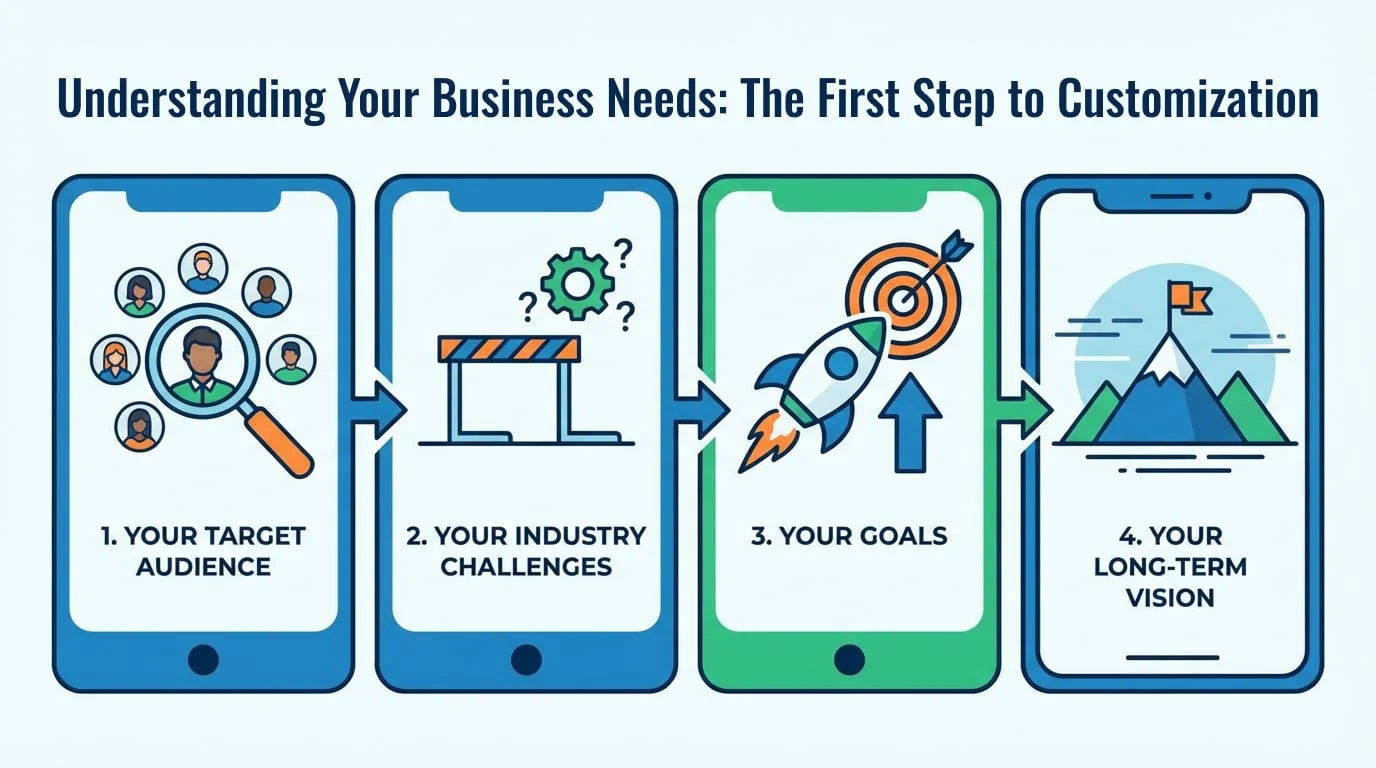
Every tailored mobile solution starts with understanding what your business truly needs. This involves deep analysis of:
🔹 Your target audience
Who will use your app? Customers? Employees? Vendors?
Each group has different expectations, pain points, and device behaviors.
🔹 Your industry challenges
Retail apps need loyalty programs.
Fintech apps need encryption.
Healthcare apps need compliance.
Manufacturing apps need IoT data syncing.
🔹 Your goals
Do you want to:
- improve customer engagement?
- automate operations?
- increase sales?
- monitor processes in real time?
- create a new revenue stream?
🔹 Your long-term vision
Custom mobile app development ensures you build a solution that can grow and adapt.
This early stage is where your app begins to take shape - not with code, but with clarity.
How to Tailor Apps for Your Business with Custom Mobile App Development
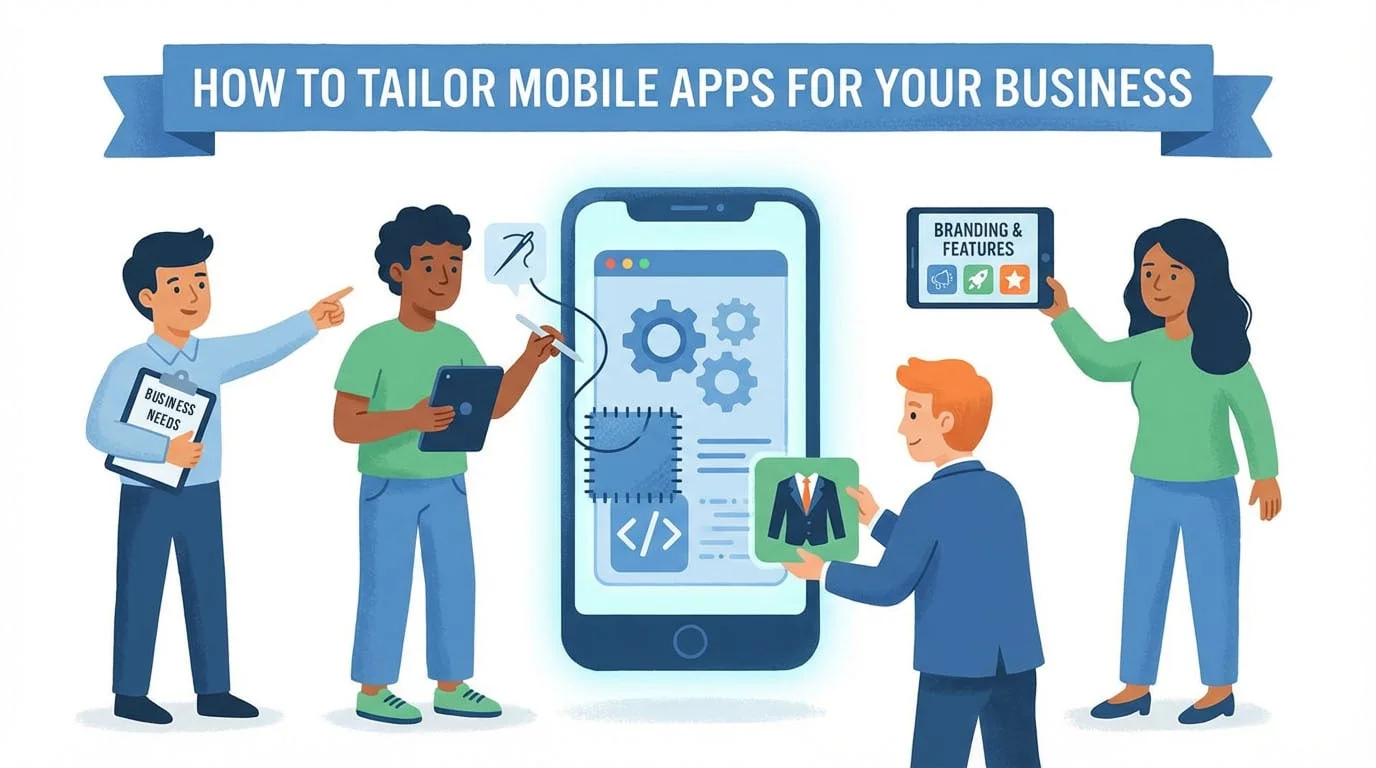
Custom apps become powerful when they’re built with a tailored development approach. Here’s how businesses can create mobile applications that align perfectly with their vision and goals.
1. Analyze User Behavior to Personalize the Experience
Personalization is no longer a luxury - it’s expected. Users crave experiences that feel intuitively built for them.
How this step tailors your app:
- Real-time data identifies what users want
- Behavioral insights help you prioritize features
- Custom recommendations increase engagement
- Dynamic UI adapts based on customer needs
For example, an eCommerce business can use custom AI-driven recommendations to boost conversions by tailoring products to each user’s browsing history.
Custom mobile app development turns user data into personalized journeys that set your business apart.
2. Choose the Right App Development Approach
Your development approach determines cost, performance, time-to-market, and user experience.
Options to evaluate:
- Native apps (Swift, Kotlin) - best performance
- Cross-platform apps (Flutter, React Native) - faster development
- Hybrid apps - cost-effective for simple experiences
Picking the right approach helps you tailor your app to your target audience’s devices, usage patterns, and performance expectations.
3. Build Future-Ready Features Based on Your Goals
Custom apps let you include features directly aligned with your business needs.
Popular tailored features include:
- Real-time analytics dashboards
- Secure payment systems
- AI-powered chatbots
- IoT device integrations
- GPS tracking and routing
- Personalized notifications
- Offline-first functionality
- Cloud data synchronization
These features aren’t limited by templates - they’re created from scratch to match your business model.
4. Integrate Your Existing Tools & Systems
Custom mobile app development shines when your app becomes the central hub of your business ecosystem.
You can integrate:
- CRMs (Salesforce, HubSpot)
- ERPs
- Payment gateways
- Inventory systems
- IoT sensors
- AI modules
- BI dashboards
Seamless integration eliminates data silos, automates workflows, and increases operational efficiency.
5. Design a Prototype to Validate User Experience Early
Prototypes allow you to visualize workflows, refine navigation, and validate app usability through UI/UX design before development begins.
Benefits of custom prototyping:
- Saves time and cost
- Ensures intuitive flows
- Helps align stakeholder expectations
- Prevents design mistakes
- Provides user feedback early
This step ensures your custom app is not just functional - it’s smooth, consistent, and delightful to use.
6. Build a Scalable Tech Stack for Long-Term Growth
Your tech stack powers your app’s performance. Custom apps need a strong foundation capable of handling growth.
A scalable stack supports:
- High-traffic events
- Data-heavy operations
- Rapid feature expansion
- Multi-device compatibility
Choosing the right mix of frameworks, databases, and cloud infrastructure ensures your app remains fast, secure, and future-ready.
7. Strengthen Security with Tailored Protection
Security can’t be an afterthought - especially for industries like fintech, healthcare, and ecommerce.
Custom apps allow you to build:
- End-to-end encryption
- Multi-factor authentication
- Role-based access controls
- Secure APIs
- Compliance frameworks (HIPAA, GDPR, PCI DSS)
Your app becomes a fortress, safeguarding users and business data at every step.
8. Test Across Devices, Platforms & Real-World Scenarios
Testing ensures your app is stable, fast, and reliable.
Custom testing includes:
- Usability testing
- Functional testing
- Performance testing
- Stress testing
- Security testing
- Cross-device testing
This ensures a flawless launch, no matter how complex your app is.
A Complete Blueprint for Custom Mobile App Development
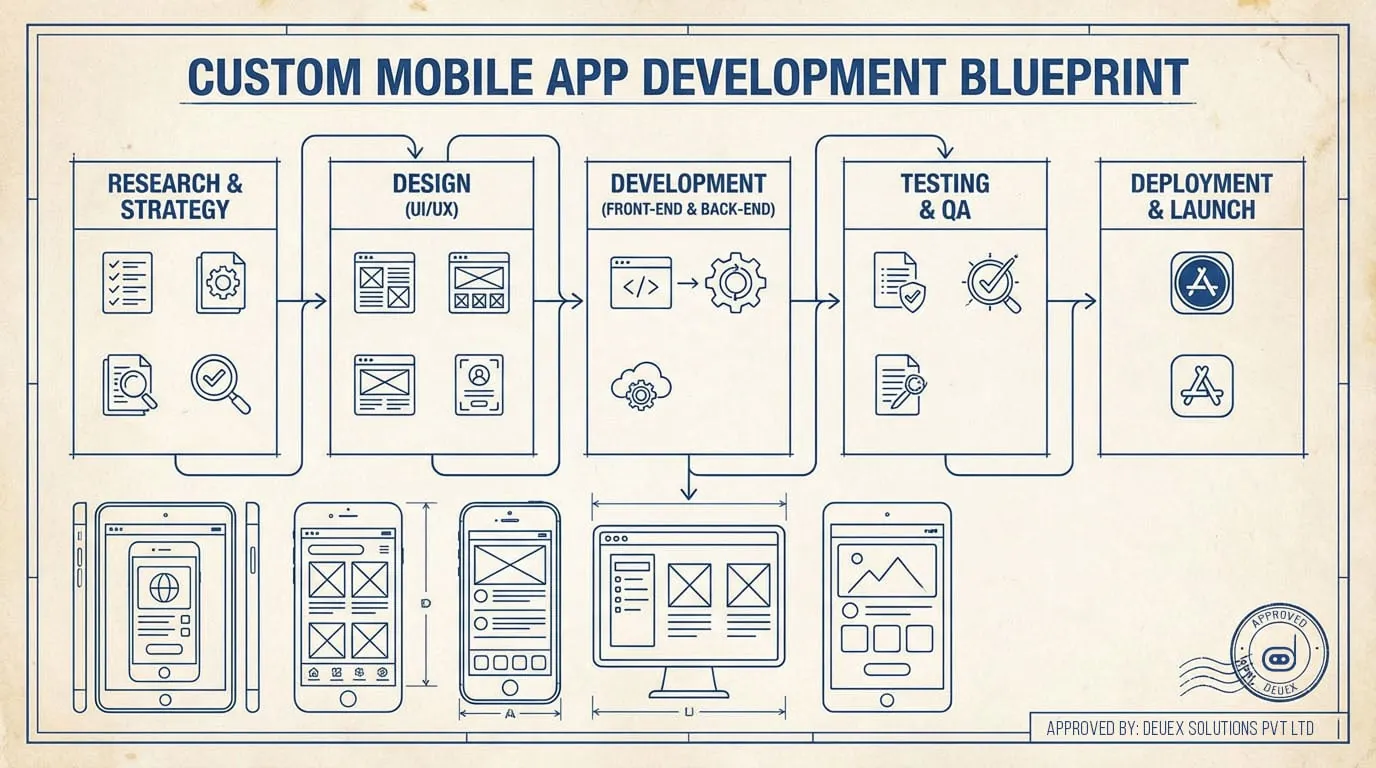
Here’s the full roadmap businesses follow to create tailored mobile experiences:
1. Discovery & Strategy
Define pain points, goals, user needs, and opportunities.
2. Requirement Engineering
Map features, workflows, and technical specifications.
3. UI/UX Design
Create wireframes, prototypes, and visual identity.
4. Development
Build custom features, integrations, and APIs.
5. Testing & QA
Ensure reliability, speed, and security.
6. Deployment
Publish apps to Play Store / App Store.
7. Maintenance & Scaling
Enhance features, support users, and scale the system.
This structured approach ensures your app is not just functional - it’s optimized for performance, engagement, and business results.
Key Features Every Custom Mobile App Should Have
No matter the industry, top-performing apps share certain essential features:
- Personalized dashboards
- Secure authentication
- Cloud backup
- Push notifications
- Real-time data sync
- Smooth navigation
- Offline mode
- Analytics and insights
These features bring consistency, control, and customization across the entire user experience.
How Custom Apps Drive Business Growth
Tailored mobile solutions unlock new growth opportunities:
💠 Increased customer loyalty
Personalization + convenience = higher retention.
💠 Higher operational efficiency
Automated workflows reduce manual tasks.
💠 New revenue streams
Subscriptions, premium features, and in-app purchases.
💠 Better decision-making
Real-time data powers smarter business strategies.
💠 Stronger brand identity
Custom apps reflect your brand’s personality and uniqueness.
Businesses embracing custom mobile app development consistently outperform competitors in engagement, productivity, and innovation.
Build Around Retention and Revenue Loops
A tailored app creates value when it helps users reach a useful result quickly and gives them a clear reason to return. Focus the roadmap on a few repeatable loops:
- shorten the time to first value during onboarding
- reduce steps for the actions customers repeat most often
- personalize recommendations and messages with clear user controls
- provide contextual help and fast support inside the app
- protect reliability through performance monitoring and regular testing
McKinsey's overview of personalization explains why relevant experiences can support growth and retention when they are executed well. Personalization should solve a user need, not add noise.
Measure whether these choices work with a focused set of indicators: Day 1, Day 7, and Day 30 retention; repeat purchase rate; average order value or revenue per active user; churn; funnel conversion; crash-free sessions; ANR rate; and support tickets per active user. Review the measures by user segment so the team can improve weak journeys instead of relying on a single average.
Final Thoughts
Custom mobile app development is more than building an app - it’s designing a digital engine that powers your business forward. From personalizing user experiences to integrating your systems, from choosing the right tech stack to strengthening security, custom apps offer unmatched scalability and value.
When you tailor your app to your business needs, you don’t just enhance operations - you build a competitive advantage that grows stronger every year.
If you're ready to transform your idea into a high-performing custom mobile solution, we’re here to help.
Build a Custom Mobile App That Drives Results
Leverage our expertise to create scalable, secure, and future-ready mobile apps aligned with your business goals.
👉 Book Your Free Mobile App Assessment
👉 Let our experts guide your mobile strategy today
FAQs
1. Why is custom mobile app development better than off-the-shelf solutions?
Custom apps match your workflows, integrate with your systems, and provide unique features that templates cannot replicate.
2. How long does custom mobile app development take?
On average, 3-9 months depending on features, integrations, and complexity.
3. What industries benefit most from custom apps?
Fintech, healthcare, ecommerce, manufacturing, real estate, and hospitality see the highest impact - but every industry benefits from tailored solutions.
4. Can custom apps scale as business needs grow?
Yes - scalability is built into the architecture, allowing you to add features, integrate tools, and support more users effortlessly.
5. How much does custom mobile app development cost?
Costs vary based on features, design, and complexity, but custom apps deliver long-term ROI through efficiency, engagement, and automation.
Related reading
- Why Mobile-First Businesses Win in Customer Experience
- All You Need to Know About Flutter Widgets
- How Custom Mobile Apps Drive Retention and Revenue Growth


Sanket Shah
CEO & Founder
I am Sanket Shah, founder and CEO of Deuex Solutions, where I focus on building scalable web mobile and data driven software products with a background in software development. I enjoy turning ideas into reliable digital solutions and working with teams to solve real world problems through technology.


