

Businesses collect data from customer activity, connected devices, cloud services and digital transactions. The real challenge is turning that information into applications that stay fast and reliable as usage grows. Teams that need support can use Deuex's big data application development services to plan the architecture, data pipelines and delivery process around measurable business goals.
For executives charting digital blueprints, this isn’t a technical sidebar. It’s a strategic mandate.
What Big Data Application Development Really Means
At its core, big data application development refers to building software systems that can handle three defining characteristics of modern datasets: volume, velocity, and variety. Traditional data models buckle under these constraints. Enterprises need applications that process, analyze, and act on data that is large in scale and fast in motion.
These applications pull from diverse sources - structured customer records one minute, unstructured sensor data the next - and produce insights that leaders use to drive decisions and competitive edge.
That’s where big data software solutions come into play. They serve as the backbone for enterprise platforms used in predictive analytics, real-time customer insights, fraud detection, predictive maintenance, and operational automation. They go beyond reporting; they power actions.
Why Scalable Systems Matter to the C-Suite

Scalability isn’t a buzzword; it’s tied directly to business outcomes.
Imagine a loyalty app that performs well with 1,000 users but slows to a crawl when usage spikes to 100,000. The technical problem quickly becomes a business problem - frustrated customers, dropped transactions, tarnished reputation.
Large enterprises face far greater stress on systems daily. Data grows by orders of magnitude. Traditional application stacks collapse when:
- Data inflow increases exponentially
- Real-time processing becomes a necessity
- Machine learning models get embedded in business workflows
A scalable architecture prevents bottlenecks so leaders can push strategic priorities forward without firefighting performance issues.
Scalable data engineering services and frameworks ensure that the underlying systems can stretch elastically with demand, maintain consistency, and deliver results under pressure.
The Strategic Forces Shaping Big Data Development in 2026

Top technology research firms consistently rank data and analytics at the top of strategic priorities. Gartner reports that data and analytics leaders must grapple with rising expectations while delivering outcomes that matter - and quickly.
These pressures include:
- Delivering reusable, composable data products
- Balancing performance with organizational demands
- Supporting business units that rely on data access and responsiveness
Unlike traditional systems that focus on static datasets, modern big data apps operate in real time, powering decisions and fueling digital innovation.
Forrester’s latest research also highlights a shift in application development practices where organizations spend more time on experimentation and rapid development, prioritizing growth and customer experience.
This means that leaders must plan for technology stacks that support agility without compromising performance or stability.
Architectural Pillars of Scalable Big Data Applications
A successful big data application rests on several core architectural pillars. Each supports a different aspect of data handling and application performance:
1. Distributed Data Processing Frameworks
Frameworks such as Apache Spark and Apache Flink enable parallel processing of large datasets across clusters of machines. They allow applications to ingest and process streaming and batch data without bottlenecks.
With distributed processing, workloads are balanced across multiple servers, improving throughput and resilience.
2. Flexible Storage Layers
Big data systems employ a mix of storage technologies:
- Distributed file systems like Hadoop HDFS for raw data storage
- NoSQL databases for high-velocity reads and writes
- Cloud object storage for cheaper, scalable capacity
These options ensure that data is stored in the right form for the right task - analytics, history, real-time access, or compliance.
3. Modular Data Pipeline Architecture
Pipelines manage the flow of data from ingestion to consumption. They transform raw inputs into curated datasets that applications can use. A modular design allows engineers to update parts of the pipeline without overhauling the entire system.
Effective pipelines are:
- Fault tolerant
- Easy to monitor
- Designed for real-time and batch workloads
Building Data-Driven Applications Step by Step
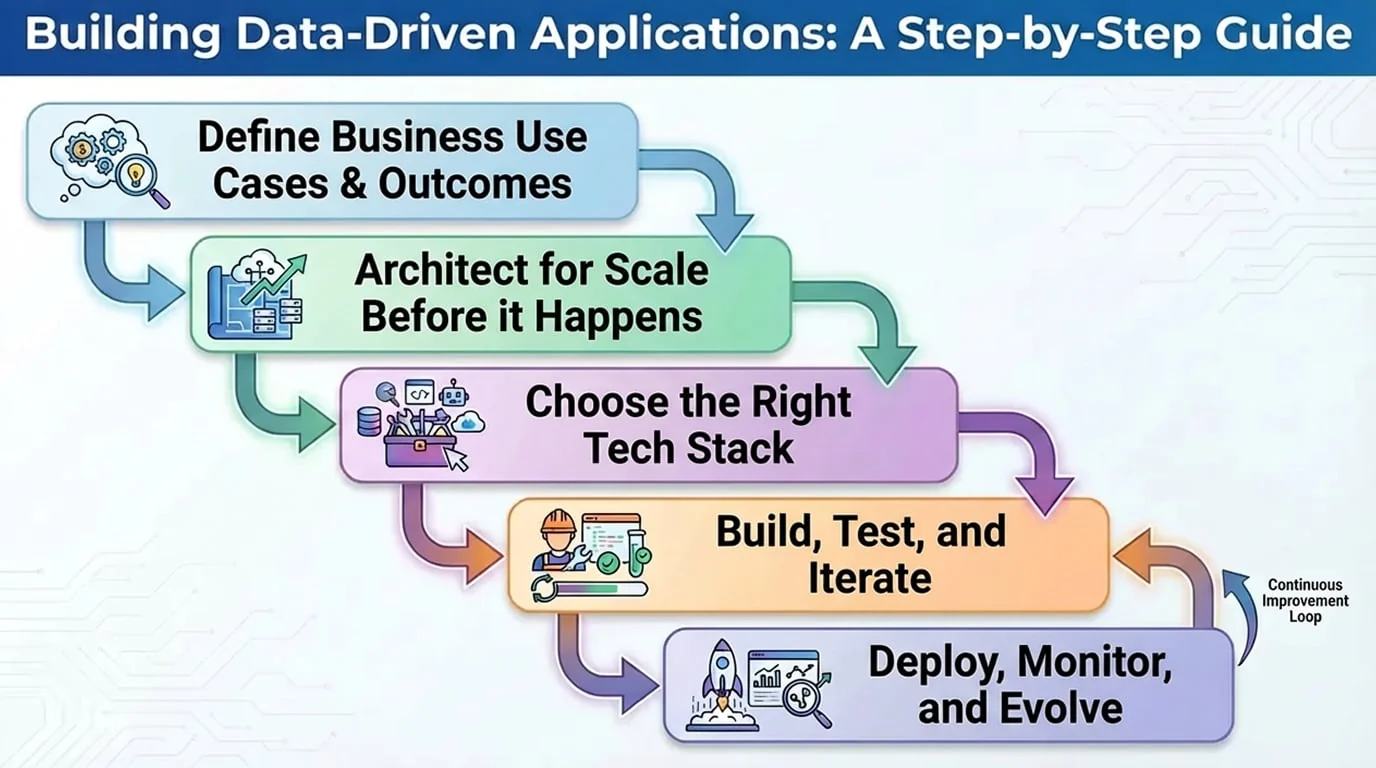
Creating big data applications is both science and craft. The process typically follows a structured progression:
1. Define Business Use Cases and Outcomes
Start with questions like:
- What decisions should the app enable?
- Will it need real-time processing?
- Who are the end users?
Getting clarity upfront avoids costly redesign later.
2. Architect for Scale Before It Happens
Anticipate future growth rather than retrofitting for scale later. For example, designing schemas that support partitioning and caching strategies from day one keeps systems responsive at high loads.
Applying scalable data engineering services during the design phase allows you to build systems that adjust horizontally - adding more processing nodes as data grows - instead of requiring vertical, costly upgrades in limited ways.
3. Choose the Right Tech Stack
Select tools and platforms that align with performance demands and skill sets. For analytics-focused applications, frameworks like Spark provide a scalable processing engine. For data ingestion, robust message brokers and stream processing frameworks ensure real-time responsiveness.
Cloud platforms offer auto-scaling and elasticity, reducing the operational burden on internal teams.
4. Build, Test, and Iterate
Rapid prototyping allows teams to validate assumptions early. Testing for performance under simulated load helps identify and correct weaknesses early in the cycle.
5. Deploy, Monitor, and Evolve
Use continuous deployment pipelines that incorporate monitoring. Track latency, throughput, error rates, and user behavior. These metrics inform incremental improvements and improve reliability over time.
This approach mirrors modern software practices but requires greater emphasis on data flows and variability.
Big Data Software Solutions: Beyond Just Tech Stacks
Big data application development isn’t only about technology layers; it’s about delivering capability that aligns with business drivers.
Strong big data software solutions:
- Provide adaptive data ingestion for many source types
- Normalize and enrich data for cross-system access
- Support analytics that drive decisions
- Enable predictive and prescriptive capabilities
These solutions require both robust backend systems and intuitive interfaces that deliver insight to business users - whether they are analysts or executives looking at dashboards.
Real-World Examples of Data-Driven Apps in Action
Consider how enterprises are leveraging big data applications:
Predictive Customer Churn Models
Retailers use streaming data to detect patterns in customer behavior. When early signals indicate potential churn, automated offers or interventions can trigger.
Real-Time Fraud Detection
Financial services companies analyze transaction streams to flag anomalous activity in real time.
Smart Manufacturing Dashboards
IoT sensors track machine performance. Big data applications correlate signals from hundreds of machines to detect impending failures.
Each of these apps processes vast amounts of data, delivers near-instant analysis, and supports mission-critical outcomes. Their success depends on scalable application design and software solutions that move with data velocity and volume.
Integration with AI and Automation
The modern data app doesn’t just store or query data. It often powers automated decision pathways. Gartner predicts that business decisions will increasingly be augmented or automated by AI agents. This means that data platforms must be ready to feed real-time models and handle synthetic datasets with high reliability.
Integrating AI capabilities within big data applications adds both power and complexity. The data stack must support:
- Model training on large datasets
- Deployment of models as part of application logic
- Feedback loops for continuous learning
This elevates the role of big data systems from analytical engines to embedded business enablers.
How Scalable Data Engineering Services Fit In

As data grows, so does the need for structured pipelines, governance, security, and scale. Scalable data engineering services help architect systems that:
- Meet performance targets regardless of load
- Maintain data quality and governance
- Feed analytics platforms and dashboards without delay
- Support future expansion into new data realms
These services ensure that data pipeline frameworks are resilient and can adapt to business shifts without costly rewrites.
Governance, Security, and Compliance
A scalable app is useless if it cannot safeguard data or meet compliance standards.
Enterprises face strict regulatory environments - from the GDPR to industry mandates. Big data systems must incorporate:
- Access controls
- Traceability
- Encryption
- Audit logs
These aren’t optional features; they are prerequisites for production systems that handle sensitive or regulated data.
Deuex Capabilities
Organizations that seek to build powerful data applications must think holistically about data engineering and application development. That’s where Deuex Solutions’ services for big data application development can help position your enterprise for growth.
Future Directions: What Leaders Should Watch
Looking ahead, big data application development will continue to evolve under several forces:
Hybrid and Multi-Cloud Architectures
Organizations are choosing hybrid strategies that blend public cloud, private cloud, and on-premises capabilities. Scalable big data apps must span these environments without friction.
Data Mesh and Domain-Oriented Strategies
The focus is shifting toward domain-oriented data products that provide reusable, business-aligned data assets. This trend reflects Gartner’s observation that data products must become more consumable and composable across teams.
AI-Enhanced Data Management
AI is reshaping data platforms - from autonomous data governance to predictive quality checks - and will progressively be integrated into pipeline operations.
These shifts suggest that leaders must build not just big data apps, but adaptive, future-ready systems.
Final Thought for Executive Leadership
Big data application development is not a checklist. It’s a continuous journey of building systems that can stretch, grow, and support evolving use cases without fracture. Today’s applications must handle data with discipline, speed, security, and clarity.
That requires thoughtful architectural choices, strong engineering practices, and clear alignment between data strategy and business strategy.
For leaders focused on long-term growth, investing in scalable data systems and partnering with experienced development teams is not just a technological choice - it’s a business imperative.
Related reading
- AI Chatbot Integration: How to Embed Conversational AI into Your Business Platforms
- Interactive Dashboards & Reports: Design, Best Practices & ROI
- Real-Time Analytics & Streaming Data: Turning Events Into Decisions


Sanket Shah
CEO & Founder
I am Sanket Shah, founder and CEO of Deuex Solutions, where I focus on building scalable web mobile and data driven software products with a background in software development. I enjoy turning ideas into reliable digital solutions and working with teams to solve real world problems through technology.


