Every CTO has seen the same story play out.
A web platform launches clean. Early traffic looks fine. Teams ship features quickly. The business is happy.
Then adoption grows.
Latency climbs. Deployments get risky. One small change breaks something unexpected. Costs spike. Engineers spend more time stabilizing than building.
That’s when architecture stops being an engineering preference and becomes a business constraint.
In 2026, building a platform that lasts means choosing a scalable web app architecture from day one. Not after the first outage. Not after the first rewrite conversation.
So what actually works now? What breaks? And what decisions matter most?
Let’s walk through it.
What is scalable web app architecture?
A scalable web app architecture is the structure that lets your platform grow without collapsing under its own weight.
Scale isn’t just about traffic.
It’s also about:
- More features
- More teams shipping code
- More integrations
- More data volume
- More regions and compliance needs
- Higher uptime expectations
A scalable system stays stable while the business expands.
Why does scalability feel harder in 2026?

Because platforms are doing more than ever.
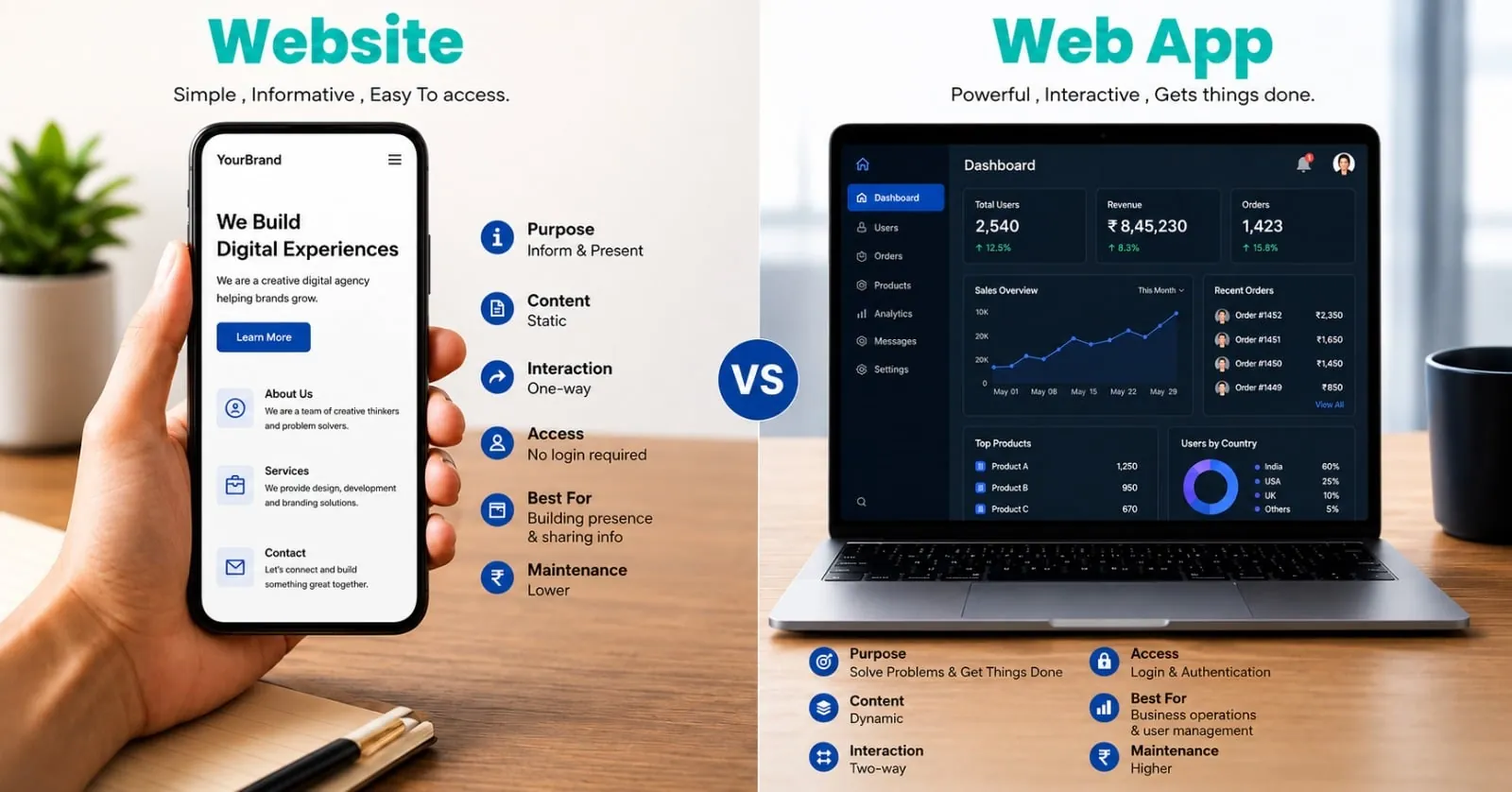
Web apps today are rarely “websites.”
They are:
- Customer portals
- Partner ecosystems
- Embedded analytics tools
- Subscription and billing engines
- Internal operations systems
- AI-assisted workflows
Users expect instant response. Boards expect reliability. Competitors ship fast.
Gartner’s 2025 software engineering outlook points to rising architectural pressure from AI-assisted development, distributed systems growth, and increasing delivery velocity expectations. That pressure lands directly on CTOs.

The first question: monolith or distributed system?
Let’s answer this directly.
Should you start with microservices?
Not always.
Microservices can scale teams, but they also introduce:
- Service sprawl
- Observability complexity
- Network failure modes
- Higher operational overhead
A modular monolith often wins early, especially for:
- Single product teams
- Clear domain boundaries
- Fast iteration needs
Microservices win when:
- Multiple teams ship independently
- Domains are mature
- Platform load is high
- Isolation is essential
The real answer is structure, not buzzwords.
Netflix and intentional microservice discipline
Netflix is still one of the clearest examples of scaling through service architecture, but the key lesson is not “microservices.”
The lesson is governance.
Netflix built:
- Strong observability
- Service ownership models
- Failure isolation
- Automated recovery patterns
Their architecture scaled because operations scaled with it.
CTOs should read Netflix as an operations case study, not just an architecture diagram.

Architecture Choice #1: API-first design
If your platform is growing, APIs are not optional.
API-first design means:
- Frontend and backend evolve independently
- Integrations don’t become brittle
- Partner ecosystems become possible
- Internal teams can build faster
Strong API discipline includes:
- Versioning
- Contract testing
- Clear ownership
- Backward compatibility
If you skip this, scaling becomes painful fast.
Architecture Choice #2: Event-driven systems for real scale
Many platforms hit limits because everything becomes synchronous.
Every request waits.
Event-driven architecture breaks that chain.
Examples:
- Order placed → emits event
- Inventory updates asynchronously
- Notification system reacts separately
- Analytics pipeline consumes events independently
This reduces coupling and improves throughput.
McKinsey’s research on digital platforms highlights that event-driven systems improve responsiveness and resilience in complex environments.
Architecture Choice #3: Frontend performance is architecture

Scaling is not only backend.
Frontend bottlenecks destroy user experience at scale.
CTOs should insist on:
- Code splitting
- Image optimization
- Performance budgets
- Monitoring real user metrics
Performance is not polish. It’s platform stability.
Architecture Choice #4: Observability is not optional
If you cannot see your system, you cannot scale it.
Modern scalable web app architecture requires:
- Distributed tracing
- Structured logs
- Metrics tied to SLOs
- Alerting that reduces noise
OpenTelemetry has become a standard layer for this.
Scaling without observability is guessing.
Architecture Choice #5: Data boundaries and single source of truth
Platforms break when data becomes inconsistent.
You see it in:
- Duplicate customer records
- Conflicting order status
- Misaligned reporting
- Hard-to-debug edge cases
Strong systems define:
- Data ownership
- Domain boundaries
- Clear truth sources
Without this, scale becomes confusion.
Shopify’s scale strategy
Shopify has published extensively on handling massive traffic bursts, especially during flash-sale events.
Their approach combines:
- Horizontal scaling
- Strong isolation patterns
- Queue-based load leveling
- Deep operational readiness
The key CTO takeaway: scale is architecture plus operational muscle.
Architecture Choice #6: DevSecOps maturity

Fast delivery without guardrails creates fragile systems.
In 2026, scalable platforms require:
- Automated security scanning
- CI/CD enforcement
- Dependency monitoring
- Secrets management
- Repeatable deployment pipelines
Security and scalability rise together.
Architecture Choice #7: Cloud strategy that avoids lock in traps
Cloud helps scale, but architecture must stay portable enough to avoid dead ends.
CTOs should design around:
- Container-based workloads
- Managed services where sensible
- Clear infrastructure boundaries
- Cost observability
Scaling without cost control becomes its own failure mode.
What CTOs should ask before committing to architecture
Here are the questions that matter:
- Will multiple teams ship independently?
- What is the latency budget?
- What failure modes are acceptable?
- How will we observe and debug production?
- What is the upgrade path in 24 months?
- What does governance look like?
These questions are architecture.
Where Deuex Solutions Fits

Scalable architecture is not a template. It’s a set of decisions tied to your business model.
Deuex Solutions helps enterprises build platforms that grow cleanly through disciplined engineering, architecture planning, and delivery governance.
Final Thought for CTOs
A scalable web app architecture is not a diagram.
It’s the set of trade-offs that decides whether your platform becomes a foundation or a bottleneck.
The best architectures in 2026 are:
- Observable
- Secure by design
- Modular
- Operationally realistic
- Built for change, not perfection
Scale is never one decision. It’s discipline over time.
Related reading
- Choosing the Right Partner for Business-Critical Web Products
- How Enterprises Build Modern Customer Portals with Web Apps
- Custom Web Application Development for Enterprises


Sanket Shah
CEO & Founder
I am Sanket Shah, founder and CEO of Deuex Solutions, where I focus on building scalable web mobile and data driven software products with a background in software development. I enjoy turning ideas into reliable digital solutions and working with teams to solve real world problems through technology.