Anyone curious about starting a career in web development in 2026 faces one reality: the field has grown broader and more demanding than ever. Yet, the fundamentals remain stable. A clear path exists - and this guide lays it out in detail. If your goal is to build real websites, ship dynamic web applications, or pursue a career in software, this web developer skills roadmap 2026 will guide you through each stage, showing exactly what to learn, when to learn it, and why it matters.
Along the way we’ll answer questions such as:
- What core skills should beginners master first?
- How does a full web development rollout look?
- What tools matter in 2026?
- How do you learn web development from zero to professional?

What is Web Development?
Web development refers to the process of building and maintaining websites and web applications. It starts with simple page markup, grows into interactive user experiences, and extends into server logic and cloud deployment.
There are three primary domains:
**Front-End Development
**This is what users see and interact with - the web pages, menus, buttons, and dynamic content shown in browsers. It relies on HTML, CSS, and JavaScript along with modern frameworks.
**Back-End Development
**This lives on servers. It includes business logic, data storage, APIs, authentication, and everything needed to make an app work behind the scenes.
**Full-Stack Development
**Combines both front-end and back-end knowledge. Full-stack developers build complete systems from the user interface to data storage.
The goal of this roadmap is to help you move from zero experience to building real projects and deploying them live on the web.
Why Learn Web Development in 2026?

Web development is not fading. Even in 2026, demand for web developers remains strong because the web is the default platform for nearly every digital experience - from e-commerce shops to enterprise software.
Companies continue to seek professionals who can build scalable, interactive sites and applications, maintain them, and grow them over time. Beyond jobs, web development skills unlock freelance opportunities, remote work, and roles in many tech niches.
A Step-By-Step Plan for Learning Web Development and Deployment for Beginners
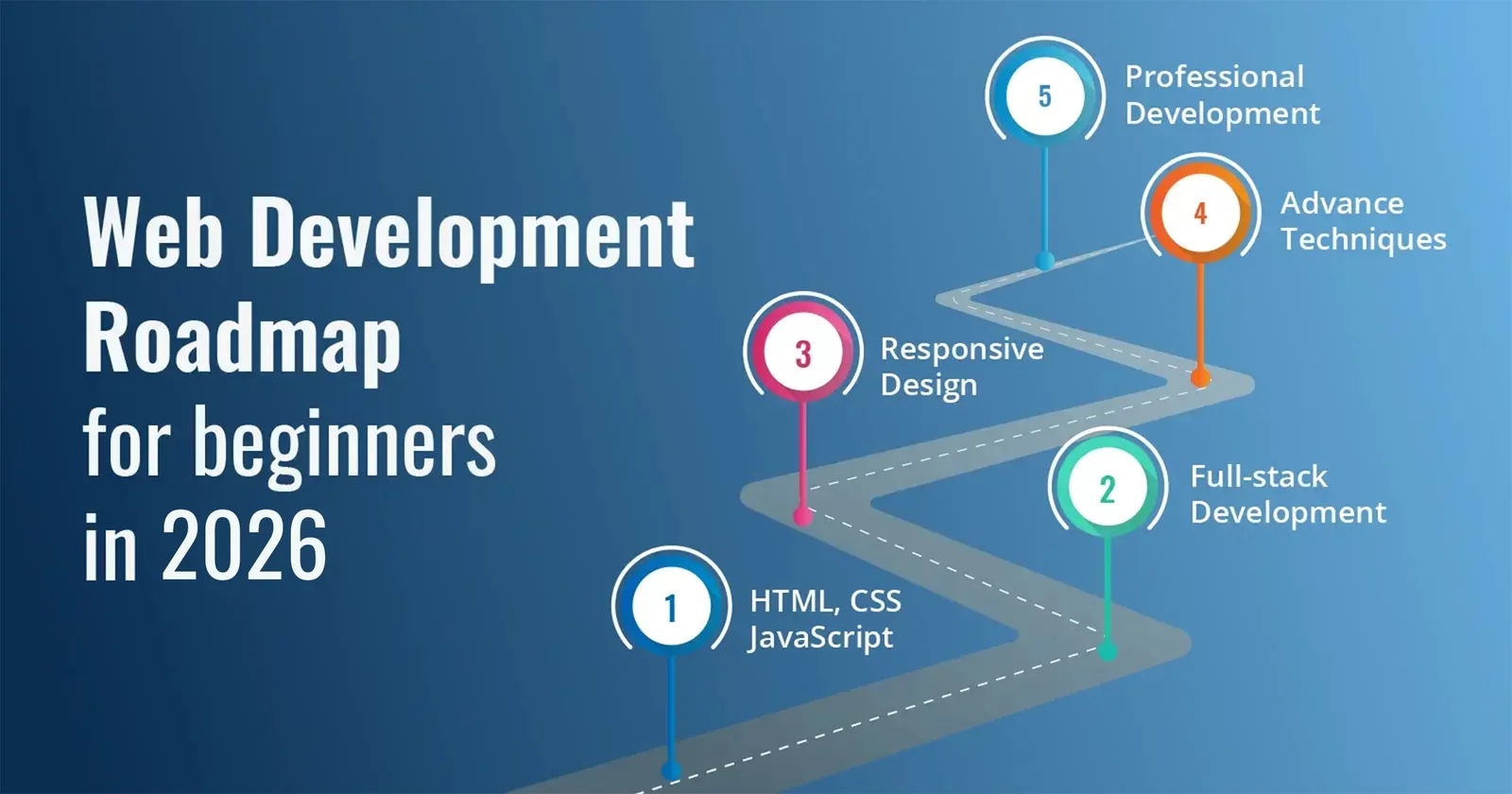
Below is the practical learning path you can follow. Each step builds on the previous one so that your skills grow steadily and logically.
Step 1: Core Building Blocks - HTML & CSS
Start here. These two languages form the foundation of the web:
HTML (HyperText Markup Language)
- Structures content
- Adds text, images, links, forms, and semantic meaning
CSS (Cascading Style Sheets)
- Controls design
- Shapes layout, typography, spacing, color
- Supports responsive design for mobile and desktop
These languages are not optional. Every web developer must master them before moving on.
Best learning tip: Build static pages (about pages, portfolios, landing pages) before trying complex applications.
Step 2: JavaScript Essentials
JavaScript is the scripting language of the web. Without it, pages would be static and unresponsive.
Key Concepts to Master:
- Variables and data types
- Functions and control flow
- DOM manipulation (interacting with page elements)
- Events (responding to clicks, input, navigation)
- ES6+ features (modern syntax)
JavaScript remains the most critical language for web developers. It powers client-side interactivity and now runs on servers too.
**JavaScript Roadmap-2026 Update:
**Today, a strong understanding of modern JavaScript includes learning about asynchronous patterns, TypeScript (a strongly typed extension of JavaScript), and how to interact with APIs.
Step 3: Responsive Modern Layouts

Once you know HTML, CSS, and JavaScript basics, make your sites look great on all devices.
Learn:
- Flexbox
- CSS Grid
- Media queries
- Mobile-first design
Responsive design ensures your creations work on phones, tablets, and desktops. Mobile traffic now dominates web usage, so this skill matters more than ever.
Step 4: Front-End Frameworks

Basic JavaScript is powerful, but real applications require structure. That’s where frameworks come in.
Choose one to start:
- React - widely used, many jobs around it
- Vue - simpler entry point, growing adoption
- Angular - comprehensive framework for larger teams
Framework skills let you:
- Build dynamic web apps
- Manage state effectively
- Render complex UI layouts
- Connect to backend APIs
Learning a front-end framework is a major milestone in the web developer skills roadmap 2026.
Step 5: Version Control with Git & GitHub
Every professional developer uses version control.
Learn how to:
- Track changes
- Commit updates
- Create branches
- Collaborate with others
- Push code to GitHub
Version control is essential for teamwork and portfolio building.
Step 6: Back-End Basics & Databases

A full web application needs logic that runs on servers and data storage.
Languages to learn:
- Node.js (JavaScript on server)
- Python (with frameworks like Django or Flask)
- PHP (still widely used)
Databases:
- SQL databases (MySQL, PostgreSQL)
- NoSQL (MongoDB)
Back-end work handles:
- Authentication
- Data fetch & store
- Business rules
- API creation
Server side knowledge opens the door to full-stack development, multiplying job opportunities.
Step 7: APIs and Data Transfer
APIs (Application Programming Interfaces) allow your front-end code to talk to the back end.
Learn how to:
- Build RESTful APIs
- Query data
- Parse JSON
- Handle API errors
Learning this makes your apps dynamic and connected.
Step 8: Deployment and Hosting
You will need to launch your work live on the internet.
Popular platforms:
- Netlify - easy front-end deployment
- Vercel - optimized for modern web apps
- AWS / Azure / Google Cloud - scalable backend hosting
Understand:
- DNS and domains
- Hosting setup
- SSL/TLS certificates
- CI/CD pipelines
Deploying projects improves confidence and strengthens your resume.
Step 9: Testing and Debugging
Debugging skills save hours of frustration. Use browser DevTools to:
- Inspect HTML elements
- Watch console logs
- Step through JavaScript code
- Test network requests and resources
More advanced testing tools (like unit and integration testing) increase application reliability.
Step 10: Advanced Front-End Skills
Once basic frameworks are familiar, explore:
- Progressive Web Apps (PWAs)
- State management libraries (Redux, Pinia)
- Component libraries
- Animations and transitions
These skills help your apps feel modern and professional.
Step 11: Cutting-Edge Back-End Ideas

For deeper expertise:
- Microservices architecture
- GraphQL APIs
- Serverless functions
- Real-time communication (WebSockets)
These trends are part of the software development roadmap for 2026 and beyond, especially in full-stack roles.
Step 12: DevOps Fundamentals for Web
Developers increasingly need to understand how apps operate after deployment.
Essential DevOps topics include:
- CI/CD pipelines
- Containerization with Docker
- Automated testing
- Performance monitoring
DevOps skills improve your ability to maintain and scale applications.
Step 13: Web Security Basics
Security can’t be ignored. Learn:
- Secure authentication
- Input validation
- HTTPS
- Cross-site scripting prevention
- Secure storage
These skills protect users and make your applications trustworthy.
Continuous Learning in Web Development
Web technologies evolve fast. To stay current:
- Follow trusted blogs and docs (e.g., Mozilla Developer Network)
- Join developer communities (e.g., GitHub, StackOverflow)
- Build real projects
- Contribute to open source
Online learning communities like freeCodeCamp provide structured learning with projects and certificates.
Linking This Roadmap to Real Career Paths
This roadmap is not academic. It maps directly to real roles - from junior web developer to senior full-stack engineer. Boards and hiring managers understand this sequence when evaluating candidates.
Consider exploring our site’s related guides:
- Web Developer Interview Preparation
- Deploying Web Apps for Beginners
- Front-End vs. Back-End: Which Path to Choose?

Final Notes - Climbing the Web Development Ladder
Your journey begins with fundamentals and grows into broad capability. Some paths accelerate into specialization - such as cloud development, performance engineering, accessibility expertise, or mobile-first design. Others lead to leadership roles in engineering.
The web development roadmap for beginners 2026 demands focus, real practice, and patience. But it also offers a clear plan, backed by industry demand and long-term viability.
Start with HTML & CSS. Master JavaScript. Build real projects. Learn deployment. Keep updating your skills as the tech evolves.
Web development is not a destination. It’s a practice - one that rewards builders, thinkers, and creators.
Related reading
- Boosting Web Security: Key Coding Practices to Mitigate Cybersecurity Threats
- Custom Web Application Development for Enterprises
- Web App Development vs Website: What Businesses Need


Sanket Shah
CEO & Founder
I am Sanket Shah, founder and CEO of Deuex Solutions, where I focus on building scalable web mobile and data driven software products with a background in software development. I enjoy turning ideas into reliable digital solutions and working with teams to solve real world problems through technology.