Quick Summary / Key Takeaways
- Web app vs website is not just a technical choice. It changes how your business serves users, collects data, supports workflows, and grows over time.
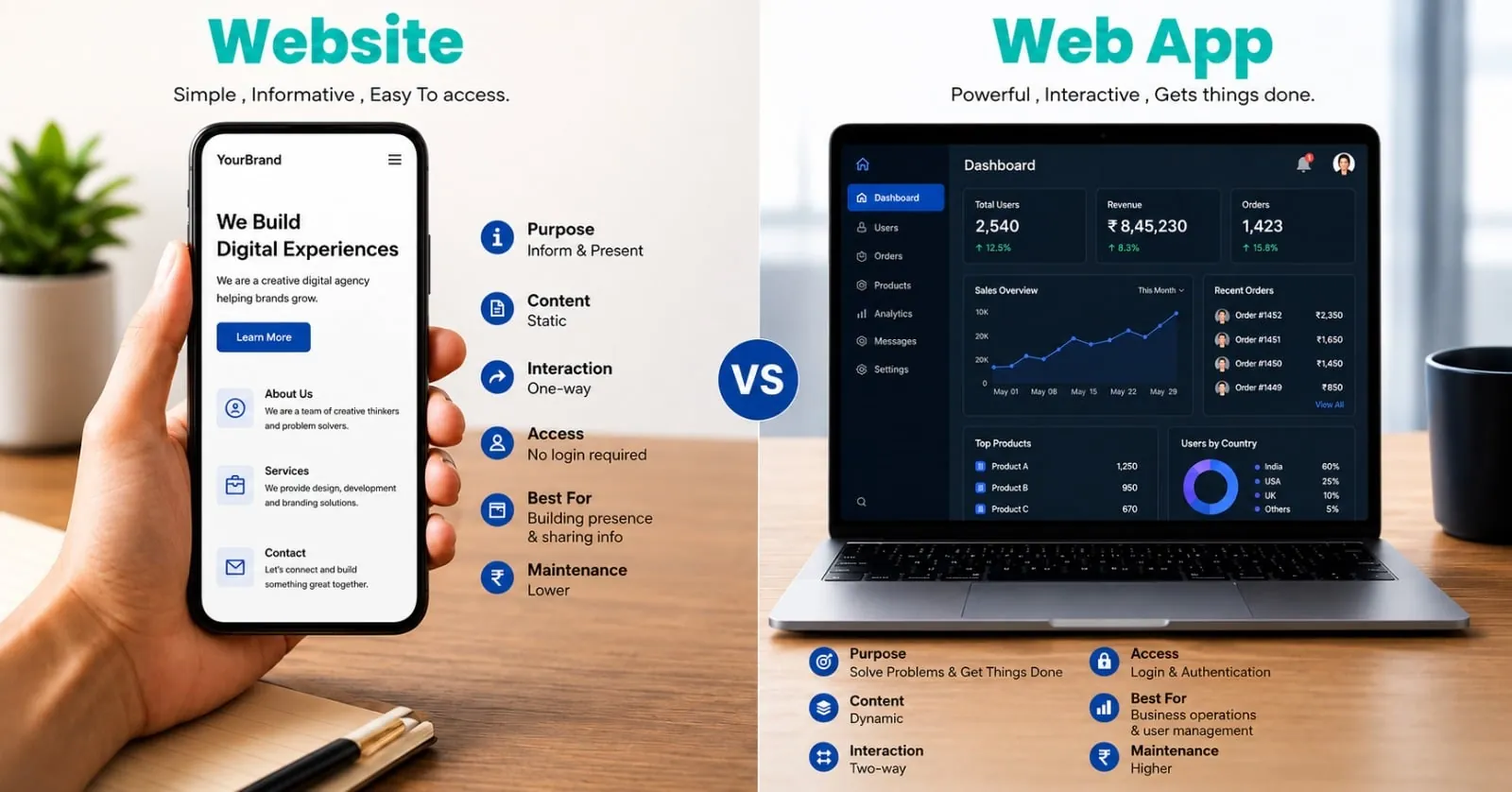
- A website is usually built to inform, attract, and convert visitors. A web app is built to help users do something.
- If your audience mainly reads, browses, and contacts you, a website may be enough.
- If your users need dashboards, logins, custom actions, or real time interactions, a web app is often the better fit.
- Many businesses do not actually need to choose one or the other forever. They start with a website, then add web app features as the business matures.
- Google’s performance research shows that faster mobile experiences lead to better conversion outcomes, which matters whether you build a website or a web app.
- MDN notes that progressive web apps are built with web technologies but can deliver an app like experience, including installability and some offline support.
Web app vs website is one of those questions that sounds simple until you start building. Then the confusion shows up fast. You want something modern, useful, and easy to scale. But do you really need an app, or are you paying for complexity you do not need yet?
This guide will help you answer that clearly, in plain language, without the usual tech fog.
Why businesses keep mixing up web apps and websites

A lot of business owners use both terms as if they mean the same thing.
That happens for a reason. Both live on the web. Both open in a browser. Both can look polished. Both can be mobile friendly.
But the purpose is different.
A website usually helps people read, learn, explore, or contact.
A web app helps people log in, work, manage, track, upload, or interact.
That difference matters more than design.
In our experience, many businesses start by saying, “We need a website,” when what they really need is a product portal, booking system, member dashboard, customer panel, or internal operations tool. That is where the conversation changes.
What is a website?
A website is a collection of public facing pages designed to share information and guide visitors toward an action.
That action could be:
- Reading about your company
- Viewing services
- Checking pricing
- Filling out a contact form
- Downloading a brochure
- Booking a call
- Buying a product
A normal business website often includes:
- Home page
- About page
- Service pages
- Blog
- Contact page
- Landing pages
The structure is mostly content driven. Even when a website includes forms or light interactions, the core purpose is still communication.
That is why websites are usually the first digital step for most businesses.
What is a web app?
A web app is a browser based application built for interaction, repeated use, and task completion.
Instead of just showing information, it lets users do something meaningful inside the system.
Examples include:
- Customer dashboards
- Project management tools
- Online booking platforms
- HR portals
- Learning management systems
- CRMs
- Inventory systems
- Analytics tools
- Client login portals
MDN describes progressive web apps as web experiences built with web technologies that can provide app like behavior, including installation and offline capabilities in some cases.
That line matters because it shows how the web has evolved. The gap between websites and apps has narrowed in some ways. Still, their business role remains very different.
Web app vs website: the core difference
Let’s make this easy.
A website talks to visitors. A web app works with users.
That one line clears up most of the confusion.
When a website is the right business choice
Not every business needs a web app. In fact, many do not.
A website is often the better choice when your goal is to:
- Build credibility
- Show services clearly
- Bring in leads
- Rank in search
- Publish content
- Share case studies
- Capture inquiries
- Support digital marketing campaigns
This is usually the smart move for:
- Service businesses
- Agencies
- consultants
- local companies
- early stage startups
- B2B firms testing demand
- brands focused on lead generation
When we worked with a company entering a new market, they first wanted a highly custom platform. After a few discovery calls, it became clear they did not need that yet. They needed a strong website with clear positioning, trust signals, lead forms, and content support. That lighter approach helped them launch faster and validate demand before investing in deeper product development.
That kind of restraint saves money.
When a web app makes more sense

You should start leaning toward a web app when users need more than content.
A web app becomes useful when people need to:
- Create accounts
- Access private dashboards
- Save preferences
- Track activity
- Upload files
- Manage data
- Collaborate with teams
- Complete repeat actions
- Receive personalized results
- Work inside the platform regularly
This is common in:
- SaaS products
- fintech tools
- healthcare platforms
- operations dashboards
- ecommerce management systems
- edtech portals
- logistics and supply chain systems
- employee tools
We noticed that once a business starts saying things like “users should be able to manage,” “customers should be able to track,” or “admins should be able to control,” the project is usually moving into web app territory.
That shift is easy to miss if you focus only on design.
Web app vs website for user experience
This is where the choice starts affecting revenue, retention, and internal productivity.
A website experience is usually linear. The visitor lands, explores, and takes a simple action.
A web app experience is active. The user comes back, interacts, and expects speed, continuity, and logic.
Here is how that feels in practice:
Google’s performance materials point out that faster pages and smoother mobile performance improve engagement and conversions. One Think with Google study cited improvements in conversion behavior with even small speed gains on mobile experiences.
That applies to both websites and web apps, but the pressure is even higher in web apps because users are trying to complete work, not just browse.
A slow website loses attention.
A slow web app loses trust.
The business goal should decide the build
This is where many projects go off track.
Business owners ask, “Which one is better?”
That is the wrong first question.
Ask this instead:
What do I need users to accomplish?
If the answer is:
- understand my business
- trust my brand
- contact my team
- discover my services
Then start with a website.
If the answer is:
- manage accounts
- automate steps
- track data
- use tools
- collaborate
- return daily
Then you are probably looking at a web app.
In our experience, the strongest digital builds are not based on trends. They are based on workflow.
That is the word many teams skip. Workflow changes everything.
Cost difference: web app vs website
This is often the part people want first.
A website usually costs less because it has fewer moving parts. A web app costs more because it includes logic, permissions, databases, testing, user roles, and deeper backend work.
A rough comparison looks like this:
The exact number depends on scope, but the pattern stays the same.
A website is usually a communication asset.
A web app is usually an operational asset.
That is why one is priced like digital presence and the other is priced more like product development.
Development timeline: what takes longer?
Web apps usually take longer. That is not because developers want to stretch timelines. It is because there is more to define, build, test, and refine.
Here is a simple comparison:
A website can often be planned and launched faster if the content is ready.
A web app usually needs more decision making before design even starts. User roles, data handling, permission levels, feature priorities, and integrations all take time.
When we worked with a client building a member platform, the most time consuming part was not the interface. It was defining how different users would behave inside the system. That kind of thinking does not show up on a homepage mockup, but it shapes the entire product.
SEO impact: which one ranks better?

For SEO, websites usually have the upper hand because they are built around public content, search intent, and crawlable pages.
That makes websites better for:
- blogs
- service pages
- location pages
- case studies
- landing pages
- educational content
A web app can support SEO around its public facing marketing pages, but the core application itself is often behind logins or not meant for ranking.
So if your goal is organic traffic, brand discovery, and inbound leads, a website plays a direct role.
If your goal is product usage and recurring actions, SEO matters less inside the application itself and more on the public pages around it.
This is why many strong SaaS companies use both:
- a public website for marketing and SEO
- a private web app for product delivery
That blend is often the right answer.
Can a website become a web app later?
Yes, and this is often the smartest path.
A business may begin with a strong website to test positioning, attract leads, and build trust. Later, once user needs become more specific, it can add app style functionality.
For example:
- A coaching business starts with a website, then adds a client portal
- A logistics company starts with service pages, then adds shipment tracking
- A B2B firm starts with lead generation, then adds account based dashboards
- A training company starts with content, then adds learning tools and user progress
MDN’s documentation on progressive web apps also shows that the web can support more app like experiences using modern browser technologies.
So no, this is not always a rigid either or decision.
You can build in stages.
That is often the financially safer move.
Real business examples: choosing the right path
Example 1: A local professional services firm
They needed stronger online visibility, better service presentation, and more leads. A website was the right answer.
A web app would have added cost without adding real business value at that stage.
Example 2: A subscription based platform
They needed users to sign in, manage access, view content based on plans, and track usage. A web app was the obvious fit.
A normal website could explain the product, but it could not deliver the actual service properly.
Example 3: A growing operations company
They first launched a website for branding, hiring, and lead generation. Six months later, after internal workflows became painful, they started building a web app for task allocation and reporting.
That sequence worked because the business need was proven before the heavier build began.
We have seen this pattern more than once. Businesses that stage their digital build often make better investment decisions than those trying to build everything at once.
Questions businesses should ask before choosing

Before you decide, ask these:
- What is the main business goal?
- Will users need accounts or private access?
- Do users need to complete tasks inside the platform?
- Is search traffic important to growth?
- Will this system need integrations or data handling?
- Do we need something now, or are we building for a later stage too?
- What will this need to become in 12 to 24 months?
Those answers usually point in the right direction faster than any trend report.
So what do most businesses actually need?
Most businesses do not need to jump straight into a complex web app.
They need clarity first.
A well planned website is often the right first move because it gives you:
- a clear public presence
- SEO value
- lead generation support
- trust building
- a place to explain what you do
Then, if your business model demands deeper interaction, you move into web app development with a stronger reason and better scope.
That is a healthier path than building an app just because the word sounds more advanced.
In our experience, businesses that start with real user behavior instead of digital vanity make better product choices. They spend more wisely. They launch faster. They learn sooner.
That matters.
What to do next if you are still unsure
If you are still deciding between a website and a web app, that is normal. The line can look blurry at first.
The better move is to map your business need before you map the technology.
If you need a strong public digital presence, better visibility, and a site that supports growth, start with the right foundation. If you already know your users need dashboards, workflows, or secure interactions, then it may be time to build something deeper.
You can explore Deuex Solutions’ web application development services to see what a more functional, growth ready solution can look like.
And if you want help deciding what fits your business best, contact our team for a practical conversation about scope, user needs, and the smartest next step.
Ready to choose the right digital path?
At Deuex Solutions, we help businesses plan, design, and build the right solution for the stage they are in. Sometimes that means a clear, conversion focused website. Sometimes it means a custom web app. Sometimes it means building one now and planning the other for later.
If you want clarity before you invest, reach out to Deuex Solutions today. We will help you decide whether your business needs a website, a web app, or a phased approach that gives you both without wasting time or budget.
Related reading
- Custom Web Application Development for Enterprises
- How to Choose a Web Application Development Company
- Why Are More Companies Turning to India for Web App Development?


Sanket Shah
CEO & Founder
I am Sanket Shah, founder and CEO of Deuex Solutions, where I focus on building scalable web mobile and data driven software products with a background in software development. I enjoy turning ideas into reliable digital solutions and working with teams to solve real world problems through technology.