


Why Customer Portals Matter More Than Ever
Customer portals have moved far beyond simple login dashboards. They now act as operational hubs where customers track orders, access services, analyze data, and interact with businesses in real time.
Engineering managers face a familiar challenge. Users expect fast and responsive interfaces, but enterprise platforms often carry heavy data loads and complex workflows.
That tension creates the core question.
How do you build customer portals that stay fast even as the system grows?
In many enterprise projects we worked on, frontend architecture made the biggest difference. The framework chosen at the beginning often determined how scalable the portal became later.
This is where Vue.js business applications stand out.
Vue.js offers a flexible and lightweight approach for building modern customer portals that remain fast, maintainable, and developer friendly.
What Makes Vue.js Suitable for Enterprise Customer Portals
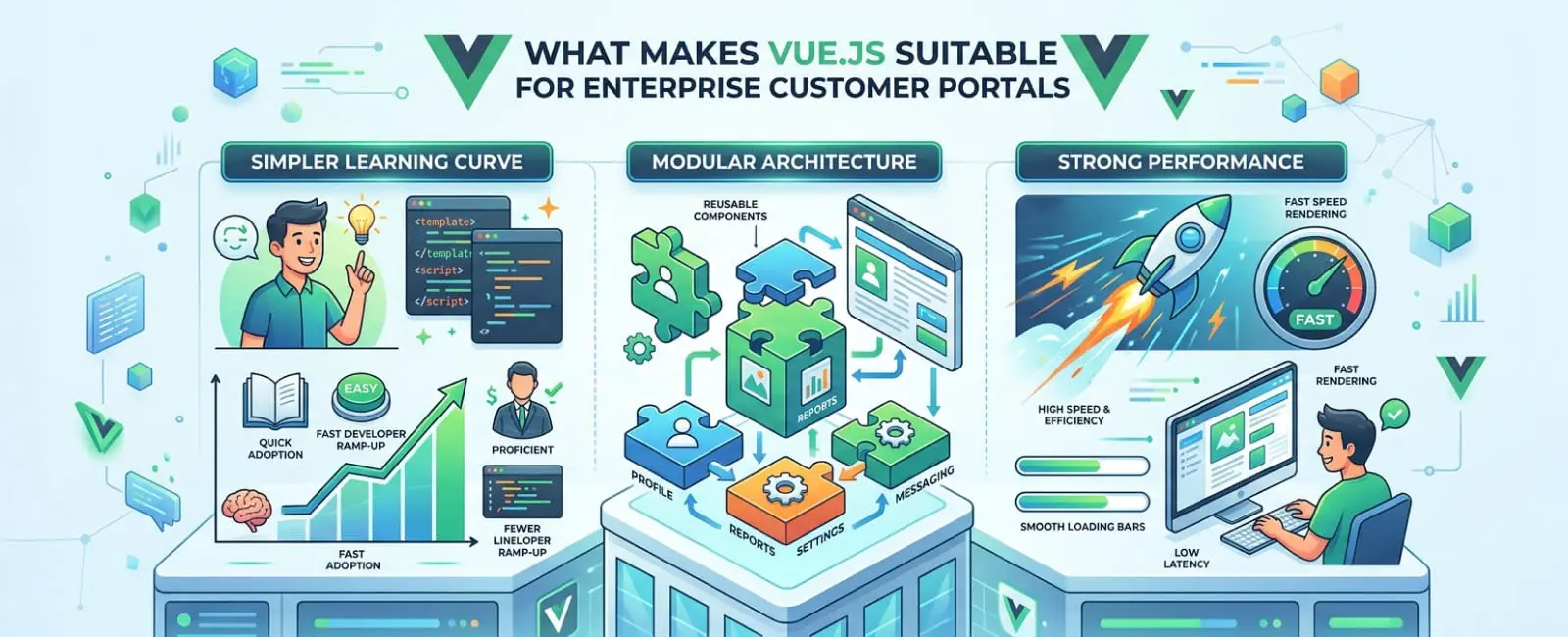
Engineering teams often evaluate frameworks like React, Next.js, and Vue when building customer platforms.
Each has strengths. Vue stands out for simplicity and performance balance.
Vue.js focuses on component based architecture. That structure helps teams build modular interfaces without overwhelming complexity.
From our experience building enterprise platforms, the most valuable advantages include:
Simpler Learning Curve
Vue allows developers to start quickly. The syntax remains readable even for teams new to modern frontend frameworks.
Engineering managers often appreciate this because onboarding becomes faster.
Modular Architecture
Customer portals usually grow over time. New modules appear regularly.
Examples include:
-
billing dashboards
-
analytics panels
-
user management interfaces
-
service request portals
Vue components help teams expand platforms without rewriting existing features.
Strong Performance
Vue’s reactive system ensures UI updates happen only where needed.
That helps maintain speed even in data heavy environments.
If your team plans to build scalable customer interfaces, our VueJS Development services provide architectural guidance and implementation support.
How Customer Portals Typically Grow Over Time
Many engineering managers underestimate how quickly portals evolve.
A platform that starts as a simple dashboard often becomes a full digital workspace.
When we worked with one enterprise client, the portal originally supported only three functions.
Within two years it expanded to include:
-
workflow automation
-
analytics dashboards
-
support ticket systems
-
AI driven insights
Frontend architecture suddenly became critical.
The initial system struggled to keep up with feature expansion.
After restructuring the frontend into modular Vue components, development speed improved significantly.
Why Performance Matters in Customer Portals

Customer portals are used repeatedly by the same users.
Slow systems quickly frustrate customers and internal teams.
Research from Google Web Performance Studies shows that user satisfaction drops sharply when page load times exceed three seconds.
In business environments, slow portals also affect productivity.
Employees and partners rely on these systems to complete daily work.
Even small delays accumulate into operational inefficiencies.
Vue.js helps maintain fast interfaces through its reactive architecture and lightweight runtime.
Vue.js and Data Heavy Business Interfaces
Customer portals often process large amounts of data.
Dashboards display analytics. Reports update continuously. Workflows trigger system actions.
Vue handles these scenarios well because its reactivity system updates only the parts of the interface that change.
Engineering teams do not need to refresh entire pages.
In several data driven platforms we built, this capability made a major difference.
Interfaces stayed responsive even when thousands of records appeared in dashboards.
For teams building analytics focused portals, it helps to combine frontend performance with streaming data architecture.
Core Architecture of Vue.js Business Applications
Customer portals typically rely on a layered architecture.
Vue handles the frontend layer while backend services process data and business logic.
A common structure looks like this.
Frontend Layer
Vue.js manages user interface components and state management.
Teams build reusable components such as:
-
dashboards
-
charts
-
user panels
-
workflow views
Backend Services
Backend APIs handle authentication, workflows, and data processing.
Many enterprises rely on technologies like:
These services communicate with the frontend through REST or GraphQL APIs.
DevOps Infrastructure
Customer portals require stable deployment pipelines.
Engineering teams often automate releases using tools such as: Jenkins
Continuous deployment ensures that portal updates reach users quickly without downtime.
Design Systems
User experience matters greatly for portals used daily.
Design frameworks often begin with structured UI design systems created using Figma.
When Vue.js Works Best for Enterprise Portals
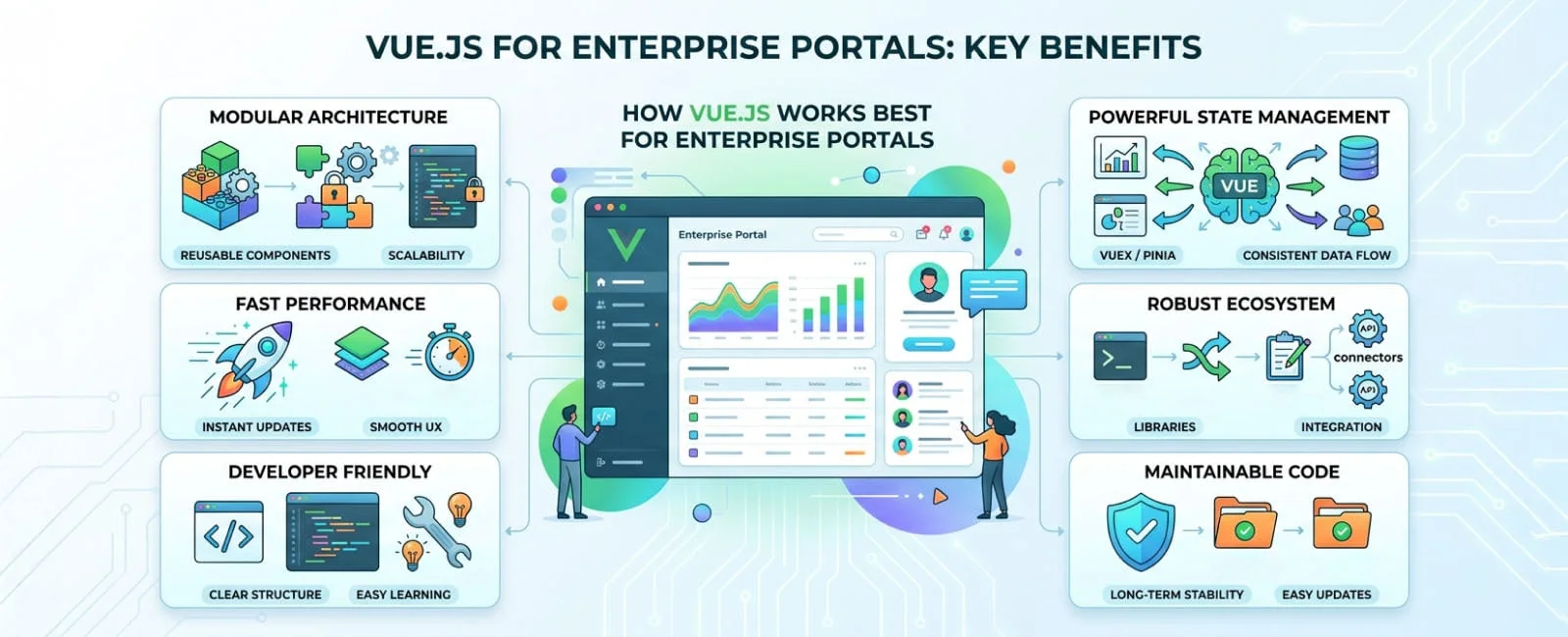
Vue is particularly effective in certain scenarios.
Engineering managers often choose it when projects require:
-
modular architecture
-
rapid feature expansion
-
responsive dashboards
-
lightweight frontend systems
Vue also works well when teams want strong performance without the overhead of complex frameworks.
Some organizations choose React or Next.js for SEO heavy platforms.
But for many operational portals used inside organizations, Vue provides an ideal balance.
Real World Example: Enterprise Operations Portal
A large manufacturing organization approached us with a challenge.
Their internal portal supported operational analytics across multiple factories. The system had grown over several years and performance issues appeared frequently.
Users reported slow dashboards and delayed interface updates.
The portal handled large operational datasets and required constant updates.
The engineering team restructured the frontend using Vue.js.
The result was noticeable.
Interfaces became faster and modular. New dashboard components could be added without disrupting existing features.
That same organization later expanded the system with predictive analytics tools.
Vue.js and AI Powered Customer Experiences
Customer portals increasingly include AI features.
Examples include:
-
conversational support assistants
-
automated recommendations
-
predictive analytics dashboards
Vue works well in AI powered environments because it supports dynamic UI updates.
AI systems can send real time insights to the frontend, and Vue updates the interface instantly.
Many businesses combine Vue interfaces with conversational systems.
When implemented correctly, AI features transform portals from static dashboards into interactive workspaces.
What Research Says About Customer Portal Experience
Research from Forrester highlights the growing importance of digital self service platforms.
Their studies show that more than 70 percent of B2B customers prefer solving service issues through digital portals instead of contacting support teams.
This shift means portals must deliver fast, reliable experiences.
Customers now expect the same responsiveness they see in consumer applications.
Engineering teams cannot ignore performance or usability.
Common Mistakes in Portal Development
Even experienced teams make avoidable mistakes while building customer portals.
These issues appear often.
Overloading the Frontend
Heavy client side processing slows down the interface.
Vue encourages modular architecture which helps distribute workloads effectively.
Poor API Design
Frontend performance depends on backend APIs.
If APIs return large datasets unnecessarily, the portal slows down.
Lack of Component Reuse
Teams sometimes build similar features repeatedly.
Vue components allow reuse across the application.
Ignoring User Experience
Portals often focus on functionality but overlook usability.
Clear navigation and intuitive design reduce user frustration.
How Engineering Managers Can Evaluate Vue.js
Choosing the right frontend framework involves several considerations.
Engineering leaders should evaluate the following.
Development Team Skills
Vue works well for teams that value readability and maintainability.
Developers can quickly understand component structures.
Application Complexity
Large portals benefit from Vue’s modular architecture.
Teams can expand features without rewriting existing components.
Integration with Existing Systems
Vue integrates easily with REST APIs and microservices.
That flexibility helps organizations modernize legacy systems gradually.
Long Term Maintainability
Clear component structure makes future development easier.
Teams can maintain the platform even as requirements evolve.
Lessons Learned from Enterprise Portal Projects

Working with large organizations reveals patterns that technical documentation rarely discusses.
One lesson stands out clearly.
Portal architecture decisions matter more than individual features.
When frontend architecture becomes messy, development slows down. Performance suffers. Teams spend more time fixing issues than building new capabilities.
In contrast, modular Vue based systems remain manageable even as platforms grow.
We noticed this repeatedly across industries.
Another lesson involves data flows.
Customer portals rarely operate in isolation. They connect with operational systems, analytics platforms, and workflow engines.
Engineering teams should design architecture that anticipates these integrations early.
The Future of Business Portals
Customer portals are becoming intelligent operational platforms.
They combine several capabilities.
-
analytics dashboards
-
automated workflows
-
AI driven insights
-
integrated communication systems
Frontend architecture must support this growth.
Vue.js business applications provide the flexibility needed to build these evolving systems.
Many organizations now treat portals as long term digital products rather than simple internal tools.
That shift changes how engineering teams design and maintain them.
When Should Companies Choose Vue.js
Vue.js is a strong choice when:
-
portals require responsive dashboards
-
applications process frequent UI updates
-
teams want modular frontend architecture
-
systems evolve continuously
Engineering managers also appreciate Vue because it reduces development complexity without sacrificing performance.
Teams can focus on solving business problems instead of fighting framework complexity.
Final Thoughts from the Field
During the past several years we worked with organizations building large operational platforms.
Customer portals often begin as small utilities.
Over time they evolve into mission critical systems.
That evolution places pressure on architecture decisions.
Vue.js offers a practical foundation for teams building high performance customer portals.
It supports modular development, responsive interfaces, and scalable systems.
For engineering managers responsible for platform reliability and growth, these qualities make a significant difference.
If your organization is planning a new portal or modernizing an existing system, our engineering teams can help design the right architecture.
Related reading
- Node.js for Real Time Data Platforms and AI Applications
- Next.js and AI: Building SEO Optimized Intelligent Platforms
- How to Create Dynamic Open Graph Images with Next.js


Sanket Shah
CEO & Founder
I am Sanket Shah, founder and CEO of Deuex Solutions, where I focus on building scalable web mobile and data driven software products with a background in software development. I enjoy turning ideas into reliable digital solutions and working with teams to solve real world problems through technology.

