

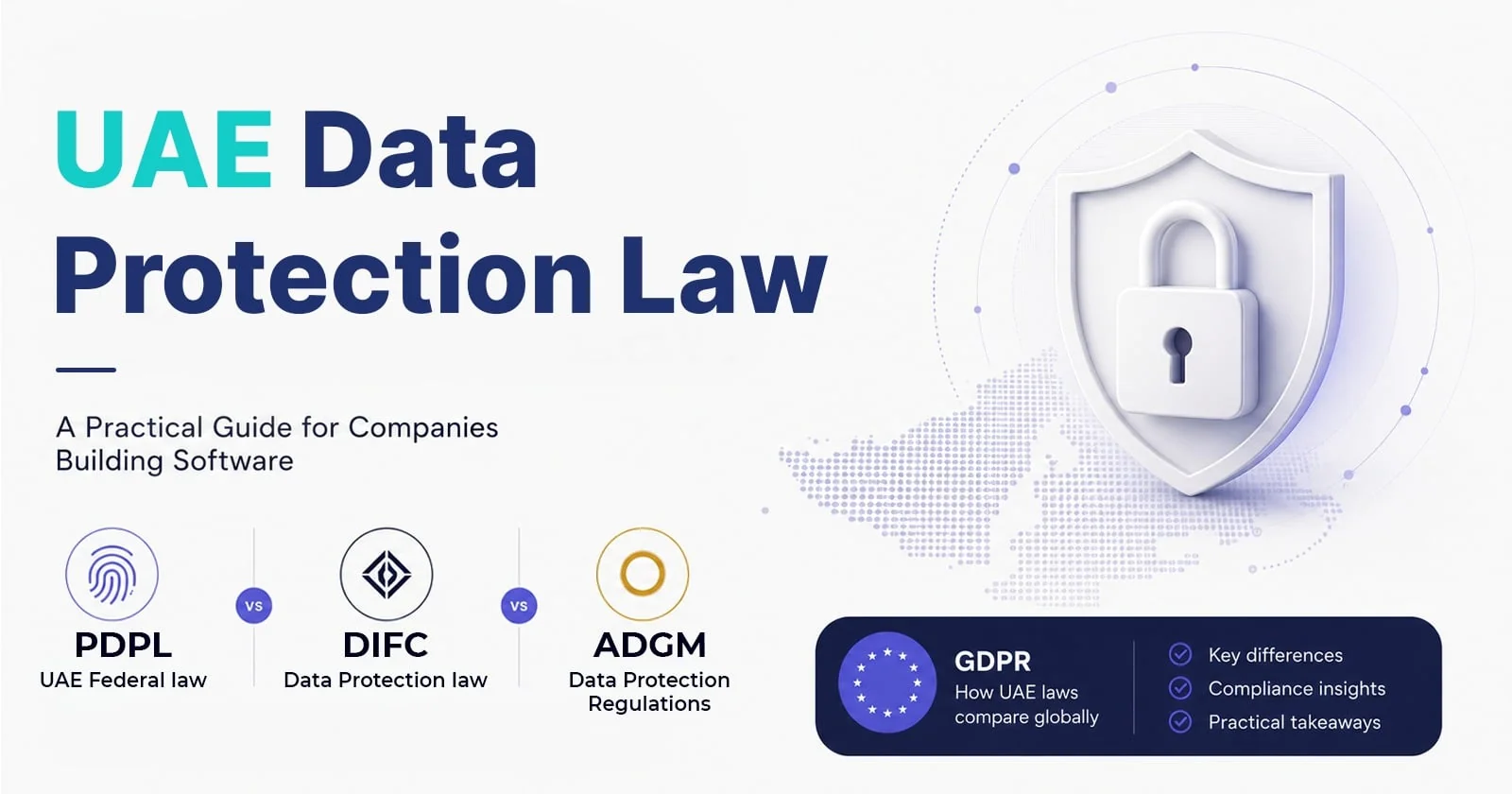
The uae data protection law is no longer something software companies can leave for the legal team after launch. If your SaaS product, mobile app, CRM, marketplace, fintech platform, AI tool, or internal dashboard collects personal data in the UAE, privacy has to show up in the product design itself.
For local delivery support, explore Deuex Solutions' software development services in Dubai for UAE-based planning, implementation, and long-term support.
One small choice can cause a large problem later. A missing consent log. A support ticket that stores passport data. A cloud vendor selected before anyone checks transfer rules. These things look harmless in sprint one. By sprint six, they can become expensive to repair.
This guide explains the personal data protection law UAE teams need to understand, how the federal PDPL compares with the DIFC data protection law and ADGM regime, and when GDPR in UAE becomes relevant for companies serving EU users.
Quick Summary: Key Takeaways
The UAE federal PDPL, Federal Decree Law No. 45 of 2021, is listed as active on the official UAE legislation portal and came into force on January 2, 2022. The law applies in several cases, including to controllers and processors in the UAE and to controllers or processors outside the UAE that process personal data of data subjects inside the UAE. It also excludes certain areas, including free zones that have special personal data protection legislation.
Why Software Companies Should Care Before the First Sprint
The first privacy question is rarely legal.
It is usually practical.
Can we store this data?
Can our support team see it?
Can we send it to a third party tool?
Can we train an AI feature on it?
Can the user delete it later?
That last question is where many products quietly break.
In our work with software teams, the problem is not always a missing privacy policy. More often, the real issue sits inside the product architecture. Customer data is copied into analytics events. Logs keep sensitive values forever. Admin users can see more than they need. Deletion works in the main database, but not in backups, search indexes, exports, or customer support notes.
That is where data protection UAE compliance becomes real.
The law may live in a PDF. Your risk lives in your database.
The UAE PDPL defines concepts that software builders should recognize quickly: controller, processor, consent, profiling, pseudonymisation, anonymization, automated processing, data breach, and data protection officer. These are not just legal labels. They map directly to product roles, data flows, permissions, logs, and backend services.
UAE Privacy Has Three Main Roads: Mainland, DIFC, and ADGM

Here is the part that often surprises founders.
There is not one single “Dubai data protection law” that covers every company in the same way. Your obligations may change depending on where your company is established and where processing happens.
The DIFC Data Protection Law No. 5 of 2020 applies to DIFC controllers and processors, and also to processing in DIFC under stable arrangements, including transfers out of DIFC. The DIFC Commissioner explains that the law covers rules for collection, handling, use, rights, and remedies, and the official consolidated version was updated through July 2025.
ADGM’s privacy rules apply to processing in the context of an ADGM controller or processor establishment, even where processing itself may take place outside ADGM. ADGM also requires record keeping for entities processing personal data, and its official fine rule says administrative fines must not exceed USD 28 million.
GDPR has its own reach. It can apply to a non EU company if that company offers goods or services to people in the EU or monitors their behavior in the EU. That is why “we are based in Dubai” does not always end the GDPR conversation.
What Does the UAE PDPL Ask Software Teams to Build?
Let’s make it simple.
The PDPL asks companies to treat personal data with purpose, restraint, clarity, and care. That sounds broad, but in software terms it becomes very specific.
1. Know what personal data you collect
You cannot protect data you have not mapped.
Start with a plain inventory:
-
What data do we collect?
-
Where does it come from?
-
Why do we need it?
-
Which service stores it?
-
Who can access it?
-
Which third parties receive it?
-
How long do we keep it?
-
What happens when a user asks for deletion?
The UAE PDPL includes principles around fair, transparent, lawful processing, specific purpose, data minimization, accuracy, security, and not keeping personal data after the purpose is exhausted unless identity is no longer linked to the data.
Small detail. Big effect.
If your onboarding form asks for Emirates ID, passport number, company license, phone, location, and payment details, but your product only needs email and billing status to create the account, you may have a minimization problem. The cleanest data is the data you never collect.
2. Treat consent as a product event, not a checkbox
Consent needs a timestamp, version, channel, purpose, and withdrawal path.
That sounds boring until a user asks, “When did I agree to this?” Your system should be able to answer.
Under the UAE PDPL, the controller must be able to prove consent, and consent should be clear, simple, unambiguous, easily accessible, and capable of withdrawal. Withdrawal can happen at any time and does not affect prior processing.
A practical consent log may include:
We have seen teams lose time because “consent” lived only in the UI. It was never stored as a real event. The frontend looked compliant. The backend had no memory.
That is a risky gap.
3. Build data subject rights into the admin workflow

The PDPL gives data subjects rights such as access to information, portability, correction, erasure in certain cases, objection to direct marketing, and objection to some automated processing and profiling.
This means your admin panel should not only help staff “manage users.” It should help them answer privacy requests.
A mature workflow often includes:
-
Export user data in a readable format
-
Correct inaccurate records
-
Trigger deletion or restriction
-
Stop marketing messages
-
Review automated decisions
-
Track who handled the request
-
Record completion dates
A privacy request should not become a Slack hunt across engineering, sales, support, and marketing.
That is when mistakes happen.
4. Plan for breach reporting before the breach
A breach plan should exist before anyone needs it.
Under the UAE PDPL, the controller must notify the Bureau when it becomes aware of a breach or violation that would prejudice the privacy, confidentiality, or security of personal data, within the period and measures set by the Executive Regulations. The processor must notify the controller as soon as it becomes aware.
Your software team should know:
-
What counts as a suspected breach?
-
Who investigates first?
-
Where are logs stored?
-
Who decides risk level?
-
Which vendors must report to you?
-
Who writes the notification?
-
How do you preserve evidence without exposing more data?
GDPR gives a useful benchmark here. It requires notifying the supervisory authority without undue delay and, where feasible, within 72 hours, unless the breach is unlikely to create risk for people.
Even when GDPR does not apply, the 72 hour habit is worth copying.
It forces readiness.
5. Use privacy by design as an engineering rule
The UAE PDPL requires security measures such as encryption, pseudonymisation, confidentiality, safety, accuracy, flexibility, timely retrieval, and regular testing and evaluation of measures. It also calls for DPIAs before certain high risk processing using modern technology.
GDPR uses a similar idea through data protection by design and by default, including measures such as pseudonymisation and data minimization.
For product teams, this means:
-
Default settings should collect less data, not more.
-
Admin access should follow role needs.
-
Logs should avoid raw personal data.
-
Sensitive exports should expire.
-
Production database access should be rare and tracked.
-
Analytics events should be reviewed before release.
-
Test data should be masked or synthetic.
A feature can be fast and still create a mess.
The better question is: will this feature still look sensible during an audit?
PDPL vs DIFC vs ADGM: Practical Build Decisions

This table is where founders, CTOs, and product managers should spend a few minutes.
DIFC has official guidance on data export and sharing, including adequacy, contractual clauses, internal data protection policies, and government authority sharing rules. The DIFC Commissioner also provides guidance tools, including breach reporting and records resources.
How GDPR in UAE Fits Into the Picture
A UAE company may need to think about GDPR when it serves EU based users.
For example:
-
A Dubai SaaS company sells subscriptions to customers in Germany.
-
A UAE marketplace targets EU residents with localized offers.
-
An analytics product monitors behavior of visitors in France or Spain.
-
A mobile app tracks EU users for profiling, ads, or personalization.
GDPR’s core principles include lawfulness, fairness, transparency, purpose limitation, data minimization, accuracy, storage limitation, integrity, confidentiality, and accountability. Its lawful bases include consent, contract, legal obligation, vital interests, public task, and legitimate interests.
GDPR’s higher tier administrative fines can reach EUR 20 million or 4 percent of worldwide annual turnover, whichever is higher.
Here is the practical lesson: if you build your UAE product with GDPR style controls from the start, you may reduce rework later. Not perfectly. Laws differ. But the habits travel well.
A Software Builder’s PDPL Checklist
This is the part you can turn into backlog tickets.
Sprint 1: Map the data
Create a simple data flow map before writing too much code.
Include:
-
Account data
-
Billing data
-
Support data
-
Marketing data
-
Logs
-
Analytics events
-
Uploaded files
-
AI prompts and responses
-
Third party tools
-
Backups and archives
The map does not need to be fancy. It needs to be honest.
Sprint 2: Reduce what you collect
Ask one uncomfortable question for every field.
Why do we need this?
If the answer is “maybe later,” remove it. Future curiosity is not a strong reason to collect personal data now.
Sprint 3: Add consent and preference controls
Build consent as a backend event.
Users should be able to say yes, say no, and change their mind. Your system should remember each action clearly.
Sprint 4: Design access by role
Support should not see everything.
Sales should not see identity documents. Developers should not browse production data without a strong reason. Admin access should be logged, reviewed, and limited.
Simple rule: fewer eyes, fewer surprises.
Sprint 5: Prepare deletion and export
Deletion is not one button unless your architecture makes it one button.
You may need to handle:
-
Main database records
-
File storage
-
Search indexes
-
CRM tools
-
Support tools
-
Marketing tools
-
Analytics platforms
-
Backups
-
Audit logs that must be retained
This is where early design pays off.
Sprint 6: Review vendors and transfers
Every vendor is a privacy decision.
Cloud hosting, email tools, payment gateways, analytics, chat widgets, AI APIs, error tracking, customer support tools, and CRM platforms may all touch personal data.
Before adding a vendor, ask:
-
What personal data will they receive?
-
Where will they store it?
-
Are they a processor or independent controller?
-
What contract terms apply?
-
Can they support deletion and access requests?
-
Do they use subprocessors?
-
What happens during a breach?
This is not paperwork for the sake of paperwork. It tells engineering what can safely connect to what.
Real Examples Software Teams Recognize
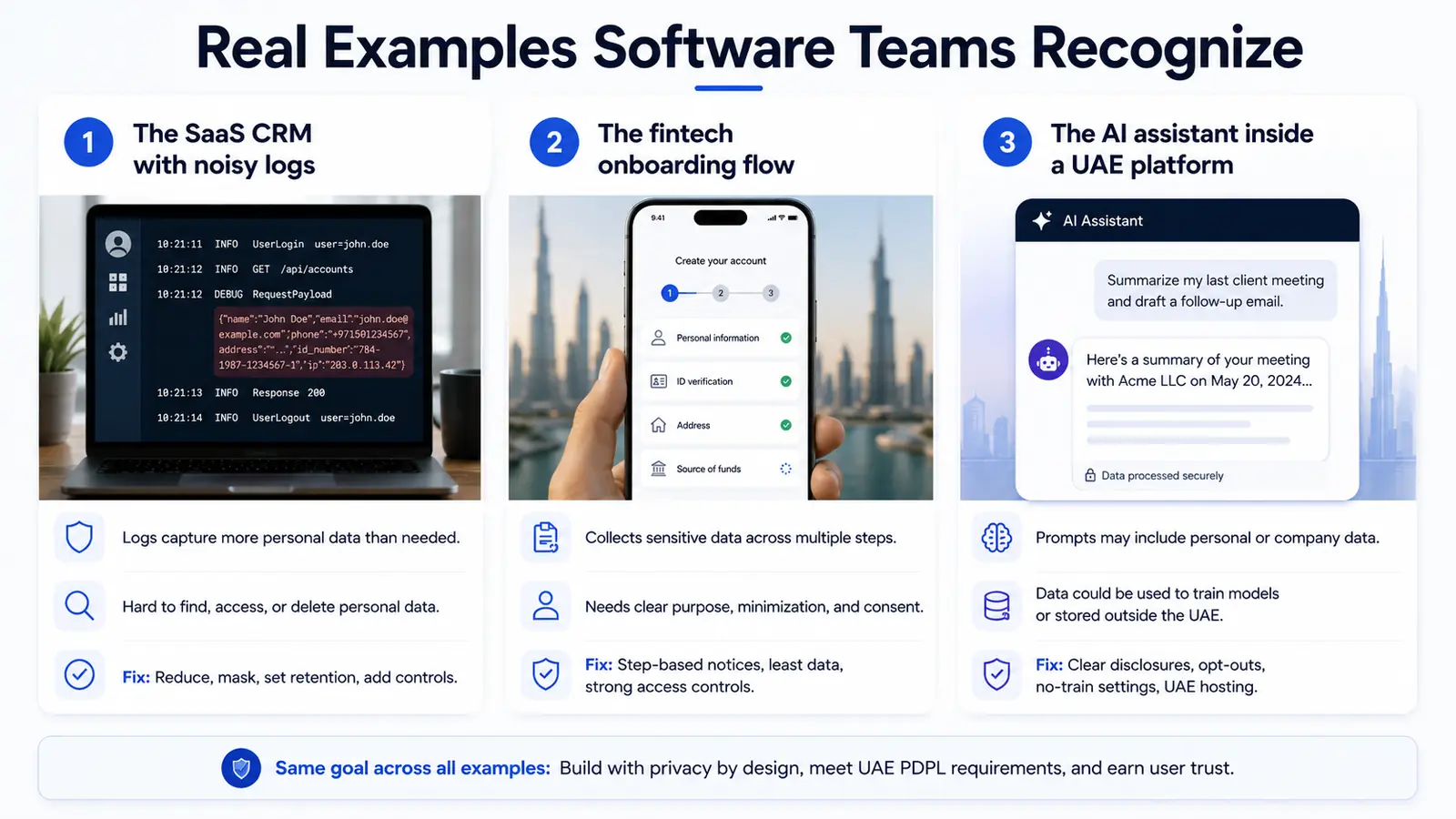
Example 1: The SaaS CRM with noisy logs
A CRM product looked clean in the database. Then someone checked the logs.
The logs stored names, emails, phone numbers, notes, and sometimes customer documents inside error messages. Nobody meant for that to happen. It came from quick debugging during a launch rush.
The fix was not dramatic. Redact sensitive values. Stop logging full payloads. Shorten retention. Restrict log access. Add review checks before new events ship.
The outcome was practical: less data exposure, faster reviews, and fewer awkward questions during vendor due diligence.
Example 2: The fintech onboarding flow
A fintech style onboarding journey collected identity data, proof of address, bank details, and risk scoring outputs.
The team first focused on the privacy policy. Then we looked at the product flow.
The bigger issue was not the policy. It was access. Too many internal users could view too much sensitive data. Some documents were also copied into a customer support tool because it was convenient.
The cleaner design separated document review from general support, masked sensitive fields, and created a clear retention rule. The product became easier to operate because staff saw only what they needed.
Example 3: The AI assistant inside a UAE platform
The feature looked harmless: let users ask questions inside the app.
Then came the real question. Were users pasting personal data into prompts? Were prompts stored? Were they sent to a third party model? Could the model provider use them for training? Could a user ask for deletion later?
AI makes privacy feel new, but the basics are old: know the data, know the purpose, control access, explain the use, and keep records.
IBM and Ponemon’s 2025 Cost of a Data Breach research reported a USD 4.4 million global average breach cost and said ungoverned AI systems were more likely to be breached and more costly when breached.
Cisco’s 2026 Data and Privacy Benchmark Study, based on a double blind survey of more than 5,200 IT, technology, and security professionals across 12 markets, found that 90 percent reported privacy programs expanding due to AI, while 46 percent identified clear communication about data use as the most effective action to build customer confidence.
That suggests something simple: privacy is not only a legal shield. It is also a product trust signal.
Build Privacy Before It Becomes Rework
Most companies do not get into trouble because one person ignored the law.
It is usually quieter than that.
A product grows. A few tools are added. Data starts moving through support, analytics, marketing, AI, and cloud services. Nobody owns the full picture. Then a customer, investor, enterprise buyer, regulator, or partner asks one clear question:
Where does our data go?
If the team cannot answer, trust drops.
The better path is to build the answer into the product from the start.
At Deuex Solutions, we help companies plan and build software with privacy aware architecture, cleaner data flows, safer vendor choices, and practical engineering controls. If you are building a SaaS product, fintech platform, marketplace, AI tool, or business application for the UAE, start with the architecture before the privacy policy.
Ready to review your product before privacy becomes expensive rework? Contact Deuex Solutions and let’s map the next step.
Related reading


Sanket Shah
CEO & Founder
I am Sanket Shah, founder and CEO of Deuex Solutions, where I focus on building scalable web mobile and data driven software products with a background in software development. I enjoy turning ideas into reliable digital solutions and working with teams to solve real world problems through technology.


