

The Growing Role of Python in AI Platforms
Artificial intelligence platforms are expanding rapidly. Businesses across industries are building systems that analyze data, automate decisions, and predict outcomes.
Behind many of these systems sits a familiar technology.
Python.
Over the past decade Python has become the dominant language for machine learning and AI systems. Its ecosystem continues to evolve as AI platforms grow more sophisticated.
Many CIOs and AI leaders ask a practical question.
Why does Python remain the preferred language for AI platforms even as new technologies emerge?
The answer lies in its combination of simplicity, ecosystem strength, and scalability.
In our experience working with enterprise AI systems, Python provides a reliable foundation for both experimentation and production deployment.
Organizations building intelligent platforms often begin with Python based models and gradually expand into full scale AI platforms.
Why Python Continues to Lead AI Development
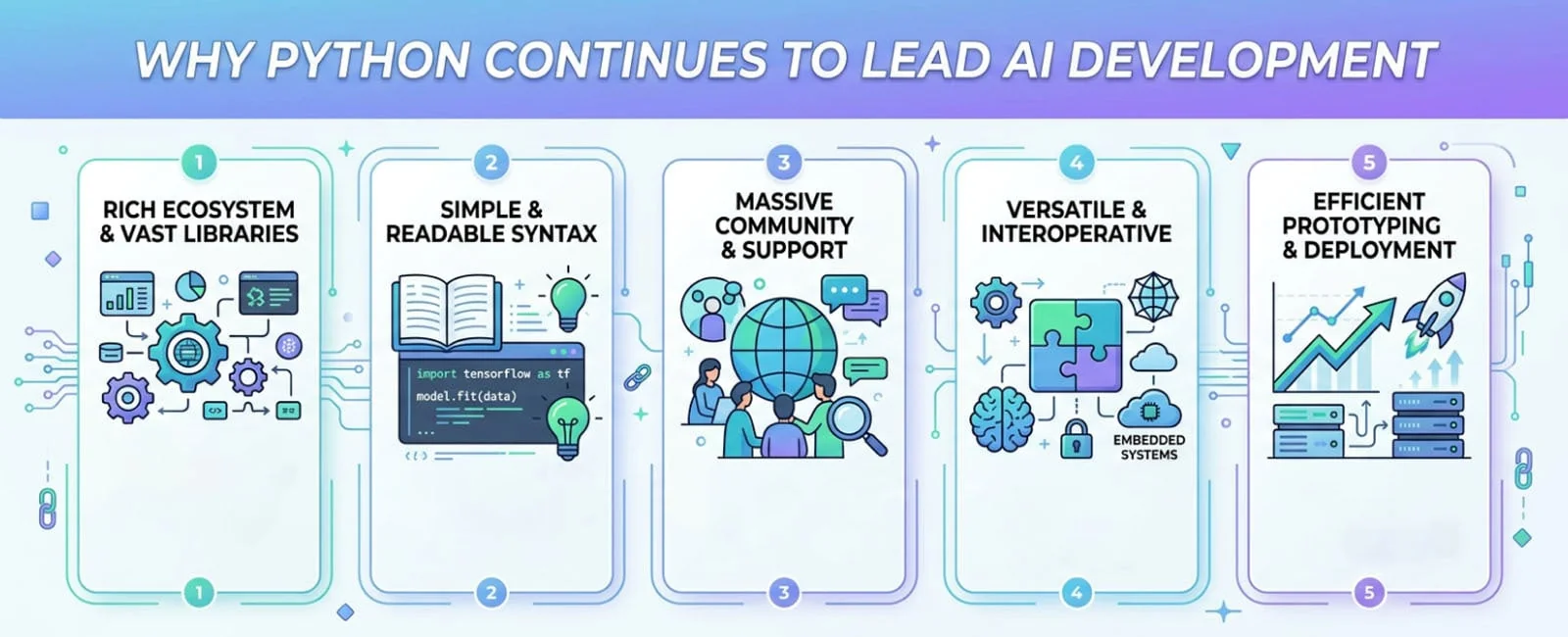
Several programming languages support machine learning. Python stands apart because of its ecosystem.
Its libraries support almost every stage of AI development.
From data preparation to model deployment, Python tools remain widely adopted across the industry.
Key reasons organizations choose Python include:
Extensive AI Libraries
Python supports widely used machine learning frameworks such as:
- TensorFlow
- PyTorch
- Scikit learn
- Pandas
- NumPy
These libraries accelerate development and reduce engineering effort.
Strong Developer Community
Python has one of the largest developer communities in the world.
This community continuously improves frameworks, tools, and libraries.
Faster AI Prototyping
AI research often begins with experimentation.
Python allows teams to build and test models quickly before deploying production systems.
For organizations building intelligent applications, our Python Development services help design scalable AI platforms and backend systems.
The Evolution of AI Platforms by 2026
AI platforms are changing rapidly. Early machine learning projects focused mainly on predictive models.
Modern AI platforms now combine multiple capabilities.
These include:
- real time analytics
- machine learning pipelines
- conversational AI systems
- recommendation engines
- generative AI interfaces
Platforms must process large volumes of data while delivering insights quickly.
This shift requires scalable backend infrastructure.
Python remains central to this ecosystem because it integrates easily with data pipelines, cloud platforms, and AI frameworks.
AI Systems Depend on Data Pipelines
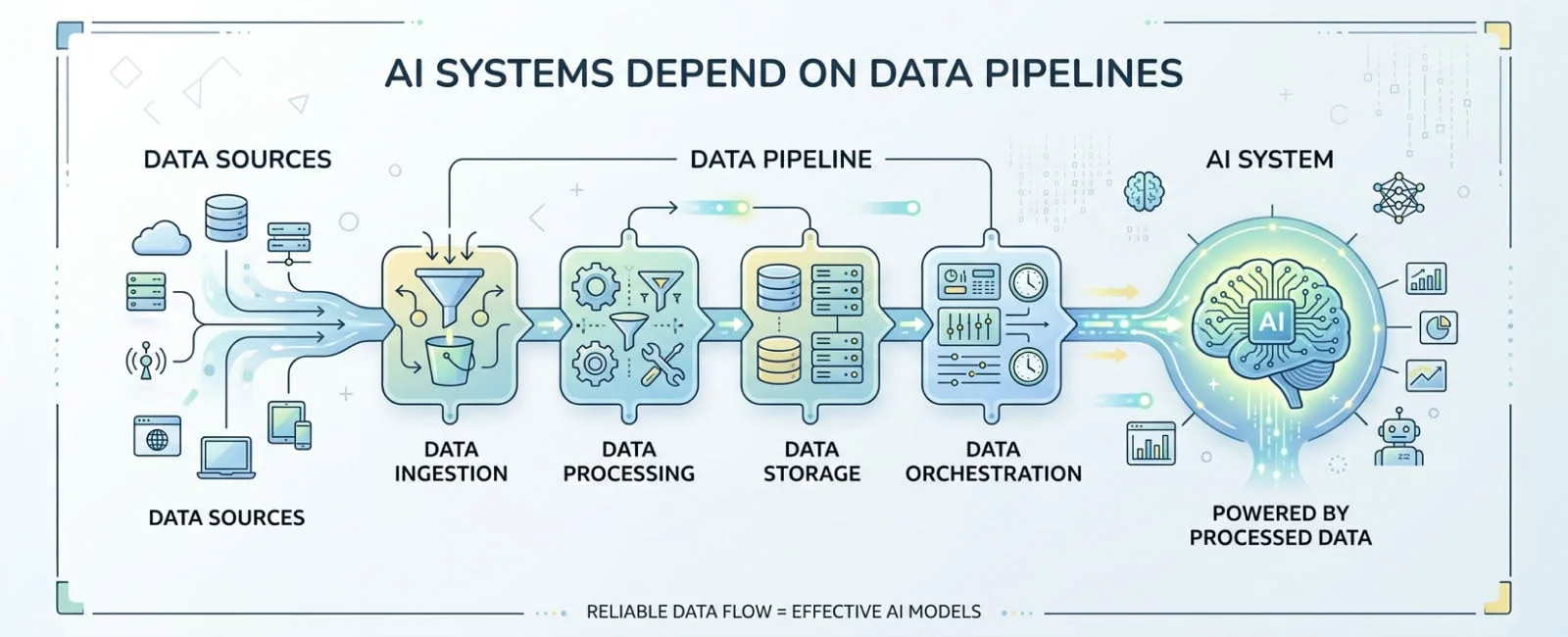
Machine learning models require continuous data input.
Without structured data pipelines, models cannot produce reliable results.
Many organizations are building real time data platforms to support AI systems.
These platforms stream operational data into machine learning models and dashboards.
Python often plays a key role in processing this data before it reaches machine learning models.
Libraries such as Pandas and Apache Spark connectors allow engineers to transform and analyze datasets efficiently.
Python and AI Driven Business Applications
AI platforms are no longer limited to research labs. Businesses now integrate AI into operational systems.
Examples include:
- predictive maintenance systems
- fraud detection platforms
- automated customer support systems
- intelligent recommendation engines
These applications rely on machine learning models that analyze data patterns continuously.
Python simplifies development because it supports the full lifecycle of AI systems.
In one industrial analytics project we worked on, machine learning models predicted equipment failure using operational data streams.
Python handled model training while backend services delivered predictions to operational dashboards.
The Role of Python in AI Platform Architecture
Enterprise AI systems rarely depend on a single technology.
They operate through layered architecture.
Python typically serves as the machine learning and analytics layer within this structure.
A common architecture includes the following components.
Frontend Interfaces
Users interact with AI insights through dashboards and web applications.
Popular frontend technologies include:
- ReactJS
- VueJS
- NextJS
These interfaces visualize predictions, reports, and AI insights.
Backend Services
Backend APIs connect frontend applications with AI systems.
Technologies frequently used include:
- NodeJS
- Java
These systems manage authentication, workflow orchestration, and API communication.
Machine Learning Layer
Python operates within this layer.
Engineers build models, train algorithms, and process datasets.
Frameworks such as TensorFlow and PyTorch support advanced AI models.
DevOps and Deployment
AI systems require stable deployment pipelines.
Many organizations use CI CD automation through tools such as Jenkins.
Design and User Experience
AI platforms must remain accessible to non technical users.
Design systems often begin with tools like Figma.
Python and Conversational AI Systems
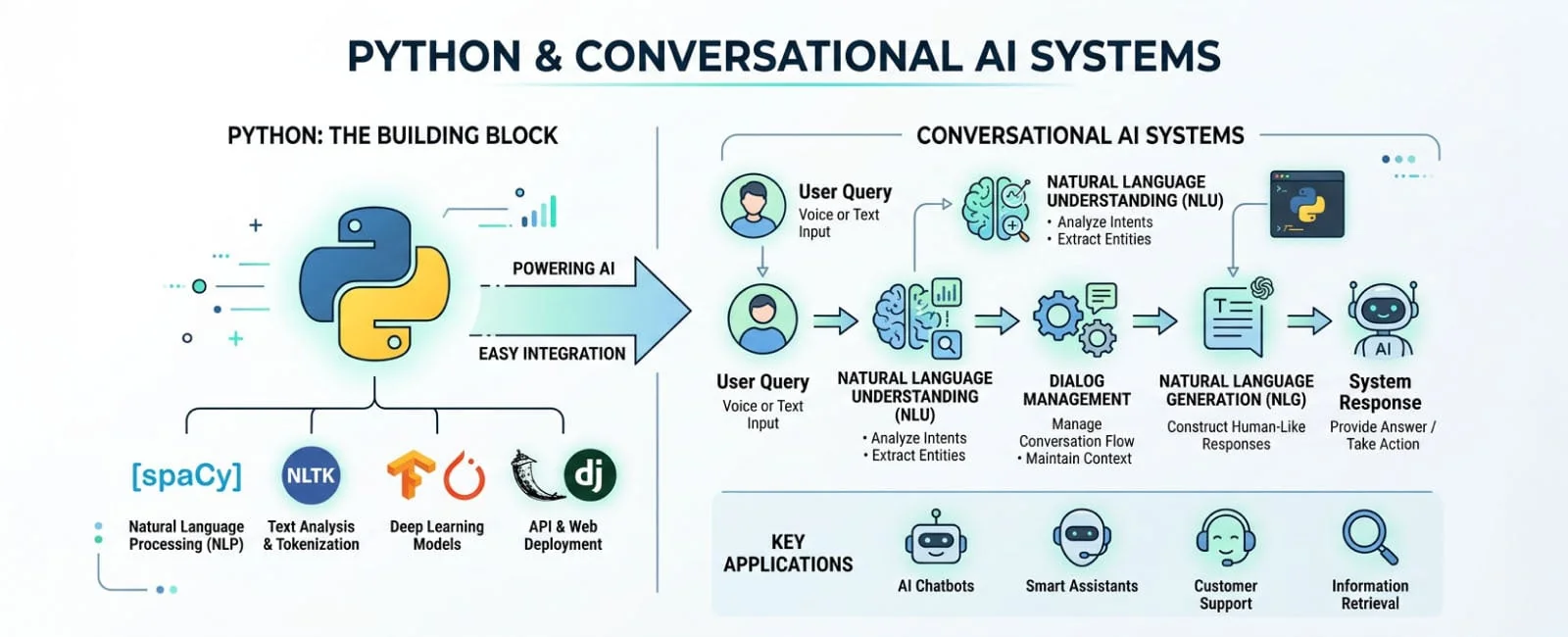
Conversational AI platforms are expanding quickly.
Businesses use chatbots and AI assistants to automate customer interactions and internal workflows.
Python supports conversational AI development through natural language processing frameworks such as:
- spaCy
- Hugging Face Transformers
- NLTK
These frameworks allow engineers to build systems capable of understanding and generating human language.
Many enterprise platforms combine conversational AI with backend automation systems.
In our experience building conversational platforms, Python models often handle language processing while backend services manage workflows and integrations.
Research Insights on Python and AI Adoption
Industry research supports the widespread adoption of Python for AI platforms.
A study from Stack Overflow Developer Survey consistently ranks Python among the most widely used languages for machine learning and data science.
Another report from McKinsey Global Institute highlights the rapid adoption of AI systems across industries.
The research suggests that organizations integrating AI into operations improve productivity and decision making significantly.
Suggested external link structure:
These insights reinforce the importance of scalable AI platforms supported by strong development ecosystems.
Challenges in AI Platform Development
AI systems bring tremendous value, but they also introduce engineering challenges.
Organizations often encounter similar issues during implementation.
Data Quality Problems
Machine learning models rely on accurate datasets.
Poor data quality leads to unreliable predictions.
Model Deployment Complexity
Moving models from research environments into production systems can be difficult.
Engineering teams must design deployment pipelines carefully.
Infrastructure Requirements
Large AI models require scalable infrastructure and compute resources.
Integration with Business Systems
AI models must connect with operational systems to deliver real value.
Python frameworks help address many of these challenges because they support data processing, experimentation, and production deployment.
When Organizations Should Use Python for AI Platforms
Python works particularly well in scenarios where companies require:
- machine learning model development
- natural language processing systems
- predictive analytics platforms
- data science pipelines
- AI research and experimentation
CIOs often choose Python because it supports both early experimentation and long term platform development.
This flexibility reduces technology switching later.
Lessons from Enterprise AI Projects
Working with enterprise clients reveals practical insights about AI platform development.
One lesson appears repeatedly.
AI success depends on platform architecture as much as model accuracy.
When we worked with an enterprise organization building a global operational analytics platform, the initial challenge involved integrating AI predictions into daily workflows.
The project improved significantly once the architecture connected machine learning models with operational dashboards and APIs.
In many AI initiatives we observed, the biggest improvements came from improving data pipelines and backend architecture rather than adjusting algorithms.
The Future of Python in AI Platforms
Looking ahead to 2026 and beyond, Python will likely remain central to AI platform development.
The ecosystem continues expanding with new frameworks and tools.
Generative AI, real time analytics, and intelligent automation platforms all depend on scalable data and machine learning infrastructure.
Python supports these capabilities through flexible libraries and strong community support.
Organizations investing in AI platforms today often choose Python as the foundation for their machine learning systems.
What CIOs Should Consider Before Building AI Platforms
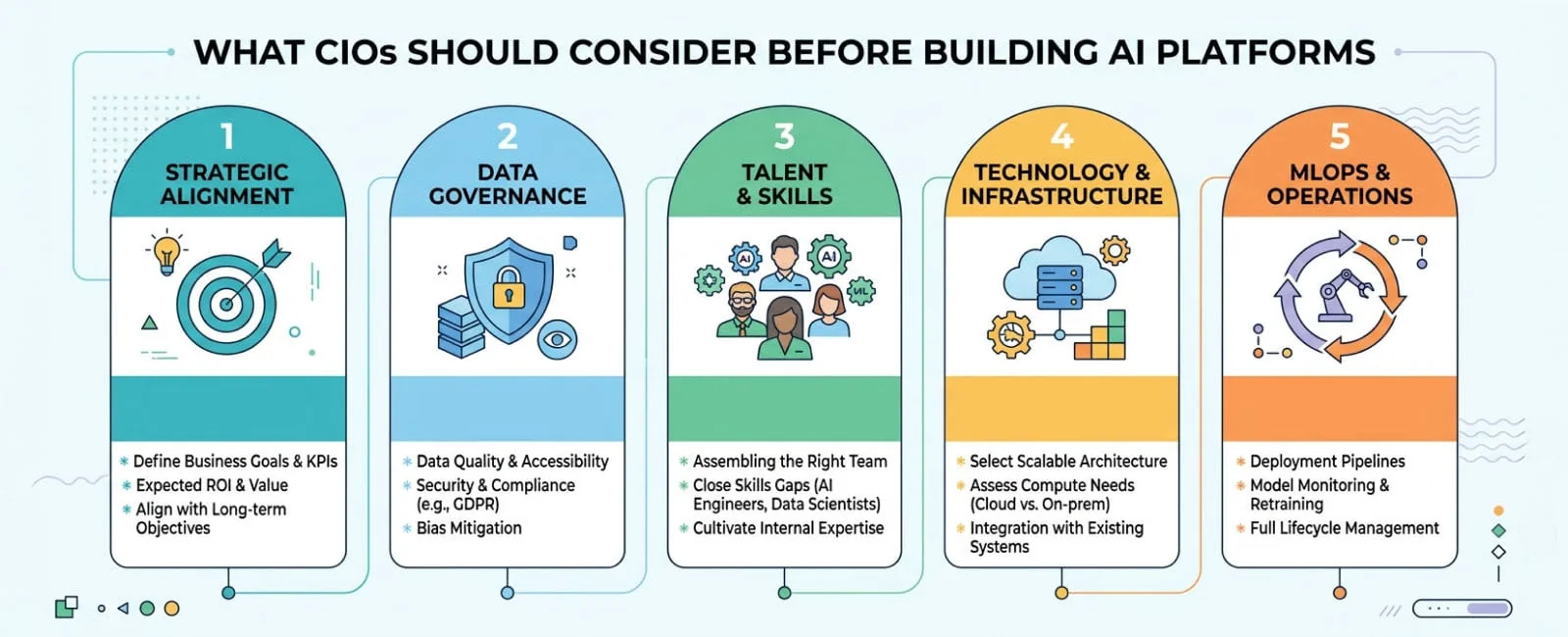
Before launching AI initiatives, leadership teams should evaluate several strategic factors.
Data Availability
AI systems depend heavily on data.
Organizations must ensure consistent access to high quality datasets.
Infrastructure Readiness
Machine learning platforms require compute resources, storage systems, and scalable pipelines.
Business Use Cases
AI should solve meaningful business problems rather than experimental ideas.
Examples include predictive analytics, automation, and intelligent recommendations.
Technology Ecosystem
Python integrates easily with cloud platforms, data pipelines, and backend services.
This flexibility makes it suitable for enterprise AI systems.
Final Thoughts from the Field
AI platforms are becoming core infrastructure for modern organizations.
From predictive analytics to intelligent automation, businesses increasingly rely on machine learning to drive operational decisions.
Python continues to play a central role in this transformation.
Its ecosystem supports data processing, machine learning, and scalable AI systems.
For CIOs and AI leaders planning long term AI strategies, Python AI application development provides a powerful foundation for building intelligent platforms.
If your organization is planning AI initiatives or modernizing existing machine learning infrastructure, our engineering teams can help design scalable architecture.
Related reading
- Jenkins and DevSecOps: Automating Secure Software Delivery
- What to Expect from a Full Service Software Development Partner
- MongoDB as Your Vector Database: Python Guide to Semantic & Hybrid Search
Related reading
- AI in Software Development: Business Use Cases That Actually Matter
- AI Standards: The Next Frontier in Technology
- MongoDB as Your Vector Database: Python Guide to Semantic & Hybrid Search


Sanket Shah
CEO & Founder
I am Sanket Shah, founder and CEO of Deuex Solutions, where I focus on building scalable web mobile and data driven software products with a background in software development. I enjoy turning ideas into reliable digital solutions and working with teams to solve real world problems through technology.


