


Quick Summary / Key Takeaways
For local delivery support, explore Deuex Solutions' software development services in Dubai for UAE-based planning, implementation, and long-term support.
-
Choosing ERP software Dubai businesses can rely on is not a simple choice between custom and ready-made products. The better question is which parts of your operation should follow standard software and which parts deserve to be built around your business.
-
Off-the-shelf ERP and CRM systems usually offer a faster start, predictable core functions, vendor updates, and lower initial development risk.
-
Custom software tends to make more sense when your workflow directly affects revenue, customer experience, delivery speed, pricing, or competitive advantage.
-
Heavy customization of packaged ERP can become the worst of both worlds. You still pay license fees, yet upgrades and maintenance begin to resemble a custom build.
-
A hybrid model often works well. Use packaged software for finance, payroll, and common records. Build custom workflows, portals, dashboards, and operational tools around it.
-
UAE businesses should also consider structured eInvoicing readiness, integrations, audit trails, data ownership, and future AI use before making a system decision.
-
Research suggests that ERP customization can improve functionality and user satisfaction, but it can also raise cost, complexity, and future upgrade effort.
If you are comparing ERP, CRM, and custom software, do not begin with a product demo. Begin with the work your teams perform when the standard process breaks.
That is usually where the answer is hiding.
The ERP Demo Went Perfectly. That Was the Problem.
The sales presentation lasted 72 minutes.
Karim, operations director at a fictional Dubai equipment distributor, watched polished dashboards glide across the screen. Purchasing looked simple. Inventory looked tidy. The CRM pipeline moved from lead to order with cheerful green check marks.
Everyone seemed impressed.
Then the warehouse manager raised his hand.
“What happens when one order draws stock from three locations, includes rented equipment, requires subcontracted installation, and gets delivered in stages?”
The consultant paused.
“We can customize that.”
Four words. Easy to say.
That sentence eventually became the center of the entire buying decision.
Karim’s company is a composite, not a named Deuex client. The situation, though, reflects a pattern we have seen repeatedly. A business evaluates an off-the-shelf product because the common features look right. The trouble appears inside the exceptions, where the company’s real operating knowledge lives.
At that point, the business has three choices:
-
Change the process to fit the software
-
Customize the packaged product
-
Build the distinctive workflow separately
The wrong choice may still work.
It just becomes expensive later.
What Is the Real Difference Between Custom and Off-the-Shelf Software?
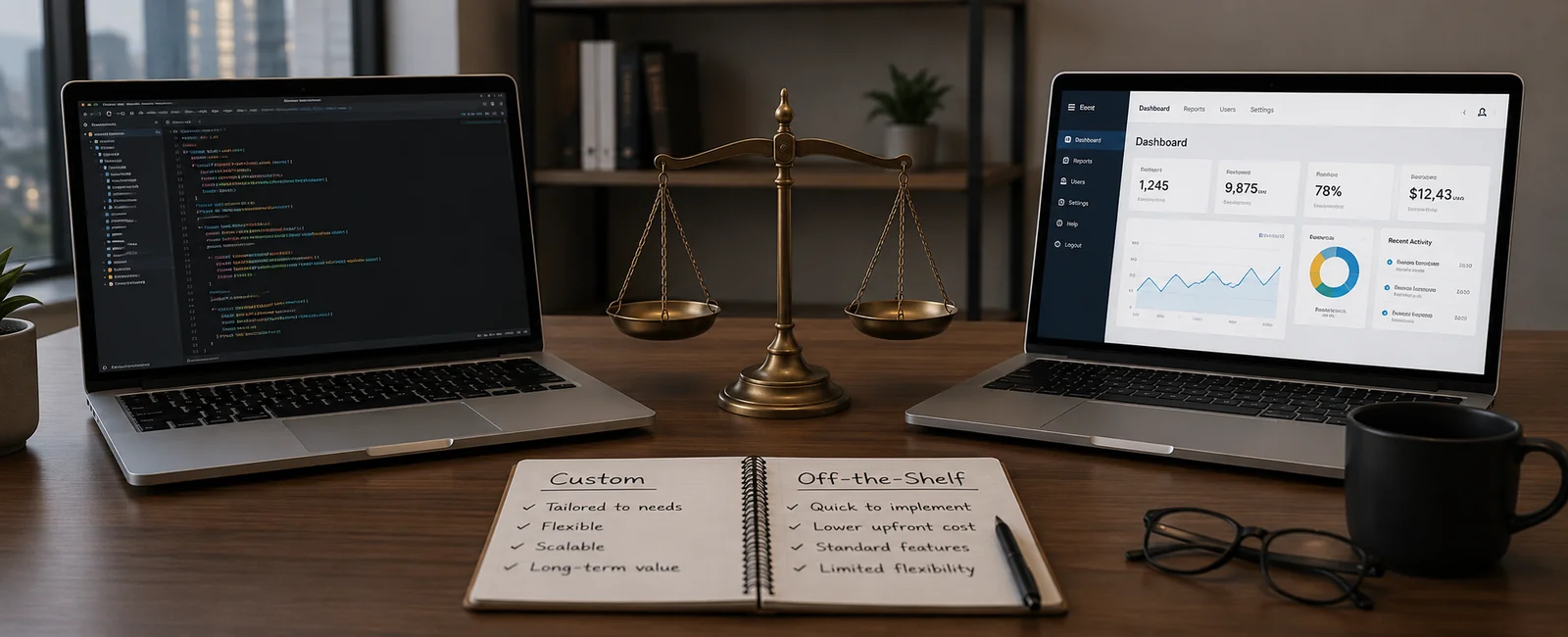
Off-the-shelf software is built for a broad market. Custom software is designed around the rules, roles, and workflows of one organization.
Neither is automatically better.
A standard ERP may handle accounting, purchasing, inventory, and payroll more sensibly than a custom system ever could. Those processes tend to share recognizable patterns across companies.
A custom application becomes more attractive when the process is unusual for a reason.
Perhaps your quotation logic is complex. Maybe customer pricing depends on contracts, locations, equipment usage, and service history. Your order process may involve approvals that standard software cannot represent cleanly.
That is where custom software development Dubai businesses commission can create real value.
Here is the simplest decision path:
Is the process common across your industry?
|
Yes | No
| | |
Buy and configure Does the process create revenue,
standard software speed, customer value, or advantage?
|
Yes | No
| | |
Consider custom Simplify the process
development before adding software
The awkward part is deciding whether a process is truly distinctive or merely complicated.
Businesses often confuse the two.
A process may have 14 approval steps because it grew without control. That does not mean it deserves custom software. It may deserve fewer approval steps.
When Does Off-the-Shelf ERP Software Win?
Off-the-shelf ERP wins when the business needs proven core functions more than unique operating logic.
Common examples include:
-
General accounting
-
Accounts payable and receivable
-
Standard procurement
-
Basic stock records
-
Payroll
-
Expense management
-
Fixed assets
-
Tax records
-
Common financial reports
Packaged systems bring prebuilt workflows, documentation, vendor support, regular updates, and an existing user base. SaaS products may also reduce infrastructure work and move companies away from large upfront technology investments.
Panorama Consulting’s 2025 ERP research found a strong preference for SaaS deployment among its respondents. Its sample covered 172 organizations, with a median project timeline of nine months and a median project cost of $450,000. Those figures represent a particular international survey rather than a Dubai price benchmark, but they show that even packaged enterprise projects require serious time and budget.
Ready-made ERP is usually a sensible choice when:
-
The process is not a market differentiator
-
The product fits most requirements without code changes
-
The company can adopt standard workflows
-
Vendor updates and support matter
-
Fast deployment matters more than perfect fit
-
The organization does not want to maintain a large proprietary codebase
Karim’s finance department fit this profile.
Its accounting needs were important, but not unusual. Building a custom general ledger would have created cost without giving the company a meaningful edge.
Finance needed a dependable system.
Not a software adventure.
When Does an Off-the-Shelf Product Stop Being “Standard”?
The line is crossed when configuration turns into deep customization.
Configuration means changing available settings. You might add fields, create user roles, adjust approval limits, or rearrange a dashboard.
Customization changes the product itself.
That may involve new code, rewritten modules, custom database behavior, unusual plugins, or modifications that make future upgrades harder.
The difference matters.
Researchers Eli Hustad and Johan Stensholt describe ERP customization as a double-edged decision. Their 2023 study found that customization can improve functionality and user satisfaction, while also increasing project cost, system complexity, and expenses tied to later upgrades.
This is the danger zone.
The company buys packaged software to reduce development risk, then modifies it so heavily that it inherits many of the costs of custom software.
It still pays the subscriptions.
Now it also owns a collection of exceptions.
Build or Buy Alert: If a vendor repeatedly says, “That will require custom development,” stop counting the product as a standard deployment. Recalculate the five-year cost.
Is CRM Software in Dubai a Different Decision From ERP?
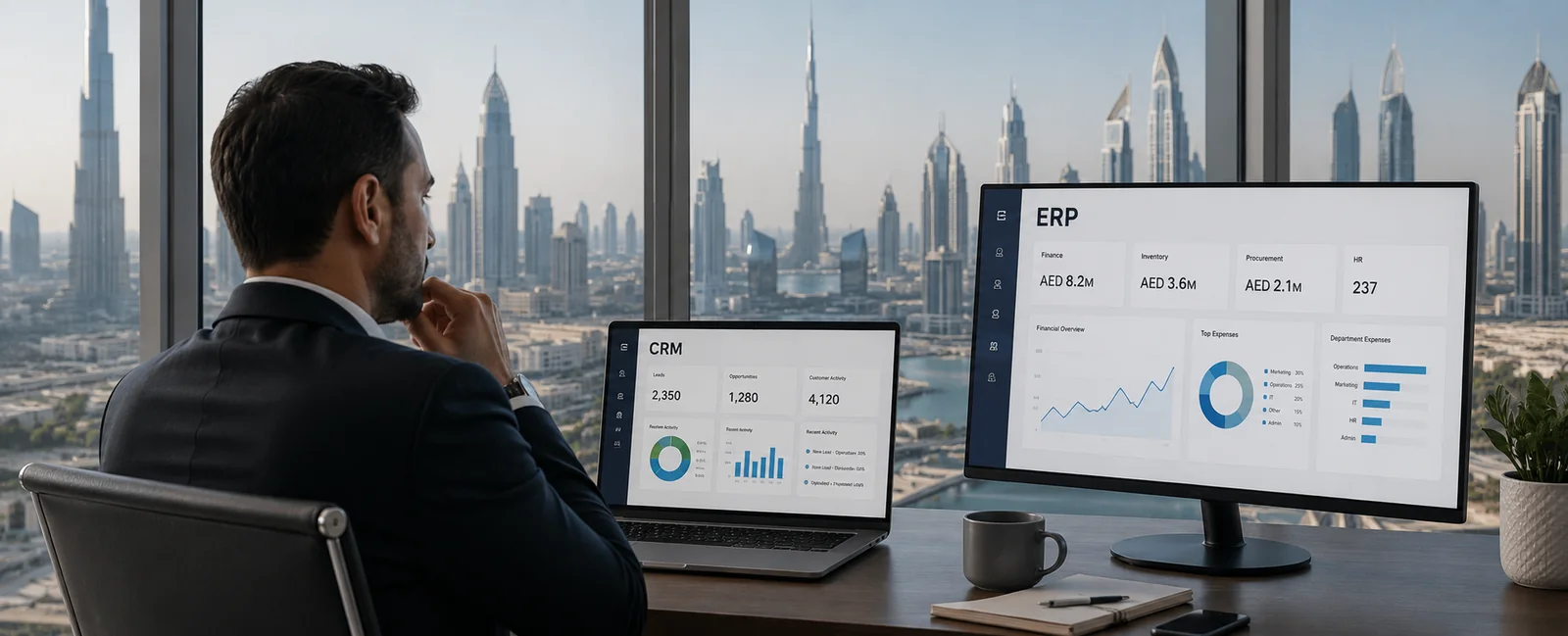
Yes. ERP manages operational and financial records, while CRM manages customer relationships, sales activity, service history, and revenue opportunities.
The two overlap, but they answer different questions.
An ERP asks:
-
What was purchased?
-
What is in stock?
-
What has been delivered?
-
What is owed?
-
What did the transaction cost?
A CRM asks:
-
Who is the customer?
-
What are they interested in?
-
When did we last speak?
-
What should sales do next?
-
Why did the opportunity close or disappear?
For businesses comparing CRM software Dubai vendors offer, the same build-versus-buy logic applies.
A sales team may work perfectly well with a mainstream CRM.
Problems begin when the company asks the CRM to become an ERP, customer portal, quotation engine, project-management tool, and service platform at the same time.
The product becomes crowded.
Users return to spreadsheets.
Then management concludes that the employees “resist change.”
It appears the software may simply be doing too many jobs.
What Did Karim’s Company Actually Need?
Not a custom ERP.
Not a completely standard one either.
The company needed a hybrid system.
The standard ERP could remain responsible for finance, purchase orders, invoices, and inventory valuation. The CRM could hold prospects, account history, and sales activity.
A custom operational layer would manage the unusual part:
-
Multi-location stock reservation
-
Rental and owned equipment
-
Split deliveries
-
Installation partners
-
Project-specific pricing
-
Delivery milestones
-
Customer status updates
The architecture looked something like this:
Custom Operations Portal
/ | \
/ | \
CRM data Workflow rules Customer view
\ | /
\ | /
ERP and Finance Core
|
eInvoicing, banking,
reporting, and audit
This model protected the company’s distinctive workflow without rebuilding common financial functions.
It also created cleaner ownership.
The CRM owned the relationship.
The ERP owned the financial transaction.
The custom layer owned delivery logic.
That sentence took weeks to agree on.
It was still more useful than another product demonstration.
Why Does the Dubai Context Affect the Decision?
Dubai businesses often operate across fast-moving, multilingual, and multi-entity environments. A software decision may need to account for local tax processes, regional expansion, different company structures, bank connections, customer portals, and Arabic or English interfaces.
There is also a broader economic direction.
Dubai’s D33 agenda aims to double the size of the emirate’s economy over a decade, while the UAE Digital Economy Strategy aims to raise the digital economy’s contribution to GDP from 9.7% in 2022 to 19.4% within ten years.
That does not mean every company needs custom software.
It does suggest that software choices are becoming operating decisions, not merely IT purchases.
UAE eInvoicing adds another practical consideration. In February 2026, the Ministry of Finance issued official guidelines for the national rollout. The program defines an eInvoice as a structured electronic document that supports automatic processing, rather than a PDF simply sent by email.
A company evaluating ERP software should now ask:
-
Can the system create and receive structured invoice data?
-
How will it connect to an accredited service provider?
-
Are customer and product records clean enough?
-
Can invoice status flow back into finance and operations?
-
Does the system preserve a useful audit trail?
-
Who owns failed or rejected transactions?
These questions may influence whether an older ERP can be extended, whether a newer cloud platform should replace it, or whether a custom connector is enough.
Do not rebuild the entire house because one doorway is too narrow.
But do measure the doorway.
How Should You Compare Total Cost Instead of Purchase Price?
Look at five years, not the first invoice.
Off-the-shelf products tend to have lower initial development cost. Custom software usually requires more spending before launch.
The pattern can reverse later.
Panorama’s 2025 report found that unexpected additional technology was the most common reason for budget overruns among respondents who exceeded budget. It also found that data problems were the leading reason for schedule overruns.
This matches what we frequently see.
The expensive surprise is not always the software.
It is the work around the software:
-
Data cleanup
-
API connections
-
Workflow changes
-
User training
-
Historical migration
-
Reporting
-
Testing
-
Support during rollout
A cheap product with expensive surrounding work may not be cheap.
A custom system with a narrow, disciplined scope may not be as costly as it first appears.
When Does Custom Software Clearly Win?
Custom software tends to win when the system represents how the company earns, serves, or differentiates.
Your Workflow Is Part of the Product
If customers buy from you because your delivery, pricing, configuration, approval, or service model is different, forcing that process into generic software may weaken the business.
Employees Spend Their Day Working Around the System
One workaround is normal.
Twenty-seven workarounds suggest poor fit.
Watch for repeated exports, shadow spreadsheets, duplicate entry, manual reclassification, and staff copying information between screens.
You Need One Experience Across Several Systems
A custom portal can sit above ERP, CRM, payments, inventory, and service data, giving customers or employees one interface without replacing every backend system.
Your Rules Change Frequently
Packaged systems can struggle when pricing, eligibility, routing, or service rules change often.
A well-built rules layer may let the company update those decisions without waiting for a vendor release.
The Software May Become a Revenue Source
If you plan to sell the platform, license it, offer it to partners, or make it part of your customer proposition, ownership becomes more valuable.
Data and AI Will Matter Later
AI needs accessible, well-structured data.
A custom architecture may provide better control over event logs, operational history, permissions, and model access. That only helps if the company is prepared to maintain it.
McKinsey’s Developer Velocity research surveyed executives at 440 large organizations after more than 100 expert interviews. It found that companies in the top quartile of its software-capability index had four to five times faster historical revenue growth than bottom-quartile companies, as well as stronger operating margins and innovation scores. The study shows correlation, not proof that custom software alone creates growth, but it suggests that strong internal software capability can become a business advantage.
Building wins when the capability matters.
Not merely because the company can afford it.
When Should You Resist Building?
Do not build software simply because standard products feel dull.
Dull can be useful.
Buying is often safer when:
-
The process is legally or financially standardized
-
Mature products already solve the need
-
The company lacks product ownership
-
Requirements are unclear
-
The feature will not create customer or operational advantage
-
The organization cannot support software after launch
-
Leadership wants custom software mainly to avoid changing an outdated process
We once heard a stakeholder request a custom expense-management platform because the existing system required managers to approve claims within three days.
That was not a software limitation.
It was an accountability problem.
Custom code would have hidden it more attractively.
What Does a Real Custom ERP Outcome Look Like?
Manufacturing is one area where standard ERP fit can become difficult. Production rules, waste tracking, inventory behavior, job scheduling, and sales commitments may vary significantly from one business to another.
Deuex Solutions’ published custom ERP systems case study describes a tailored manufacturing platform connecting inventory, production, sales, analytics, and operational management. The case study reports a 40% increase in efficiency, 20% reduction in unnecessary waste, and 35% improvement in productivity. Those results relate to the project described and should not be treated as universal benchmarks.
The interesting lesson is not simply “custom ERP works.”
It is that the software was shaped around connected manufacturing work rather than a generic feature list.
That is the standard a custom project should meet.
If the system cannot explain which workflow it improves, why users need it, and how the result will be measured, it is not ready to be built.
How Can You Make the Decision Without Guessing?
Use a scoring exercise before requesting proposals.
Rate each statement from 1 to 5.
Process Fit
-
Our workflow is genuinely different from common industry practice.
-
The difference helps us win, retain, or serve customers.
-
Standard products would require substantial customization.
Economic Value
-
The current process creates measurable delay, cost, error, or lost revenue.
-
A better system would affect a high-volume activity.
-
We can define what success looks like.
Ownership Readiness
-
One business leader will own the product.
-
Users can join discovery and testing.
-
We have a plan for maintenance after launch.
Technology Readiness
-
We understand where the important data lives.
-
Existing systems provide usable APIs or export options.
-
Security, access, and compliance requirements are known.
Interpret the result carefully:
-
Mostly 1s and 2s: Buy a packaged product or simplify the process.
-
Mostly 3s: Consider configuration, integrations, or a hybrid model.
-
Mostly 4s and 5s: Custom software may deserve serious evaluation.
The score is not a verdict.
It forces the right conversation.
What Should Happen Before You Sign With an ERP or CRM Vendor?
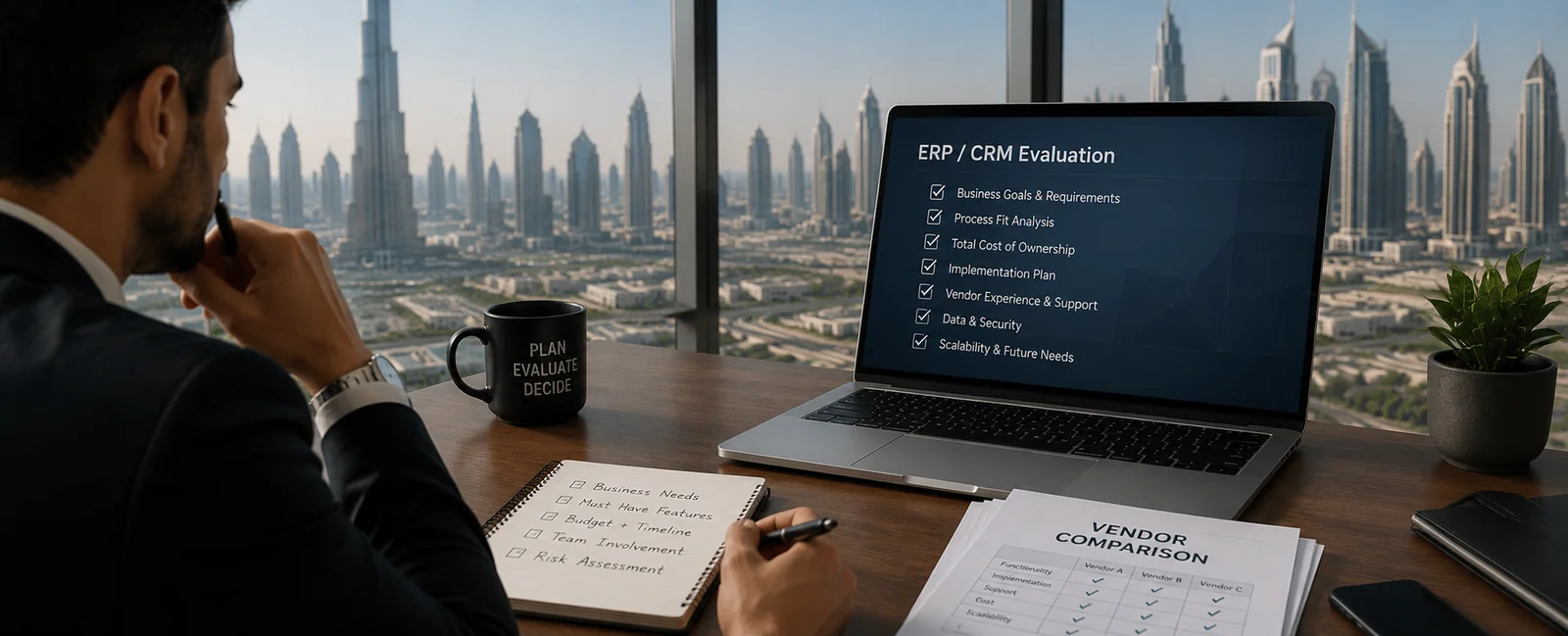
Ask for proof using your hardest workflow.
Not the vendor’s best demo.
Give shortlisted providers a realistic scenario. Include awkward details, exceptions, partial approvals, data changes, refunds, split orders, or permission rules.
Then watch what happens.
Ask these questions:
-
Is this standard configuration or custom code?
-
Which party maintains the customization?
-
What happens during the next major upgrade?
-
Are APIs included in the license?
-
Can we export all our data in a usable format?
-
What are the five-year user and support costs?
-
Which features require third-party products?
-
What happens if we leave the platform?
-
Who owns custom connectors?
-
How is eInvoicing support handled?
Get the answers in writing.
The demonstration should show your working day.
Not an imaginary company where every transaction behaves perfectly.
Buy the Core. Build the Edge.
Karim’s company did not choose the most impressive demo.
It chose boundaries.
Finance stayed inside a packaged ERP. Sales kept a focused CRM. The unusual operational workflow became a custom application connected to both.
Nothing tried to own everything.
That may be the most useful answer for many Dubai businesses.
Buy software for processes where standardization helps. Build where the workflow protects revenue, customer experience, speed, or hard-won operating knowledge. Connect the two carefully.
At Deuex Solutions, we help businesses assess software fit, design custom operational systems, connect ERP and CRM platforms, and build applications around the work that packaged products cannot handle cleanly.
Ready to decide what your business should buy, configure, connect, or build? Contact Deuex Solutions for a practical software assessment.
The goal is not to own more software. It is to own fewer workarounds.
Buy the Core. Build the Edge.
Karim’s company did not choose the most impressive demo.
It chose boundaries.
Finance stayed inside a packaged ERP. Sales kept a focused CRM. The unusual operational workflow became a custom application connected to both.
Nothing tried to own everything.
That may be the most useful answer for many Dubai businesses.
Buy software for processes where standardization helps. Build where the workflow protects revenue, customer experience, speed, or hard-won operating knowledge. Connect the two carefully.
At Deuex Solutions, we help businesses assess software fit, design custom operational systems, connect ERP and CRM platforms, and build applications around the work that packaged products cannot handle cleanly.
Ready to decide what your business should buy, configure, connect, or build? Contact Deuex Solutions for a practical software assessment.
The goal is not to own more software. It is to own fewer workarounds.
Related reading
-
SaaS Application Development: A Complete Guide From First Customer to Real Product
-
Custom Software vs. Off-the-Shelf Solutions: What’s Best for Your Business?


Sanket Shah
CEO & Founder
I am Sanket Shah, founder and CEO of Deuex Solutions, where I focus on building scalable web mobile and data driven software products with a background in software development. I enjoy turning ideas into reliable digital solutions and working with teams to solve real world problems through technology.


